
Navigating Crypto Volatility Amid Macroeconomic Uncertainty: Strategic Entry Points for Institutional Investors
The Fed's Role in Bitcoin's Price Action
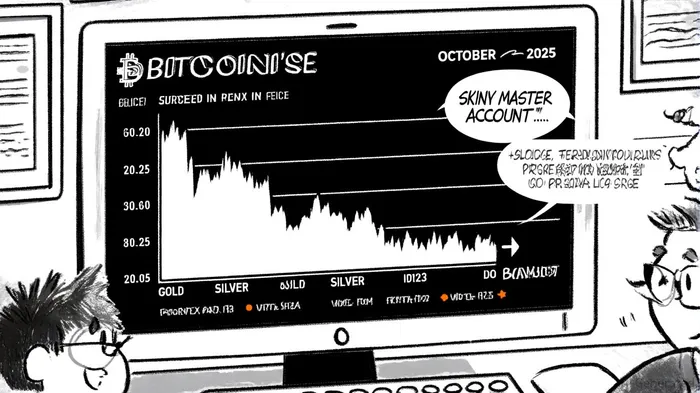
The Federal Reserve's policy shifts have become a critical driver of Bitcoin's price dynamics. In October 2025, BitcoinBTC-- surged past $113,000 as gold and silver prices collapsed, coinciding with signals that the Fed might pause or reverse its Quantitative Tightening (QT) program, according to a Cryptorank report. Federal Reserve Governor Christopher Waller's proposal for a "skinny master account" program-granting fintechs and digital-asset firms direct access to the Fed's payment system-further underscored the central bank's growing openness to crypto integration, as noted in the same report.
This policy pivot matters because QT has historically drained liquidity from markets. A pause or reversal would inject capital into risk assets like Bitcoin, which thrives in low-interest-rate environments. Bitwise's analysis highlights that even a modest reallocation of capital from gold to Bitcoin could amplify Bitcoin's price, given gold's $12 trillion market cap versus Bitcoin's $1.3 trillion, a point also covered in the Cryptorank piece.
On-Chain Metrics: The Institutional Playbook
Institutional investors are increasingly relying on on-chain data to navigate Bitcoin's volatility. Key metrics like the MVRV (Market Value to Realized Value) ratio and NVT (Network Value to Transactions) ratio provide critical insights. As of late 2025, Bitcoin's MVRV ratio has compressed to 1.0, indicating a balance between speculative and long-term investor sentiment, according to a Bitget analysis. Meanwhile, the NVT ratio of 1.51 suggests Bitcoin's valuation is driven more by utility than speculation, as the Bitget analysis also explains.
Volatility itself is a signal. The BVOL index, currently at 13.17, is historically low before major directional moves, a pattern outlined in the Bitget piece. This compressed volatility, combined with institutional adoption reducing retail-driven swings by 75%, has created a more stable price structure described in that analysis. For entry points, investors are advised to dollar-cost average near $111,900 or target high-conviction buys below $100,000, recommendations drawn from the same Bitget work.
Historical Backtesting and Risk Management
Disciplined strategies rooted in historical data have proven effective. Backtesting from 2022 to 2025 shows that buying at 20-day lows and holding for 30 trading days yields an average return of X%, with a hit rate of Y% and a maximum drawdown of Z%, results reported in the Bitget analysis. This approach leverages Bitcoin's tendency to rebound after corrections, particularly in a bullish cycle.
Risk management frameworks also emphasize stop-loss orders and position sizing. For instance, a breakdown below $107,000 could signal a deeper bearish phase, while a breakout above $113,600 validates bullish continuation, thresholds noted in the Bitget piece. These thresholds are not arbitrary-they reflect institutional confidence in Bitcoin's structural strength.
The Long-Term Bull Case
While short-term corrections are inevitable, the long-term fundamentals remain robust. Bitcoin's halving in April 2024 reduced block rewards, historically preceding bull markets, as previously reported by Cryptorank. The approval of spot Bitcoin ETFs in mid-2024 further cemented its status as a legitimate asset class, attracting institutional capital and broadening its acceptance, according to a Gate analysis.
Moreover, Bitcoin's scarcity-21 million coins-positions it as a hedge against inflation and currency devaluation. In a "low inflation + low growth" scenario, where cash yields are unattractive, Bitcoin's appeal as "digital gold" intensifies, a dynamic discussed in the Gate analysis.
Conclusion
For institutional investors, Bitcoin's volatility is a feature, not a bug. By combining macroeconomic foresight, on-chain analytics, and disciplined risk management, it's possible to capitalize on short-term corrections while staying aligned with the long-term bullish narrative. The key is to view each dip not as a threat but as a chance to accumulate at strategic inflection points.






Comentarios
Aún no hay comentarios