
Navigating Crypto Fraud Risks in Informal Investment Arrangements: Legal and Operational Safeguards for 2025 and Beyond
The Legal Framework: From Federal Legislation to State-Level Protections
Post-2023, the U.S. has seen a wave of legislative and executive actions aimed at curbing crypto fraud. At the federal level, the GENIUS Act and CLARITY Act have reshaped the regulatory landscape. The GENIUS Act, for instance, mandates transparency for U.S.-dollar stablecoins by requiring monthly reserve reporting and redemption clarity, addressing risks of instability and mismanagement, as detailed in a Global Legal Insights analysis. Meanwhile, the CLARITY Act distinguishes between investment contracts and digital commodities, enabling clearer anti-fraud measures for blockchain-based systems, per the same Global Legal Insights analysis.
Executive Order 14178 further solidified this framework by prioritizing the U.S. dollar's role in crypto and promoting technology-neutral regulations, as outlined in the Global Legal Insights analysis. Simultaneously, the Department of Justice (DoJ) has shifted focus toward prosecuting financial crimes like unlicensed money transmission and fraud, deprioritizing regulatory classification disputes, according to the same Global Legal Insights analysis.
State-level innovations are equally critical. Illinois, for example, passed the Digital Assets and Consumer Protection Act (DACPA) and Digital Asset Kiosk Act (DAKA) in 2025. These laws require digital asset businesses to register with the state, adhere to cybersecurity standards, and cap fees at 18% for kiosk transactions, as reported in a Consumer Financial Services Law Monitor article. Such measures aim to protect retail investors from predatory practices in informal arrangements.
Operational Safeguards: Combining Human Expertise and Technology
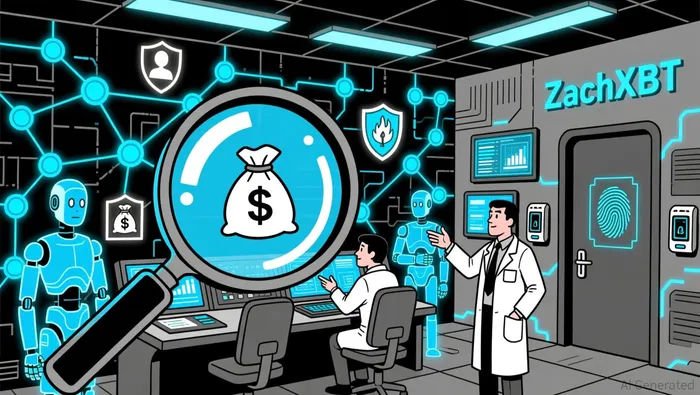
While legal frameworks set the stage, operational safeguards are the frontline defense against fraud. BNBBNB-- Chain's partnership with on-chain investigator ZachXBT exemplifies this hybrid approach. By integrating human-driven intelligence with automated tools, BNB Chain aims to trace stolen funds, expose scams, and enhance transparency in its ecosystem, according to the Cryptoninjas report. ZachXBT's track record-exposing multimillion-dollar frauds and tracking illicit flows-underscores the value of combining technical expertise with investigative rigor, per the Cryptoninjas report.
Such efforts are part of a broader trend toward multi-layered security. For instance, smart contract audits, multi-signature wallets, and decentralized identity verification are becoming table stakes for platforms seeking to mitigate risks. However, as fraud schemes evolve-leveraging AI-generated phishing attacks or decentralized autonomous organization (DAO) exploits-continuous innovation in operational protocols is essential, as highlighted in the Cryptoninjas report.
The Investor's Playbook: Staying Ahead of the Curve
For individual investors, the key lies in leveraging both legal and operational safeguards. This includes:
1. Due Diligence: Prioritizing platforms registered under frameworks like DACPA or CLARITY Act.
2. Technology Adoption: Using non-custodial wallets and enabling multi-factor authentication.
3. Education: Staying informed about emerging fraud tactics, such as social engineering or fake airdrops.
As the crypto space transitions from a Wild West to a regulated market, the onus is on investors to adopt a proactive mindset. The convergence of federal oversight, state-level consumer protections, and operational innovation is not just a response to fraud-it's a blueprint for sustainable growth.






Comentarios
Aún no hay comentarios