
Navigating the Crypto Fear & Greed Index at 10: A Contrarian Opportunity Amid Panic Selling?
The crypto Fear & Greed Index currently sits at an abysmal 10, a level last seen during the darkest days of the 2018 and 2022 bear markets. This "Extreme Fear" reading, as classified by multiple sentiment trackers, underscores a market gripped by panic selling and capitulation. Yet for long-term investors, such moments often represent the most compelling entry points in crypto's cyclical journey. History repeatedly shows that fear-driven selloffs are not endpoints but catalysts for eventual rebounds-provided one has the conviction to act.
Historical Precedents: Fear as a Precursor to Recovery
The current index level mirrors critical inflection points in past cycles. For instance, in July 2022, the index plummeted to 10 following the Terra/Luna collapse, only for BitcoinBTC-- to consolidate and eventually reclaim its dominance narrative. Similarly, during the 2018 bear market, the index hit comparable levels before the 2019 bull run materialized. These patterns suggest that extreme fear often precedes accumulation phases, where patient investors can capitalize on undervalued assets.
Data from Morningstar reinforces this thesis, noting that the median six-month and 12-month returns after bear market entries have historically been 31% and 42%, respectively. 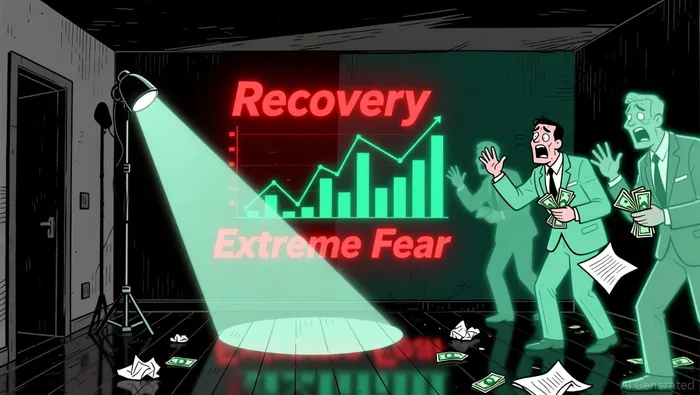 While short-term volatility remains inevitable, these figures highlight the asymmetric reward of dollar-cost averaging (DCA) into high-conviction assets during periods of widespread pessimism.
Strategic Entry Points: Dollar-Cost Averaging and Conviction
For long-term investors, the key lies in leveraging DCA to mitigate downside risk while accumulating assets with strong fundamentals. Bitcoin's halving cycle, for example, has historically created buying opportunities during the accumulation phase, as reduced supply and steady demand drive eventual price appreciation. The same logic applies to layer-1 blockchains like SolanaSOL-- (SOL) and EthereumETH-- (ETH), which continue to innovate despite current market conditions.
Moreover, the current environment offers a unique chance to "buy the dip" in blue-chip assets that have been unfairly dragged down by sector-wide panic. As CoinMarketCap's historical data shows, tokens with robust use cases and active development teams often outperform during recovery phases. This underscores the importance of distinguishing between systemic market fear and project-specific fundamentals.
Navigating the Psychological Hurdle
The challenge for investors lies not in the strategy itself but in overcoming emotional resistance. When the Fear & Greed Index hits "Extreme Fear," headlines scream of "crashes" and "collapses," amplifying FOMO (fear of missing out) into FUD (fear, uncertainty, doubt). Yet contrarian success in crypto-and markets broadly-requires embracing volatility as a feature, not a bug.
As stated by a report from Nasdaq, "Historical patterns suggest that buying the dip during extreme fear levels has often led to strong returns in the long run." This is not a call to speculate recklessly but to methodically allocate capital into assets with durable value propositions, regardless of short-term noise.
Conclusion: The Road to Recovery Begins in the Darkest Hours
The crypto Fear & Greed Index at 10 is a stark reminder of markets' cyclical nature. While the pain of the present moment is real, history provides a roadmap for navigating such periods. For disciplined, long-term investors, this is a time to act-not out of fear, but with the strategic clarity that comes from understanding cycles. As the market's pendulum swings back toward optimism, those who entered during panic may find themselves positioned for the next bull run.






Comentarios
Aún no hay comentarios