
Navigating the Crypto Bear: Strategic Rebalancing and Value Identification in a Correcting Market
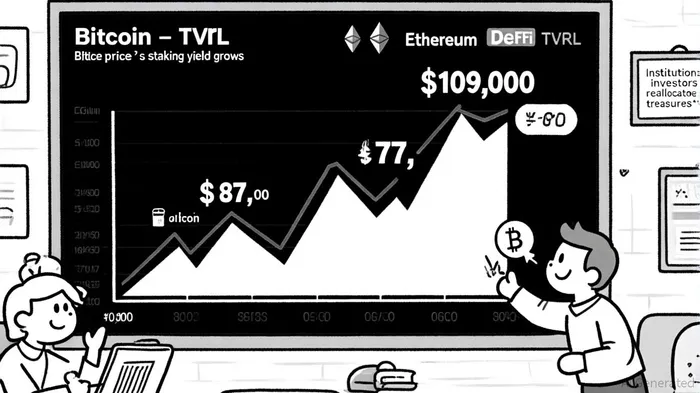
The crypto market's 2025 correction, marked by Bitcoin's decline from $109,000 to $87,000, has reignited debates about long-term resilience and strategic adaptation in bear cycles. While volatility remains a hallmark of digital assets, this downturn has also revealed opportunities for investors who prioritize rebalancing and value identification. Historical patterns, coupled with institutional shifts, underscore a market recalibrating for the next phase of growth.
The Anatomy of the 2025 Correction
Bitcoin's four-year halving cycle has historically driven bull runs followed by sharp corrections[3]. The 2025 selloff aligns with this pattern, but its depth and institutional response differ from prior cycles. According to a report by Blocktech Buzz, the correction coincided with Ethereum's Dencun and Pectra upgrades, which slashed LayerLAYER-- 2 transaction fees and attracted $27.6 billion in ETF inflows by Q3 2025[4]. This shift reflects a broader reallocation of capital toward protocols with tangible utility and deflationary mechanics.
Meanwhile, Bitcoin's market share dropped to 59%, signaling a “risk-on” environment for altcoins[4]. Institutional players, including whales, have actively converted BTC to ETHETH-- to stake, removing $2.5 billion in BitcoinBTC-- from circulation[4]. Such activity highlights a strategic pivot toward yield-generating assets, even amid broader market uncertainty.
Strategic Rebalancing: Diversification and DCA in Action
For investors, the 2025 correction has reinforced the importance of strategic rebalancing. Dollar-Cost Averaging (DCA) remains a cornerstone strategy, allowing participants to accumulate assets at lower prices without overexposure to short-term volatility[1]. However, diversification has taken on new urgency as altcoins like SolanaSOL-- (SOL) and XRPXRP-- attract $3.1 billion in institutional capital[4]. Projects with robust on-chain metrics and regulatory alignment are now critical components of a resilient portfolio.
Ethereum's dominance in DeFi further illustrates this trend. With 35.7 million ETH staked (29.6% of total supply) and staking yields at 3.5%, the network has become a magnet for capital seeking passive returns[4]. This dynamic contrasts with Bitcoin's role as a “digital gold” store of value, emphasizing the need for a balanced approach that leverages both asset classes.
Value Identification: Beyond the Noise
Identifying value in a bear market requires a focus on fundamentals. Ethereum's deflationary supply model, driven by EIP-1559 and staking demand, has created a compelling narrative for long-term holders[4]. Similarly, altcoins with utility-driven models—such as Solana's high-throughput infrastructure—are attracting capital by addressing real-world scalability challenges[4].
Institutional adoption has also played a pivotal role. Data from Bitget shows that whale activity and ETF inflows have disproportionately favored projects with clear use cases and regulatory clarity[4]. For example, XRP's resurgence in cross-border payments and Solana's partnerships with DeFi platforms have positioned them as “risk-on” assets in a market hungry for growth.
The Road Ahead: Resilience Through Adaptation
While the 2025 correction has tested investor resolve, it has also demonstrated the crypto market's capacity for reinvention. Strategic rebalancing—whether through DCA, diversification, or yield-seeking allocations—enables participants to navigate downturns while positioning for the next bull cycle. As The Blockverse notes, corrections are not terminal but rather catalysts for innovation and reallocation[1].






Comentarios
Aún no hay comentarios