
Navigating the Crossroads of Tariffs and Turbulence: How Trump's Policies Are Reshaping U.S. Sectors and Investment Strategies
The U.S. economy in 2025 is teetering on the edge of a crossroads. President Donald Trump's aggressive tariff policies, combined with a labor market showing signs of fatigue, have created a volatile cocktail of sectoral disruption and investor uncertainty. The July 2025 jobs report—revealing a mere 73,000 new jobs, far below expectations—has amplified fears of a looming recession. Meanwhile, Trump's tariffs, now averaging 17% on imports (the highest since the 1930s), have reshaped supply chains, inflated costs, and triggered retaliatory measures from global trading partners. For investors, the challenge lies in decoding these interconnected forces and recalibrating strategies to mitigate risk while capitalizing on emerging opportunities.
Sectoral Shockwaves: Manufacturing, Tech, and Agriculture in the Crosshairs
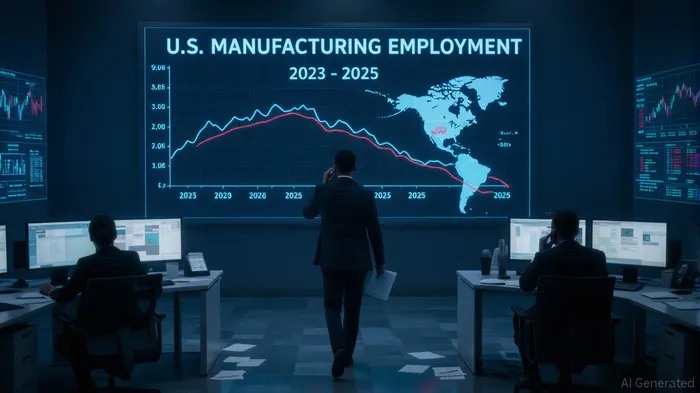
The manufacturing sector, long a cornerstone of the Trump administration's “America First” agenda, has become a paradoxical casualty. Section 232 tariffs on steel and aluminum—raised to 50% for most countries—have driven up input costs for downstream industries. The ripple effects are stark: factories lost 11,000 jobs in July 2025, following a 15,000-job decline in June. The sector's GDP contribution is projected to shrink by 0.2% over the next year, with 158,000 full-time equivalent jobs at risk. For investors, this signals a need to underweight cyclical manufacturing equities and pivot toward sectors with diversified supply chains.
Technology and pharmaceuticals face a different kind of threat. Trump's 200% tariff threat on pharmaceuticals and 25%+ tariffs on semiconductors have raised the specter of innovation bottlenecks. While tech giants like MicrosoftMSFT-- and MetaMETA-- have bucked the trend with AI-driven earnings, smaller firms in the supply chain are grappling with margin compression. The sector's import intensity—reliance on global components—makes it particularly vulnerable to further tariff escalations. Investors should favor tech firms with strong R&D moats and nearshoring capabilities, while avoiding those with heavy exposure to China or Southeast Asia.
Agriculture, meanwhile, is caught in a double bind. Trump's retaliatory tariffs on Canadian and Mexican agricultural imports have triggered reciprocal measures from trading partners. China's 84% tariff on U.S. agricultural exports in April 2025 alone could shave 0.2% off U.S. GDP. For agribusinesses, the path forward hinges on diversification into markets like Brazil and Mexico, which have seen increased demand for U.S. goods. Investors might consider overweighting agricultural commodities or ETFs tracking emerging-market agribusinesses.
Labor Market Weakness and the Fed's Dilemma
The labor market's slowdown is compounding these challenges. With the unemployment rate rising to 4.2% in July 2025 and job gains averaging just 35,000 per month, the Fed faces a critical juncture. While the central bank has kept rates steady, two of its most hawkish members—Michelle Bowman and Christopher Waller—have hinted at potential rate cuts by September. The dilemma for investors is twofold: a rate cut could stimulate growth but may also exacerbate inflation from tariff-driven supply chain bottlenecks.
The labor market's contraction is also reshaping sectoral demand. Healthcare, which added 55,400 jobs in July, has become a defensive haven, while construction and hospitality—reliant on immigrant labor—have seen flat to negative growth. This shift underscores the importance of sector rotation, with investors favoring healthcare, education, and essential services over discretionary and capital-intensive industries.
Investor Strategies: Defensive Positioning and Geographic Diversification
Given the current climate, a defensive and diversified approach is paramountPARA--. Here are three key strategies:
Inflation Hedging and Safe Havens:
Tariff-driven inflation and supply chain disruptions are pushing investors toward assets that protect against price erosion. Treasury Inflation-Protected Securities (TIPS) and gold—up 1.9% in August 2025—have become critical components of balanced portfolios. Additionally, energy equities, particularly those with exposure to U.S. shale, offer a hedge against geopolitical instability.Geographic Rebalancing:
U.S.-centric portfolios are increasingly overexposed to domestic policy risks. Emerging markets like Brazil and Indonesia, which are less entangled in Trump's trade wars, present growth opportunities. For instance, Brazil's agricultural exports have surged due to U.S. import restrictions, making agribusiness ETFs an attractive play.Sector Rotation Toward Resilience:
Investors should underweight manufacturing and retail while overweights in healthcare and technology. Within tech, focus on firms with robust nearshoring capabilities (e.g., IntelINTC--, ASML) and those insulated from trade tensions (e.g., cybersecurity providers).
The Path Forward: A Call for Prudence
The interplay of Trump's tariffs and a weakening labor market has created a high-uncertainty environment. While the Fed's potential rate cuts may provide short-term relief, the long-term outlook hinges on policy clarity and global cooperation. For now, investors must prioritize resilience over momentum, embracing defensive positioning, geographic diversification, and a cautious stance on leveraged sectors.
As the market navigates this turbulent crossroads, one thing is clear: adaptability will be the hallmark of successful investing in 2025.







Comentarios
Aún no hay comentarios