
Navigating the Crossroads: Strategic Opportunities in South Korea's Automotive and Semiconductor Sectors Post-Tariff Relief
The U.S.-South Korea trade negotiations, now entering a critical phase ahead of the July 8 deadline, are poised to reshape the strategic landscape for two of South Korea's most vital industries: automotive and semiconductors. The outcome of these talks will determine whether companies like Hyundai, Kia, Samsung, and SK Hynix can avoid crippling tariffs or seize new opportunities through U.S. market alignment. For investors, the stakes are high—but so are the rewards for those positioned to capitalize on a resolution.
Automotive: A Tariff-Laden Crossroads
South Korea's automotive giants Hyundai and Kia are confronting a stark reality: failure to secure exemptions from U.S. Section 232 tariffs by July 8 could trigger retaliatory U.S. tariffs of 26% on South Korean auto exports. These automakers, which account for 16% of U.S. auto imports, already face existing 25% tariffs on light vehicles and 50% on steel/aluminum, a burden that inflates production costs by 20%.
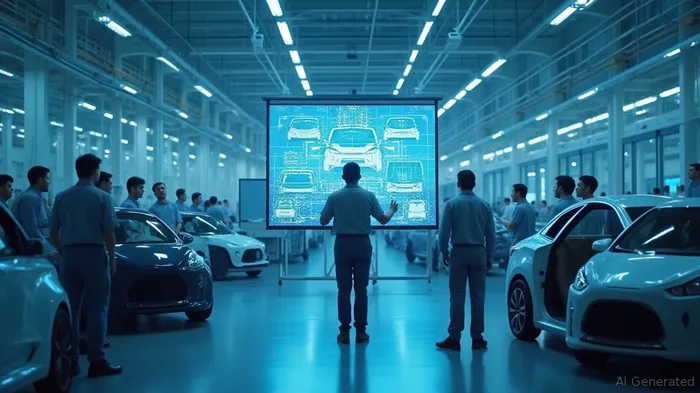
Hyundai's aggressive U.S. expansion—most notably its $5.5 billion EV plant in Alabama—is a direct response to U.S. Manufacturing and Trade Act (USMCA) requirements. To qualify for tariff exemptions, automakers must source 75% of steel and aluminum from North America. Hyundai's Alabama plant, set to produce 450,000 EVs annually, not only meets this threshold but also positions the company to dominate the U.S. EV market.
Investors should monitor Hyundai's EV sales growth in the U.S. and its compliance with USMCA rules. If tariffs ease post-July 8, shares of Hyundai (KS:005380) and Kia (KS:000270) could see a 15–20% upside, closing the gapGAP-- from their current 8x–9x EV/EBITDA valuations (below their 10-year average of 11x). Conversely, a missed deadline could exacerbate South Korea's economic slowdown, with GDP risks as high as 0.5% contraction this year.
Semiconductors: A Battle for Global Dominance
The semiconductor sector is equally pivotal. U.S. tariffs averaging 25% on South Korean semiconductors—critical for industries from AI to automotive—threaten the competitiveness of Samsung and SK Hynix, which control 36% of the global DRAM market. The U.S. Inflation Reduction Act and CHIPS Act have incentivized localization: Samsung's $37 billion semiconductor plant in Texas, for instance, aims to secure subsidies and supply chain resilience.
Investors should prioritize firms pivoting to AI-driven advanced nodes, such as SK Hynix's 12-inch wafer fabs, over legacy players. The VanEck Semiconductor ETF (SMH) offers exposure to these trends but carries broader market risks. Direct plays like SK Hynix (KS:000660) could outperform if U.S. tariffs on semiconductors are resolved, though the sector faces reciprocal risks of extended tariffs on equipment.
Strategic Recommendations: Timing and Hedges
- Optimistic Bets Post-July 8: If tariffs are lifted, invest in Hyundai and Kia for their EV-driven U.S. growth. Monitor Samsung's Texas plant progress as a bellwether for U.S.-ROK alignment.
- Avoid: Steel producers like POSCO (PKX) and sectors reliant on China-U.S. supply chains (e.g., passive components).
- Geopolitical Hedges: Prioritize firms with diversified production (e.g., Hyundai's U.S. plants) and exposure to advanced semiconductors.
The Bottom Line: A Pivot Point for Global Trade
The July 8 deadline is a high-stakes pivot point. A resolution would unlock South Korea's export engine and bolster U.S. tech dominance, while a breakdown risks global supply chain disruptions. Investors should remain cautious until the deadline but prepare to act swiftly if tariffs ease. The path forward favors companies that blend geographic diversification with regulatory compliance—and that are ready to accelerate innovation in EVs and semiconductors.
For now, patience and a focus on fundamentals are key. The next month could redefine not just South Korean industries but the global economy itself.







Comentarios
Aún no hay comentarios