
Navigating the Contradictions in Consumer Stock Momentum: A Deep Dive into Holiday Seasonal Catalysts and Retail Resilience
Sector Performance: Discretionary Volatility vs. Staples Stability
Consumer discretionary stocks have shown a mixed bag of results in Q3 2025. While Levi Strauss Class A contributed positively to the Macquarie Mid Cap Income Opportunities Fund with a total effect of 0.59, Darden Restaurants Inc. dragged down performance by -0.46, underscoring uneven demand trends in the sector according to Q3 2025 commentary. In contrast, consumer staples demonstrated more consistent performance, with a positive total effect of 0.23 despite lagging behind other sectors according to Q3 2025 commentary. This divergence reflects broader economic dynamics: discretionary spending remains sensitive to macroeconomic headwinds, while staples benefit from inelastic demand as households prioritize essentials.
 Retail sales data for November 2025 further complicates the picture. While the sector saw a modest 0.2% rise in September, this fell short of expectations, signaling slowing momentum in discretionary spending. Meanwhile, e-commerce platforms are bucking the trend, Deloitte projects 7% to 9% growth in holiday e-commerce sales as consumers leverage online deals to stretch budgets. This resilience in digital channels highlights a shift in consumer behavior, where price sensitivity and convenience are driving online adoption even as overall retail spending moderates.
Retail Resilience and the Two-Tier Economy
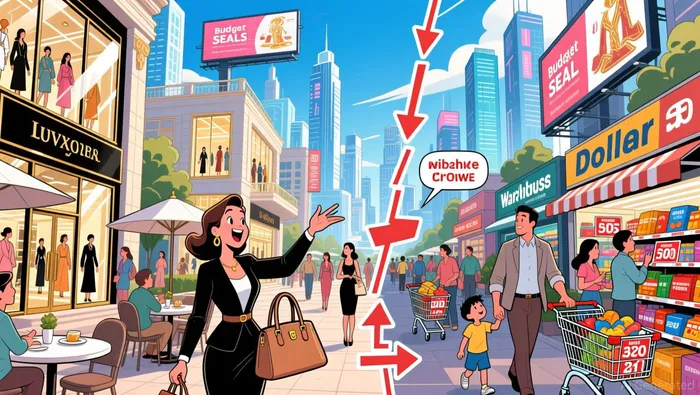
The Q4 2025 retail landscape is defined by a stark "two-tier economy." Affluent consumers are maintaining spending on luxury goods, fine dining, and specialty groceries. Conversely, lower- to middle-income households are gravitating toward value-oriented retailers like warehouse clubs, dollar stores, and off-price apparel chains. This bifurcation has forced retailers to adopt dual strategies: offering budget-friendly bundles for price-sensitive shoppers while curating premium experiences for high-income demographics.
The early and aggressive rollout of holiday promotions-initiated as early as September-exemplifies this duality. Retailers are competing fiercely for limited consumer budgets, with 8% of U.S. retailers planning to offer more promotions than in 2024. Walmart and Costco, for instance, have reported strong quarterly performance despite broader economic anxieties, leveraging their value propositions to attract price-conscious shoppers. Meanwhile, luxury retailers are capitalizing on the confidence of high-net-worth individuals, maintaining steady traffic even as overall retail activity softens according to retail outlook analysis.
Bold Corporate Moves: AI, E-Commerce, and Omnichannel Orchestration
Major retailers are deploying bold strategies to navigate these contradictions. Walmart, Amazon, and Costco have initiated overlapping sales events in late September and October, often aligning with Amazon Prime Day to capture early holiday traffic. These moves reflect a promotional arms race driven by the need to secure market share in a competitive environment.
Technological innovation is another key battleground. Retailers are doubling down on AI to enhance demand forecasting, inventory management, and personalized shopping experiences. According to the Deloitte 2025 Outlook, seven in ten executives plan to implement AI capabilities by year-end, signaling a sector-wide shift toward data-driven decision-making. Mobile commerce is also gaining traction, with over 54.5% of e-commerce sales in 2024 coming from mobile devices-a trend expected to accelerate in 2025. Retailers are optimizing mobile-first experiences through AI-powered app features and seamless checkout processes to meet the expectations of Gen Z and Millennial shoppers.
The Road Ahead: Balancing Risks and Opportunities
While the retail sector's resilience is evident, risks remain. The "vibecession" continues to weigh on big-ticket purchases and hiring decisions. Additionally, the maturation of retail media networks (RMNs) presents both opportunities and challenges, with U.S. ad spend projected to reach $100 billion by 2029 but hampered by high media costs and interoperability issues.
For investors, the key lies in identifying companies that can balance cost optimization with innovation. Those leveraging AI, omnichannel integration, and hyper-personalization-while maintaining disciplined execution-are best positioned to thrive in this fragmented environment. As the holiday season unfolds, the interplay between sectoral performance and corporate agility will remain a critical barometer for the broader economy.





Comentarios
Aún no hay comentarios