
Navigating Consumer Staples Rotation: Unilever's Strategic Position in a Shifting Market
Valuation Dislocation: Operational Efficiency as a Proxy for Metrics
While specific 2025 valuation metrics like P/E, P/B, and EV/EBITDA for Unilever remain elusive in the latest data, the company's operational performance suggests a narrowing gap between intrinsic value and market perception. Unilever's Q3 2025 results , . This outperforms the sector's average growth, . The Power Brands-contributing 78% of turnover-, underscoring the company's ability to leverage premiumization trends.
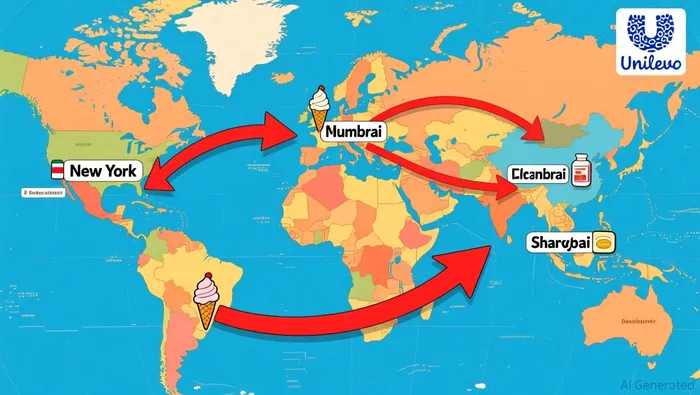
The demerger of its Ice Cream business, slated for Q4 2025, is a strategic move to streamline operations. Excluding Ice Cream, , . This margin expansion, coupled with a simplified corporate structure, positions Unilever to outperform peers reliant on stagnant pricing models. While direct comparisons to sector averages are limited, the company's focus on cost discipline and digital commerce-particularly in high-growth markets like India-suggests a valuation gap that could close as investors recognize its operational agility.
Long-Term Growth: Diversification and Emerging Markets
Unilever's growth narrative extends beyond 2025. The company's 2025-2030 roadmap emphasizes market diversification, . In Q3 2025, , fueled by improving trends in China and Indonesia. North America, a key developed market, , reflecting the resilience of its premium portfolio in a maturing economy.
Analysts project that Unilever's strategic bets on digital commerce and sustainability will compound its advantages. For instance, its digital-first approach in the U.S. and India-where e-commerce adoption is surging-aligns with global consumption shifts. While 5-10 year growth projections are not explicitly detailed in recent reports, the company's historical performance . This is competitive with the sector's average but amplified by Unilever's margin expansion potential.
Defensive Play Potential: Stability in Uncertain Times
As a defensive play, Unilever's appeal lies in its dual strength: consistent cash flow and geographic diversification. , while emerging markets offer growth. This balance mitigates risks from regional economic shocks. For example, Unilever's performance in China-a market that has seen cyclical volatility-improved in Q3 2025, signaling adaptability to shifting consumer sentiment.
The company's further reinforces its defensive credentials. Though recent Ghana-focused dividend announcements are geographically specific, they reflect a broader commitment to shareholder returns. , Unilever is well-positioned to sustain dividends even in downturns, a critical trait for defensive assets.
Conclusion: A Case for Strategic Allocation
Unilever's 2025 trajectory-marked by margin expansion, strategic divestitures, and a balanced market mix-positions it as a prime candidate for sector rotation into defensive plays. While the absence of granular valuation metrics introduces some ambiguity, the company's operational performance and long-term strategic clarity suggest undervaluation relative to its growth potential. For investors seeking stability without sacrificing growth, Unilever embodies the ideal blend of resilience and adaptability in a post-pandemic, inflation-adjusted world.







Comentarios
Aún no hay comentarios