
Navigating Coffee Market Volatility: Commodity Cycles and Strategic Risk Management in 2025
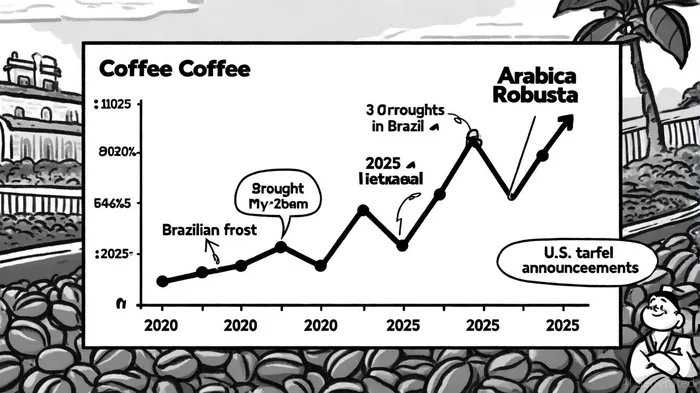
The global coffee market in 2025 is a textbook case of perfect storm volatility, driven by converging forces of climate chaos, geopolitical tensions, and speculative trading. For investors, understanding the interplay of commodity cycles and risk management strategies is critical to navigating this high-stakes environment.
Current Market Dynamics: A Perfect Storm of Disruption
The 2025 coffee price surge—Arabica futures hitting $3.92 per pound in September—reflects a cascade of supply-side shocks. Prolonged droughts in Brazil, the world's largest Arabica producer, and catastrophic flooding in Vietnam, a key Robusta supplier, have slashed harvests by 11.2% and 20% respectively[1]. These climate-driven supply constraints are compounded by geopolitical headwinds: U.S. tariffs on Brazilian and Vietnamese exports and shipping delays in the Red Sea have disrupted logistics, pushing global certified stocks to historic lows (686,863 bags for Arabica in September 2025)[2].
Demand-side resilience further amplifies price pressures. In developed markets like the U.S., coffee consumption rose 12% in 2024, with ready-to-drink products driving demand[3]. However, price-sensitive emerging markets are shifting to tea, creating a dual dynamic of inelastic demand in the West and elastic demand in the East.
Historical Cycles and the Role of Speculation
The collapse of the International Coffee Agreement (ICA) in 1989 marked a turning point, transitioning the market from quota-driven stability to speculative volatility[4]. Today's market operates in a "Diversification and Reconsolidation" phase, where large roasters dominate and futures trading on exchanges like ICE and LIFFE amplify price swings. For instance, the 2021 Brazilian frost triggered a 40% spike in Arabica prices within weeks, illustrating how external shocks interact with speculative behavior[5].
Spot markets now play a dominant role in price discovery, with volatility spilling over to futures. This dynamic underscores the importance of monitoring both short-term and long-term indicators.
Risk Management Strategies: Hedging in a High-Volatility Era
Investors and producers must adopt a multifaceted approach to mitigate risks:
Futures and Options Contracts:
Coffee futures remain the cornerstone of risk management. By locking in prices, producers and roasters can hedge against short-term volatility. Options on futures add flexibility, allowing investors to cap downside risk while retaining upside potential[6].Technical and Fundamental Analysis:
Algorithmic trading based on historical price patterns (technical analysis) complements fundamental analysis of supply-demand imbalances and macroeconomic trends. For example, the 2025 droughts in Brazil and Vietnam were flagged by satellite-based yield forecasts, enabling early hedging[7].Currency and Geopolitical Hedging:
A stronger U.S. dollar typically suppresses coffee prices, while a weaker dollar stimulates exports. Investors should monitor exchange rate trends and geopolitical developments, such as U.S.-China trade dynamics, which indirectly influence coffee tariffs[8].Digital Tools and Supply Chain Resilience:
Blockchain traceability and AI-driven supply chain analytics are emerging as critical tools. These technologies help traders adapt to non-tariff barriers (e.g., EU Deforestation Regulation compliance) and environmental disruptions[9].
Investment Implications: Short-Term Gains vs. Long-Term Stability
For speculative investors, the 2025 market offers both opportunities and pitfalls. Short-term strategies could capitalize on price spikes from weather events or geopolitical shocks, but require precise timing. Long-term investors, however, should focus on structural trends:
- Specialty Coffee: Projected to reach $183 billion by 2030, driven by millennials and Gen Z's preference for quality[10].
- Sustainability Certifications: Brands leveraging ESG (Environmental, Social, Governance) frameworks can command premium pricing and attract ESG-focused investors[11].
- Asian Markets: China's evolving coffee culture presents untapped potential, though price sensitivity remains a barrier[12].
Conclusion: A Call for Strategic Agility
The 2025 coffee market exemplifies the fragility of global commodity systems in the face of climate and geopolitical uncertainty. While prices may stabilize if harvests improve, the long-term outlook remains clouded by recurring extreme weather events and shifting trade policies. Investors must balance speculative bets with strategic hedging, leveraging both traditional financial instruments and cutting-edge technologies to navigate this volatile landscape.







Comentarios
Aún no hay comentarios