
Navigating Climate Transition Risk and Opportunity in a Post-COP30 World
The COP30 Landscape: A Fractured Consensus
COP30 underscored the growing divergence between developed and developing nations. India, for instance, reaffirmed its commitment to climate action but emphasized equity, urging wealthier countries to accelerate emission cuts and provide financial support, according to an India Times report. Meanwhile, the EU's updated Nationally Determined Contributions (NDCs)-targeting a 66.25–72.5% emissions reduction by 2035-highlighted its leadership in the transition, as reported by Fibre2Fashion. Iraq's launch of a national carbon market under Article 6 of the Paris Agreement, as noted in Iraqi news, and the Gates Foundation's $1.4 billion investment in smallholder farmer resilience, as detailed in Pulse2, further illustrated the diversification of climate finance. Yet, the summit also revealed tensions, such as Brazil's simultaneous push for Amazon infrastructure projects and climate pledges, as reported in Context News.
U.S. Withdrawal: A Leadership Vacuum and Market Reconfiguration
The U.S. withdrawal from the Paris Agreement under Trump (2017–2021) had lasting repercussions. By exiting the agreement, the U.S. ceded influence in global climate governance, enabling the EU and China to collaborate more closely on initiatives like carbon pricing and green technology, as described in GIS Reports. This shift redirected investment flows: while the U.S. federal government rolled back climate policies in 2025, state-level actions-such as California's rebranded "cap and invest" program-maintained a carbon price of $3–$4 per ton, according to Resource.org. Globally, this created a fragmented landscape where private capital and multilateral banks increasingly filled the void left by U.S. inaction.
Brazil's Dual Strategy: Renewable Ambitions and Fossil Reliance
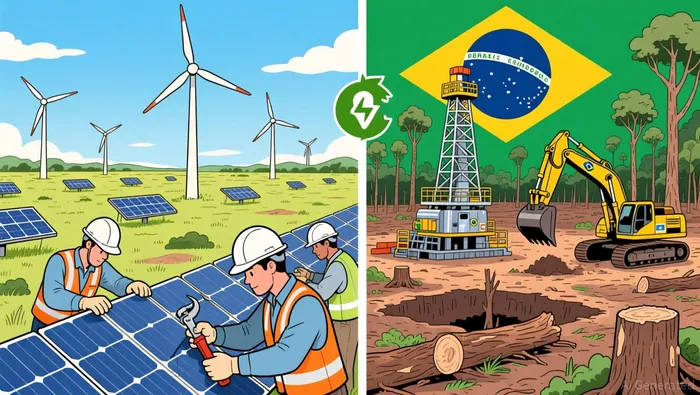
Brazil's energy transition epitomizes the contradictions of the post-COP30 era. The country leads G20 nations in clean electricity generation and has ambitious plans for solar, wind, and biofuels, according to the BNEF Factbook. However, its reliance on fossil fuels-exacerbated by offshore oil expansion and Amazon infrastructure projects-creates a paradox, as highlighted in SlGuardian. The "Baku to Belem roadmap," aiming to scale climate finance to $1.3 trillion annually by 2035, reflects Brazil's dual role as both a climate champion and a fossil-dependent economy, according to Carbon Brief. For investors, this duality signals opportunities in renewables and adaptation infrastructure but risks from policy inconsistency.
Investment Flows: Clean Energy Dominance and Adaptation Gaps
Global investment in clean energy reached $2.2 trillion in 2025, with solar PV alone attracting $450 billion, according to the IEA World Energy Investment 2025 report. This outpaces fossil fuel investments, which face declining upstream spending due to lower oil prices, as also noted in the IEA report. However, adaptation finance remains a critical gap: the U.N. Adaptation Gap Report estimates $310 billion annually will be needed by 2035, yet current spending is just $26 billion, according to Reuters. The Baku to Belem roadmap seeks to bridge this gap through private capital and multilateral banks, but success hinges on political will.
Strategic Positioning for Investors
For investors, the post-COP30 world demands a nuanced approach:
1. Adaptation Infrastructure: Prioritize sectors like climate-resilient agriculture (e.g., Gates Foundation-backed projects, as detailed in the Pulse2 report) and coastal protection, where demand is surging.
2. Emerging Renewables: Target markets with policy momentum, such as Brazil's biofuels and the EU's nuclear expansion, as noted in the IEA report.
3. Geopolitical Hedging: Diversify portfolios to account for U.S. policy volatility, favoring regions with stable climate frameworks (e.g., EU, China).
Conclusion
COP30 revealed a world in transition-fraught with geopolitical tensions but rich with opportunities for those who can navigate the shifting landscape. As Brazil's dual strategy and the U.S. withdrawal reshape markets, investors must balance the urgency of adaptation with the promise of renewables. The path forward lies not in binary choices but in strategic alignment with the evolving realities of the climate transition.







Comentarios
Aún no hay comentarios