
Navigating China's Two-Speed Economy: Export Resilience vs. Domestic Struggles – Where to Invest Now
China's economy is bifurcating into two distinct speeds: export-driven sectors are surging, while domestic consumption stumbles under deflationary pressures and structural challenges. For investors, this divergence creates both opportunities and pitfalls. Let's dissect the data to identify sectors poised to thrive—and those to avoid—amid U.S.-China trade uncertainties and Beijing's policy responses.
The Two-Speed Divide: Exports Boom, Domestic Demand Sputters
China's second-quarter GDP grew 5.2% year-on-year, largely fueled by export resilience. Yet this growth is unevenly distributed. While non-U.S. exports to regions like the EU, ASEAN, and India surged, domestic retail sales grew just 4.8% in June—well below expectations. 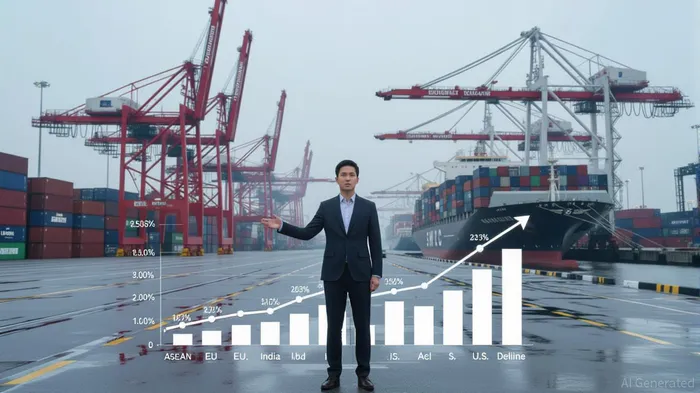
The contrast is stark:
- Exports to non-U.S. markets rose 8.3% (EU), 20.8% (ASEAN), and 21.7% (India) in April 2025, offsetting a 16.1% slump in U.S. shipments.
- Domestic demand remains hamstrung by weak consumer confidence, falling property prices (-0.2% month-on-month in May), and high youth unemployment (20.4% in Q2).
This divergence means investors must focus on geographically diversified exporters and policy-backed sectors, while steering clear of domestic consumption-heavy stocks.
Sector-Specific Opportunities: Tech, Machinery, and Discretionary Niches
1. Tech Hardware: The Engine of Value Creation
China's tech exports are leading the charge, buoyed by strategic shifts toward high-value manufacturing.
- Semiconductors: Integrated circuit exports jumped 14.7% year-on-year in April, driven by global demand for advanced chips. Companies like Semiconductor Manufacturing International Corp (SMIC) and Yangtze Memory Technologies (YMTC) are beneficiaries of state subsidies and R&D incentives.
- New Energy Vehicles (NEVs): Domestic NEV sales rose 28% year-on-year in May, with BYD capturing 52.9% of China's passenger vehicle market. Global demand is equally strong, as BYD's exports to Europe and Southeast Asia surged.
Investment Play: Overweight companies with exposure to semiconductors and NEVs. BYD's dominance and its expanding export footprint make it a prime candidate, while SMIC benefits from China's “chip self-reliance” push.
2. Machinery & Equipment: Riding the Global Infrastructure Wave
Exports of machinery to the EU and ASEAN highlight China's role as a supplier of industrial and green infrastructure.
- EU Exports: German demand for Chinese machinery surged 20.4% year-on-year, as European firms source cost-effective components to meet green-energy targets.
- Policy Tailwinds: Beijing's subsidies for equipment upgrades and the Regional Comprehensive Economic Partnership (RCEP) are accelerating Southeast Asian infrastructure projects.
Investment Play: Look for machinery firms with strong regional ties. Companies like Sany Heavy Industry (600031.SS), a leader in construction equipment, or Zhejiang Huayou Group (2100.HK), which supplies industrial valves, offer exposure to this trend.
3. Discretionary: Luxury and High-End Goods Defy the Slump
While general retail sales stagnate, premium and tech-driven discretionary sectors are thriving.
- Luxury & Premium Goods: Jewelry exports rose 10.6% year-on-year, while high-end appliance sales jumped 53% due to government trade-in programs. Domestic brands like Midea (000333.SZ) and joint ventures with LVMH are capitalizing on China's luxury market boom.
- E-commerce Logistics: Firms like JD.com (JD.O) and Alibaba (BABA.N) are leveraging bonded logistics zones to boost exports, with e-commerce shipments growing 22.3% year-on-year.
Investment Play: Focus on luxury and premium brands with pricing power. Alibaba and JDJD--.com's logistics networks also provide scalable export platforms.
Risks and Sectors to Avoid
1. U.S.-Exposed Sectors
Exports to the U.S. dropped 16.1% year-on-year in June, and tariffs remain a Sword of Damocles. A permanent resolution hinges on the August 12 tariff truce deadline. Sectors like textiles (0.6% growth) and petrochemicals (stagnant at 1.4%) are particularly vulnerable.
2. Domestic Consumption Plays
- Real Estate: Falling home prices and weak demand mean developers like China Vanke (000002.SZ) remain risky bets.
- General Retail: Chains reliant on domestic sales (e.g., Suning (002024.SZ)) face deflation and shifting consumer priorities toward experiences and premium goods.
3. Low-Margin Manufacturing
Firms without technological differentiation (e.g., basic textiles) lack pricing power and face stiff competition from Southeast Asian producers.
Investment Strategy: Balance Growth and Agility
- Overweight:
- Tech Hardware: SMIC (688981.SH), BYD (002594.SZ), and Huawei (not listed, but its ecosystem partners like Wingtech (002180.SZ)).
- Machinery & Equipment: Sany Heavy Industry (600031.SS), ZTE (000063.SZ) for telecom infrastructure.
Premium Discretionary: Midea (000333.SZ), Alibaba (BABA.N).
Underweight:
Real estate, low-margin textiles, and general retailers.
Monitor:
- The August 12 tariff deadline: A permanent deal could boost U.S. exports, while a stalemate risks further declines.
- Policy stimulus: Expect Q3 measures like consumption vouchers or infrastructure bonds to support domestic demand.
Conclusion
China's two-speed economy demands a nuanced approach. Investors should prioritize sectors with global demand resilience (tech, machinery) and policy support, while avoiding domestic consumption traps. The August tariff deadline and Beijing's stimulus response will be pivotal in determining whether this export-driven momentum can offset slowing homegrown growth—or if a broader correction is looming. Stay agile, and focus on the sectors steering China's recovery.







Comentarios
Aún no hay comentarios