
Navigating Catastrophic Losses: Mercury General’s Resilience in Maintaining Dividends
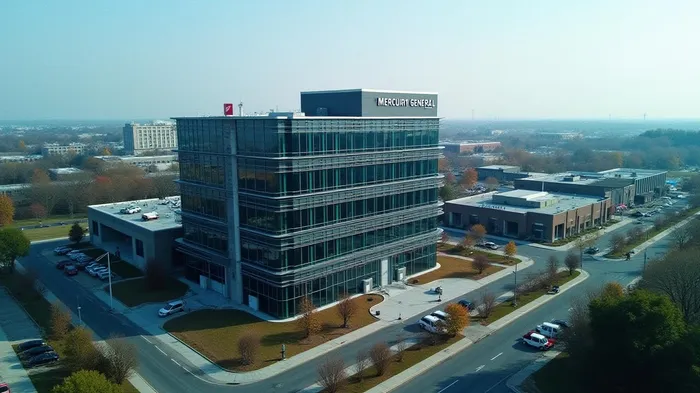
Mercury General Corporation (MCY) has long been a symbol of stability in the insurance sector, but its first-quarter 2025 results tested that reputation. Despite reporting a net loss of $108.3 million, the company reaffirmed its commitment to shareholders by declaring a quarterly dividend of $0.3175 per share, payable on June 26, 2025. This decision, made amid a $447 million surge in catastrophe losses from Southern California wildfires, underscores the interplay between risk management, reinsurance strategies, and investor confidence.
The Financial Gauntlet: Catastrophes and Capital
The quarter’s losses were disproportionately driven by wildfire-related damages—a stark reminder of the industry’s vulnerability to climate-driven disasters. Gross catastrophe losses climbed to $1.294 billion year-over-year, with reinsurance absorbing the bulk of the burden. Crucially, Mercury General expects 100% collection on its reinsurance billings, a critical factor in mitigating the immediate financial hit. The company also highlighted a projected $525 million recovery from Southern California Edison (SCE) via subrogation, stemming from the Eaton wildfire—a rare silver lining in a quarter dominated by losses.
While underwriting results were strained, the dividend’s preservation hinged on two pillars: diversified revenue streams and strategic capital allocation. Net premiums rose 10% to $1.28 billion, reflecting robust demand for Mercury’s auto and property coverage. Meanwhile, net investment income increased to $81.5 million, bolstered by higher-yielding fixed-income holdings. These gains, combined with disciplined reinsurance practices, insulated the balance sheet from the worst impacts of the catastrophe.
Investors have historically rewarded Mercury General’s dividend discipline. Over the past year, MCY’s stock has trended upward, gaining 15% despite broader market volatility—a testament to its reputation for consistency. Yet the Q1 results pose a question: Can this trajectory continue if catastrophic losses persist?
The Dividend Decision: Prudent or Overly Aggressive?
Maintaining dividends during a loss is a calculated risk. Mercury General’s board emphasized confidence in its “strong capital position”, citing total capital of $2.1 billion as of Q1. However, the decision also carries implicit assumptions: that reinsurance recoveries will materialize as promised and that future catastrophes won’t outpace reinsurance coverage.
The dividend’s yield—2.4% as of June 2025—remains competitive within the property & casualty (P&C) sector. For comparison:
While peers like Allstate (ALL) and Travelers (TRV) offer comparable yields, Mercury General’s smaller scale and geographic concentration in California amplify its exposure to regional risks. Investors must weigh this against its demonstrated ability to leverage subrogation and reinsurance for recovery.
Risks on the Horizon
The Southern California wildfires highlighted two vulnerabilities. First, climate change is increasing the frequency and severity of disasters, potentially straining even the most robust reinsurance agreements. Second, the lag between catastrophe events and reinsurance payouts creates liquidity risks. Mercury General’s reliance on SCE’s eventual payout underscores the dependency on third-party obligations—a variable beyond its control.
Conclusion: A Dividend Worth Defending?
Mercury General’s dividend decision is defensible, but not without caveats. The company’s $525 million subrogation recovery and $1.294 billion in reinsured losses provide tangible buffers against Q1’s catastrophe blowout. Meanwhile, 10% premium growth and rising investment income signal underlying health in non-catastrophe-driven operations.
However, the path forward hinges on two critical factors:
1. Climate Resilience: Can Mercury General adapt its underwriting and risk models to mitigate exposure to worsening wildfires and storms?
2. Capital Flexibility: Will the company maintain sufficient liquidity to weather future shocks without diluting shareholder returns?
For income-focused investors, the 2.4% yield and Mercury’s 50-year dividend history offer compelling value. Yet, the Q1 results serve as a reminder: in an era of climate volatility, even the most stable insurers must be prepared to navigate the unexpected.
In the end, Mercury General’s resilience in Q1 2025 reaffirms its standing as a dividend stalwart—provided the next catastrophe doesn’t outpace its defenses.





Comentarios
Aún no hay comentarios