
Navigating the Canadian Retail Sector's Recovery: Short-Term Volatility and Long-Term Resilience
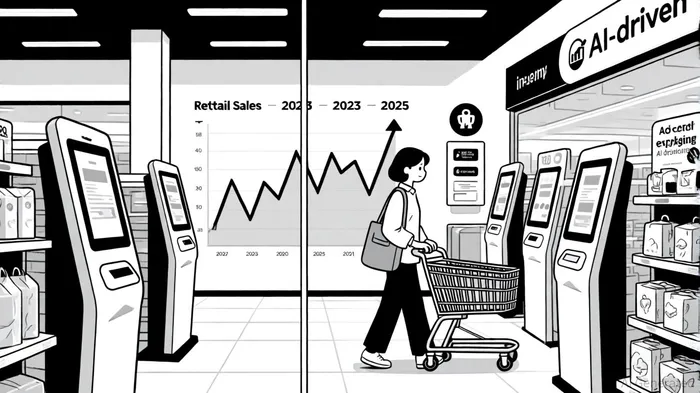
The Canadian retail sector is at a crossroads, balancing immediate turbulence with enduring consumer adaptability. While 2023-2024 saw a 3.2% annual increase in retail spending and $67.7 billion in e-commerce revenue[3], the path forward is marked by both headwinds and tailwinds. For investors, dissecting this duality is critical to identifying opportunities amid uncertainty.
Short-Term Volatility: Navigating Shifting Tides
The sector's near-term challenges stem from a confluence of macroeconomic and geopolitical factors. Inflation, supply chain bottlenecks, and high interest rates have created a volatile environment. For instance, gasoline station revenues plummeted 7.3% in 2023 due to fluctuating energy costs[3], while trade tensions loom large. A report by Blakes[1] highlights the risk of 25% U.S. tariffs on Canadian exports, which could inflate import prices and strain domestic manufacturers.
Compounding these pressures, Q2 2025 saw a moderation in retail sales growth to 4.6% year-over-year, down from earlier momentum[2]. Yet, even in this context, 80% of retailers reported year-over-year sales gains[2], underscoring a fragmented recovery. The Canadian economy's projected negative growth in Q2 and Q3 2025[5] further amplifies near-term risks, particularly for non-essential sectors like fashion and electronics, which are witnessing declining demand[1].
Long-Term Resilience: Adapting to a New Normal
Beneath the volatility lies a resilient consumer base adapting to economic pressures. Sixty-four percent of shoppers now prioritize meeting expectations[2], driving innovation in loyalty programs and creative lease structures[1]. Discount retailers such as Dollarama and Giant Tiger are thriving, as 64% of consumers increasingly opt for private-label products and value-packaged staples[1].
Technological and sustainability-driven shifts are reshaping the sector. Agentic AI is streamlining low-consideration purchases, while retailers like Royalmount in Montreal are pioneering experiential, multi-use retail environments[2]. Sustainability initiatives, including circular economy models, are gaining traction, aligning with consumer demand for ethical consumption[2].
Falling interest rates in 2024 have also provided a tailwind, boosting consumer spending and driving vacancy rates to a record-low 1.5%[4]. This suggests that while the sector faces headwinds, structural adaptations—such as hybrid retail models blending online and in-store experiences—are creating durable value[1].
Investment Implications: Balancing Risks and Opportunities
For investors, the Canadian retail sector offers a nuanced landscape. Short-term volatility, particularly in non-essential categories and regions exposed to trade tensions, warrants caution. However, long-term opportunities abound in value-driven retailers, AI-integrated platforms, and experiential retail projects.
Discount chains and private-label brands are well-positioned to capitalize on shifting consumer priorities, while tech-savvy firms leveraging agentic AI could redefine customer engagement. Meanwhile, experiential retail developments, such as mixed-use hubs, may attract both tenants and shoppers in an era of high vacancy constraints[1].
The key lies in discerning which players can navigate near-term turbulence while embedding themselves in the sector's evolving DNA. As Carl Boutet, a retail strategist, notes, balancing AI efficiency with meaningful customer experiences will be pivotal[2].
Conclusion
The Canadian retail sector's recovery is neither linear nor uniform. While short-term volatility from inflation, tariffs, and economic polarization persists, long-term resilience is being forged through innovation, sustainability, and consumer-centric strategies. For investors, the challenge—and opportunity—lies in identifying firms that can thrive in this dynamic environment.







Comentarios
Aún no hay comentarios