
Navigating Brazil's Currency and Equity Declines: Tariff Risks vs. Undervalued Opportunities
The U.S. imposition of 50% tariffs on all Brazilian imports, effective August 1, 2025, has sent shockwaves through global markets. While the Brazilian real (BRL) and equity markets face near-term volatility, the situation presents a nuanced opportunity for investors willing to parse the short-term chaos from long-term value. Here's how to assess the risks and rewards.
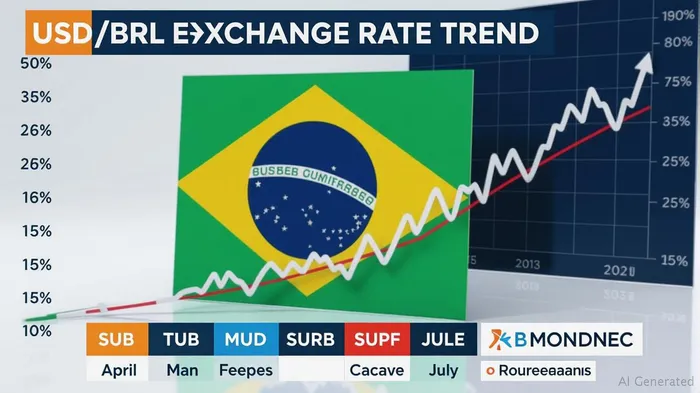
The Real: Not Yet Oversold, But Watch Technicals
The BRL has held up remarkably well despite the tariff threat. As of July 7, USD/BRL traded at R$5.4088—the lowest in over a year—driven by Brazil's 15% Selic rate attracting carry trades and rising commodity prices like iron ore. Technical indicators paint a mixed picture:
- RSI (14-day): 38 (neutral, not oversold).
- Moving Averages: The pair remains below the 50-day MA (5.48) but above the 200-day MA (5.60), signaling a bearish bias against the dollar.
- Support/Resistance: Near-term support at 5.40; resistance at 5.57.
Investors should monitor whether the real holds above 5.40. A breach could signal a deeper correction, but current fundamentals (high rates, commodity demand) favor stabilization.
Sectors Most Vulnerable to the 50% Tariffs
The blanket tariff hits Brazil's key U.S. exports:
Crude Oil and Petrochemicals:
Brazil's crude exports to the U.S. face a 50% price hike, squeezing margins for PetrobrasPBR.A-- (PBR) and other producers. However, global oil prices (currently $85/bbl) may mitigate some impact.Steel and Pig Iron:
Companies like ValeVALE-- (VALE), a major iron ore exporter, could see reduced competitiveness in U.S. markets. Domestic demand in Brazil might offset losses if infrastructure projects proceed.Agriculture:
Coffee and soybean exports—critical to companies like JBSJBS-- (JBS) and BRF—could face reduced demand if U.S. buyers seek alternatives.Aviation:
While not explicitly targeted, EmbraerERJ-- (EMBR) faces indirect pressure. U.S. tariffs on Brazilian-made aircraft could deter sales, though the company's joint venture with BoeingBA-- (BA) may offer some insulation.
Equity Opportunities: Look for Undervalued Resilience
Brazil's equity market (tracked by ETF EWZ) has underperformed this year, down 8% since April. However, select sectors could rebound if diplomatic tensions ease:
- Financials: Banks like Itaú Unibanco (ITUB) benefit from high rates and a strong real. Their dividend yields (over 7%) are compelling.
- Utilities: Companhia Energética de Minas Gerais (CIGS) offers stable income with exposure to Brazil's energy transition.
- Consumer Staples: Companies like AmbevABEV-- (ABEV), reliant on domestic demand, are less exposed to trade wars.
Caveat: Avoid overexposure to export-heavy sectors until the tariff's full impact is clear.
The Diplomatic Wild Card: Monitor Trade Talks and Retaliation
The U.S.-Brazil standoff hinges on two factors:
1. Diplomatic Resolution: If talks ease tensions by August, tariffs could be scaled back, boosting equities.
2. Brazilian Retaliation: Brazil may impose its own tariffs on U.S. goods like soybeans or aircraft parts. Such moves could pressure companies like Boeing or agricultural giants like Archer-Daniels-MidlandADM-- (ADM).
Investors should track statements from Brazilian President Lula and U.S. negotiators closely. A compromise by early August could spark a relief rally.
Investment Strategy: Short-Term Caution, Long-Term Optimism
- Short-Term: Avoid aggressive bets. Use volatility to accumulate defensive stocks (utilities, banks) at dips.
- Long-Term: Consider Brazil's undervalued equities (EWZ's P/E is 12x, below historical averages) as a play on eventual tariff resolution and commodity demand.
The real's strength and high yields suggest Brazil remains a compelling destination—if you can stomach near-term turbulence.
In conclusion, Brazil's assets are pricing in worst-case tariff scenarios. While short-term volatility is inevitable, investors with a 12–18-month horizon may find compelling value in resilient sectors. Stay nimble, and let diplomacy guide your next move.





Comentarios
Aún no hay comentarios