
Navigating Bond Markets in a Fed Easing Cycle
The Federal Reserve's recent 25-basis-point rate cut in September 2025 marks the resumption of an easing cycle, signaling a shift from a nine-month pause in monetary tightening to a more accommodative stance[1]. With unemployment rising to 4.3% and inflation lingering at 2.9%, the Fed has projected two additional cuts by year-end, conditional on economic data[4]. For bond investors, this environment presents both opportunities and challenges. Strategic entry points and duration management are critical to capitalizing on the Fed's easing cycle while mitigating risks from macroeconomic uncertainties.
Strategic Entry Points: Sector Rotation and Credit Quality
As the Fed signals a dovish pivot, bond investors must prioritize flexibility and active management. According to a report by Forbes contributor Garth Friesen, multi-sector bond funds—spanning high-yield corporates, securitized credit, and emerging-market debt—offer a dynamic approach to capturing relative value in a shifting rate environment[1]. These strategies allow investors to rotate into sectors with stronger fundamentals while avoiding overexposure to long-dated Treasuries, which may underperform in a non-recessionary slowdown[4].
Historical data underscores the importance of credit quality in entry-point decisions. Morgan Stanley's Fixed Income Outlook 2025 highlights that investment-grade corporate bonds remain resilient despite global supply chain pressures, making them a safer bet for income generation[2]. Meanwhile, high-yield and securitized credit (e.g., asset-backed securities) offer enhanced yields, provided investors can tolerate higher volatility[2]. Emerging-market debt also emerges as a compelling opportunity, particularly in countries with robust fiscal positions and central banks poised to cut rates[2].
A key takeaway is to avoid passive allocations in a tightening-spread environment. As BlackRockBLK-- notes, bond yields and spreads have narrowed significantly, reducing the appeal of broad-market indices[4]. Instead, investors should focus on active selection of individual securities, particularly those with mispriced valuations, to optimize risk-adjusted returns.
Duration Management: Beyond Headline Metrics
Duration management in a rate-cutting environment requires a nuanced approach. Traditional duration metrics often oversimplify the relationship between interest rates and bond prices, as yield curve shifts are rarely parallel. For instance, during the Fed's 100-basis-point rate cuts in late 2024, the 10-year Treasury yield paradoxically rose due to inflation expectations and supply dynamics, despite aggressive short-end easing[1]. This highlights the need to deconstruct duration using tools like key rate duration, which isolates a portfolio's sensitivity to changes at specific points along the yield curve[1].
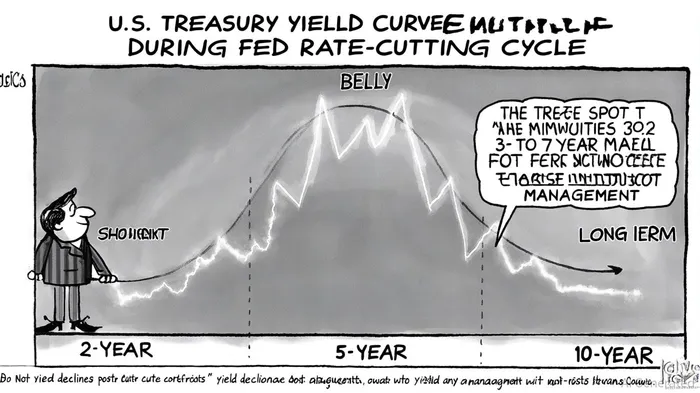
Historical patterns provide further guidance. Data from the CFA Institute blog reveals that short-term (6- to 12-month) Treasury yields typically fall by 0.75% to 1% after the first rate cut, while 2-year yields decline by 0.50% within 60 days[3]. The 10-year yield, however, tends to fall by 1% into the initial cut and continues to decline afterward, outperforming shorter maturities by an average of 6% across cycles[2]. This suggests that intermediate-term bonds (3- to 7-year maturities) may offer a balanced trade-off between income and downside protection—a segment often referred to as the “belly” of the curve[4].
Investors should also consider the economic context. If the Fed cuts rates due to softening growth without a recession, the yield curve may steepen, favoring short- to intermediate-term bonds[3]. Conversely, in a deep rate-cut cycle driven by recessionary risks, long-duration assets could outperform. Given the current environment—a moderate slowdown with inflation still above target—tilting toward intermediate-term bonds appears prudent[4].
Tactical Considerations for 2025
With the Fed projecting two more rate cuts in October and December 2025, investors should adopt a phased entry strategy. Dollar-cost averaging into bond markets can mitigate timing risks, while tactical shifts toward sectors with strong fundamentals (e.g., investment-grade corporates) enhance resilience[3]. Additionally, monitoring curve inversion levels is critical: deeper inversions (where long-term yields fall below short-term yields) may limit the magnitude of yield declines post-cuts[3].
For those seeking yield, the Bloomberg Aggregate Bond Index's six-year duration offers a benchmark, but its performance during the 2024 rate cuts underscores the need for active management[1]. A diversified portfolio combining U.S. Treasuries, corporate bonds, and securitized credit—weighted toward intermediate maturities—can balance income generation with capital preservation[2].
Conclusion
The Fed's easing cycle in 2025 presents a unique window for bond investors to enhance returns through strategic entry points and duration management. By leveraging active sector rotation, prioritizing credit quality, and deconstructing duration along the yield curve, investors can navigate the complexities of a rate-cutting environment. As the Fed's conditional guidance underscores, vigilance toward incoming economic data and curve dynamics will remain essential. In this climate, a disciplined, adaptive approach to bond portfolio construction is not just prudent—it is imperative.





Comentarios
Aún no hay comentarios