
Navigating Bitcoin's Volatility: Risk Management Strategies Amid Options Expiry Dynamics
The Mechanics of Options Expiry and "Max Pain"
Bitcoin's price volatility around major options expiries is driven by a confluence of strategic trading behavior and mathematical inevitability. When large notional amounts—such as the $23 billion in BitcoinBTC-- and EthereumETH-- options that expired in 2025—reach their deadlines, market participants adjust positions to either hedge, roll over, or let contracts expire[6]. This activity often triggers sharp price swings, particularly when heavy open interest exists in specific strike prices.
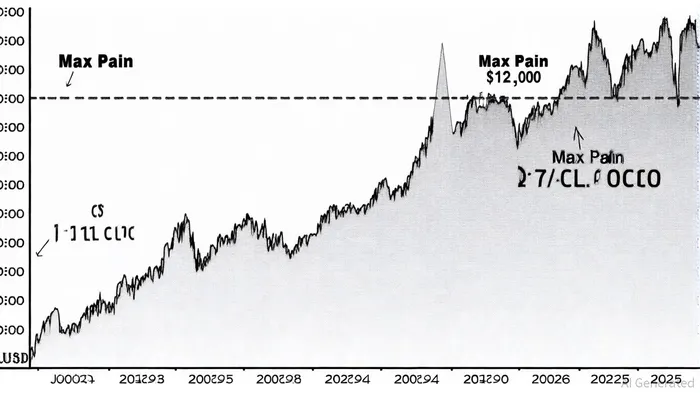
A critical concept here is the "Max Pain" theory, which posits that prices gravitate toward strike levels where the most option holders face losses. For example, in June 2025, Bitcoin's Max Pain was calculated at $102,000, and historical data from Deribit showed prices converging toward this level before stabilizing[4]. Similarly, the September 2025 expiry had a Max Pain of $110,000, with Bitcoin trading at $112,000—a slight premium that could still exert downward pressure as expiry approached[1].
Market makers and institutional traders play a pivotal role in these dynamics. During the $20 billion options expiry in 2025, institutions executed delta hedging strategies to mitigate risk, amplifying price movements in both Bitcoin and Ethereum[3]. These actions create a feedback loop: as market makers adjust their hedges, they inadvertently influence the very price levels they're trying to stabilize.
Market Sentiment: Put/Call Ratios and Positioning
Market sentiment is a key determinant of how options expiries unfold. The put/call ratio—a measure of bearish (put) versus bullish (call) positioning—offers critical insights. In September 2025, Bitcoin's put/call ratio stood at 1.23, indicating a bearish bias[2], while Ethereum's ratio of 0.99 suggested a more balanced outlook[6]. These metrics reflect not just trader psychology but also strategic positioning, such as yield-generation tactics like cash-secured puts, which can skew ratios[6].
The June 2025 expiry further illustrates this complexity. Despite a put/call open interest ratio of 0.72, which initially seemed bullish, the majority of call options were out-of-the-money. In-the-money calls, however, indicated profitable positions held by traders, suggesting a nuanced mix of optimism and caution[6]. This duality underscores the importance of analyzing both open interest and strike price distribution, rather than relying solely on ratios.
Risk Management: Navigating Volatility
For investors, managing risk during options expiries requires a multi-layered approach. Short-term traders can capitalize on volatility through strategies like straddles or strangles, which profit from large price swings regardless of direction. For example, during the $14 billion expiry in June 2025, traders who anticipated a sharp move toward the $102,000 Max Pain level could have profited from a straddle strategy[4].
Long-term investors, meanwhile, should focus on post-expiry rebalancing opportunities. After a volatile expiry, prices often consolidate around key levels, offering entry points for those with a bullish or bearish thesis. Monitoring metrics like implied volatility (IV) is essential; high IV before expiry typically reverts to lower levels afterward, creating potential for mean reversion trades[4].
Risk mitigation techniques such as stop-loss orders and position diversification are non-negotiable. During the August 2025 expiry, heightened demand for put options signaled defensive positioning, a trend that justified tighter stop-loss levels for long positions[5]. Diversifying across assets—such as Ethereum, which often exhibits less volatility than Bitcoin—can also buffer against sector-specific shocks.
External Factors: When Macro Overrules Micro
While options expiries are significant, they are not the sole drivers of Bitcoin's volatility. Macroeconomic developments, such as Federal Reserve policy, can override expiry effects. In June 2024, expectations of a Fed rate cut partially offset potential downside pressure from an options expiry, illustrating how macro narratives can dominate short-term price action[4]. Similarly, geopolitical risks—such as trade wars or regulatory shifts—can amplify or mute expiry-driven volatility.
Conclusion
Bitcoin's volatility around options expiries is a double-edged sword: it presents both risks and opportunities. By understanding the mechanics of Max Pain, monitoring sentiment through put/call ratios, and employing disciplined risk management, investors can navigate these events with confidence. However, the broader macroeconomic context must always be factored in—expiry dynamics are powerful, but they operate within a larger ecosystem of forces.






Comentarios
Aún no hay comentarios