
Navigating Bitcoin's Volatility in a Post-QE Era: Strategic Positioning and Risk Management for Institutional Investors
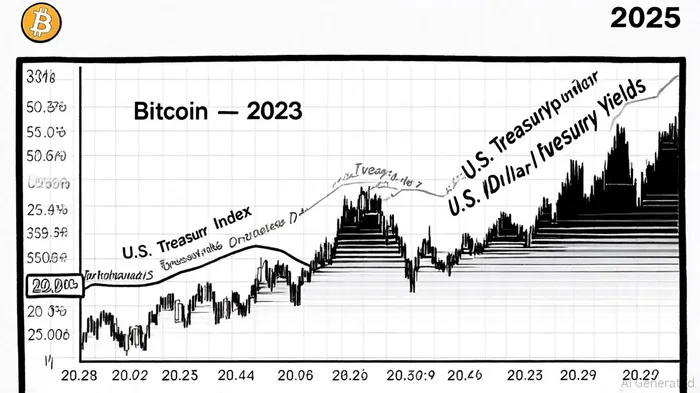
Bitcoin's volatility in the post-quantitative easing (QE) era has become a defining feature of its role in global financial markets. As central banks unwind years of accommodative monetary policy, the interplay between Bitcoin's speculative nature and macroeconomic forces has intensified. For institutional investors, understanding this dynamic—and deploying robust risk management frameworks—is critical to harnessing Bitcoin's potential while mitigating its inherent risks.
Macroeconomic Drivers and Bitcoin's Dual Role
Bitcoin's price trajectory in 2023–2025 has been shaped by shifting monetary policy, inflationary pressures, and liquidity conditions. According to a report by ScienceDirect, U.S. Treasury yields and the U.S. Dollar Index have emerged as key determinants of BitcoinBTC-- returns, with rising yields diverting institutional capital away from risk assets like Bitcoin [1]. For instance, in January 2025, Treasury yields hit a 14-month high of 4.79%, coinciding with a sharp correction in Bitcoin prices as investors reallocated to higher-yielding traditional assets [2]. Conversely, Bitcoin's fixed supply of 21 million coins positions it as a hedge against inflation, a role reinforced by its adoption in economies like Argentina and Turkey, where currency devaluation has driven demand [6].
Central banks, however, view Bitcoin's rise with growing scrutiny. The European Central Bank (ECB) and the Minneapolis Federal Reserve have highlighted how Bitcoin's price appreciation exacerbates wealth inequality through the Cantillon effect, disproportionately benefiting early adopters [1]. Meanwhile, the IMF has warned that cryptocurrencies could undermine monetary sovereignty, prompting calls for stricter regulatory frameworks [1]. These perspectives underscore Bitcoin's dual identity: a decentralized store of value and a disruptive force challenging traditional monetary systems.
Strategic Positioning in a QT-Driven Environment
The transition from QE to quantitative tightening (QT) has introduced new complexities for Bitcoin investors. Historical data reveals that Bitcoin's price systematically reacts to Federal Reserve and ECB policy decisions, though its sensitivity has evolved over time [5]. During the 2020 pandemic, global QE injected liquidity into markets, fueling Bitcoin's bull run. In contrast, QT has tightened liquidity, amplifying volatility and prompting sharp corrections [3].
Institutional investors are adapting by integrating Bitcoin into diversified portfolios. The approval of spot Bitcoin ETFs in early 2024 marked a turning point, enabling regulated access to Bitcoin with over $58 billion in assets under management by Q2 2025 [3]. Companies like MicroStrategy and Tesla have further legitimized Bitcoin as a corporate treasury asset, allocating significant portions of their reserves to the cryptocurrency [2]. These strategies leverage Bitcoin's low correlation with traditional assets, offering a hedge against inflation and macroeconomic uncertainty [6].
Risk Management: Tools and Frameworks
Managing Bitcoin's volatility requires a multifaceted approach. A 2025 analysis by Editverse emphasizes the need for real-time monitoring, cybersecurity infrastructure, and compliance systems to address market and operational risks [2]. Institutions are also adopting advanced hedging mechanisms, such as derivatives and insurance solutions, to mitigate exposure during periods of heightened volatility [2]. For example, multi-signature wallets and qualified custodians have become standard for securing large Bitcoin holdings, reducing the risk of theft or regulatory non-compliance [4].
Regulatory uncertainty remains a wildcard. The U.S. Department of Justice's plan to liquidate $6.5 billion in seized Bitcoin in 2024 exemplifies how policy developments can trigger abrupt price swings [2]. To navigate this, institutional investors are prioritizing flexibility, adjusting allocations based on macroeconomic signals and central bank actions. As the Federal Reserve's QT slows in 2025, liquidity conditions have improved, offering a glimpse of stability [3].
Conclusion: Balancing Opportunity and Caution
Bitcoin's integration into institutional portfolios reflects a broader realignment in asset management, particularly in post-QE environments where traditional markets remain volatile. While its potential as an inflation hedge and diversification tool is compelling, investors must remain vigilant against macroeconomic headwinds and regulatory shifts. By deploying sophisticated risk management frameworks and leveraging Bitcoin's unique properties, institutions can strategically position themselves to capitalize on its long-term value proposition while navigating the turbulence of a tightening monetary landscape.






Comentarios
Aún no hay comentarios