
Navigating Binance Futures Delisting: Strategic Position Management for MANA and EGLD Traders
Understanding the Delisting Context
Binance's decision to delist MANA/USD and EGLD/USD perpetual futures follows its established criteria of prioritizing liquidity and technical efficiency. According to Binance's official announcements, contracts with declining trading volumes or outdated infrastructure are phased out to maintain platform performance, as detailed in a Lookonchain report. For MANA and EGLD, the delisting timeline includes a critical window: traders must manually close positions by 08:30 UTC on November 13, 2025, to avoid automatic liquidation at 09:00 UTC, as reported in a BitcoinSistemi article. This process mirrors recent delistings of KDA, AXS, and THETA, where forced deleveraging occurred without prior manual intervention, as noted in a BitcoinSistemi report.
The delisting does not affect spot trading for MANA and EGLD, but leveraged traders face immediate challenges. Open futures positions will be settled at the final mark price, potentially leading to slippage or unexpected losses if markets are volatile during the closure period, according to a OneSafe analysis.
Risk Mitigation Frameworks for Leveraged Traders
To navigate this transition, traders must employ a multi-layered risk management approach:
Pre-Delisting Position Closure
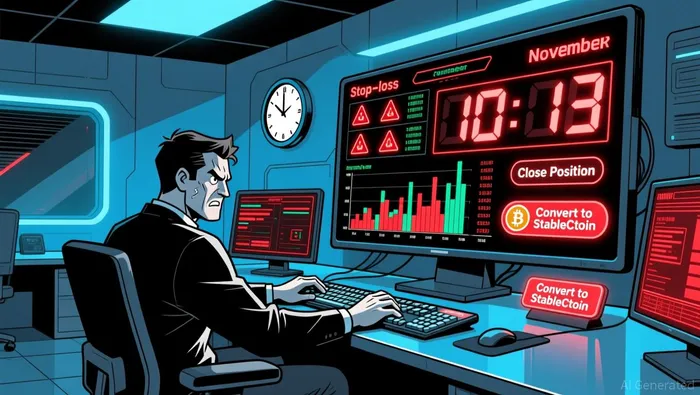
Traders are advised to close leveraged positions well before the 08:30 UTC deadline. Historical data from similar delistings shows that last-minute closures often coincide with heightened volatility, increasing the risk of adverse price movements, as highlighted in a CryptoRank alert. For example, the delisting of USDⓈ-M KDAUSDT on November 6, 2025, saw a 12% price swing in the final hour as liquidity dried up, according to a BitcoinWorld report.Asset Reallocation Strategies
Converting delisted assets into stablecoins (e.g., USDT, BUSD) or high-liquidity pairs (e.g., BTC, ETH) can reduce exposure to illiquid markets. Experts recommend transferring tokens to private wallets for long-term storage, ensuring control even if spot trading resumes post-delisting, as advised in a Bokiko Medium post.Stop-Loss and Trailing Stop Mechanisms
Automated stop-loss orders are critical during volatile periods. During the October 10, 2025, market crash, traders who utilized trailing stops preserved 30–40% more capital compared to those relying on manual exits, according to a Coinbureau guide.
Timing Strategies for Optimal Execution
Timing is paramount in minimizing losses or capitalizing on residual liquidity. Key strategies include:
- Laddered Exits: Selling positions in tranches allows traders to capture gains while retaining some exposure to potential price rebounds. For instance, a 50% exit at 08:00 UTC and a 30% exit at 08:30 UTC balances risk and reward, as discussed in a ScienceDirect study.
- Technical Indicators: Monitoring RSI overbought levels (above 70) or MACD crossovers can signal overextended markets, prompting early closures.
- Market Cycle Awareness: Historical patterns suggest that delistings often coincide with broader market corrections. Traders should align exits with macroeconomic triggers, such as regulatory updates or sector-specific news.
Broader Implications for Crypto Trading
The delisting of MANA and EGLD reflects Binance's broader strategy to align its offerings with institutional-grade standards. As regulatory scrutiny intensifies, platforms are increasingly prioritizing compliance and liquidity, leaving smaller tokens vulnerable to exclusion. For traders, this underscores the need for dynamic portfolio management and continuous monitoring of exchange policies.
Conclusion
The delisting of MANA and EGLD futures on Binance Futures presents both challenges and opportunities. By adhering to disciplined risk mitigation practices-such as pre-set stop-losses, laddered exits, and asset reallocation-traders can navigate this transition with minimal disruption. As the crypto market evolves, adaptability and foresight will remain the cornerstones of successful leveraged trading.







Comentarios
Aún no hay comentarios