
Navigating the Bank of England's Stablecoin Regulations: Strategic Implications for UK Financial Markets and Crypto Assets
A Dual-Track Regulatory Framework: Systemic vs. Non-Systemic Stablecoins
The BoE's proposed regime distinguishes between "systemic" stablecoins-those integral to payment ecosystems-and smaller, less critical tokens. Systemic stablecoins will fall under the BoE's direct oversight, with stringent reserve requirements mandating backing by short-term government bonds maturing within three months, as outlined in the Blockonomi analysis. Non-systemic stablecoins, meanwhile, will be regulated by the Financial Conduct Authority (FCA) under a lighter framework, as noted in the CoinCentral report. This bifurcation reflects the UK's structural reliance on commercial banks, which differ from the U.S.'s government-backed mortgage system. By prioritizing systemic stability, the BoE aims to prevent sudden capital flight from traditional banks, a risk amplified by the UK's mortgage-dependent economy, as detailed in the Coinotag piece.
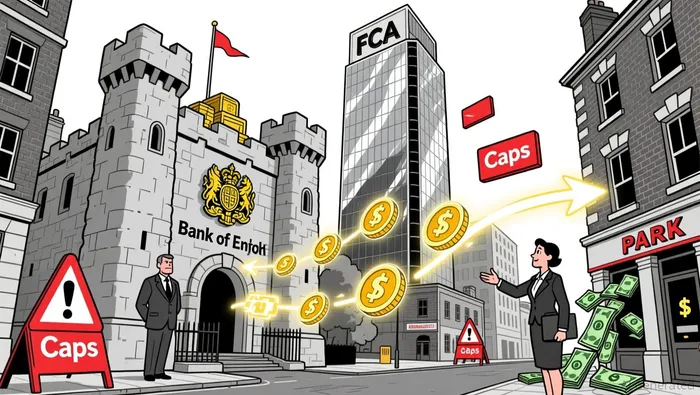
Temporary holding caps-£20,000 for individuals and £10 million for businesses-further underscore this risk-averse stance. These limits, set to be proposed in the November 10 consultation, are designed to mitigate liquidity shocks while the regulatory infrastructure matures, as noted in the CoinCentral report. Deputy Governor Sarah Breeden has emphasized the need for "a balanced framework that promotes trust without stifling innovation," as reported in the Coinotag piece, yet critics argue the caps could stifle adoption. Simon Jennings of the UK Cryptoasset Business Council, for instance, has called the measures "cumbersome, costly, and potentially unworkable," as reported in the Decrypt article, highlighting tensions between prudence and practicality.
Risk Assessment: Financial Stability vs. Innovation
The BoE's primary concern is safeguarding the UK's bank-driven financial system. By capping stablecoin holdings, the central bank aims to prevent a scenario where users shift large sums from bank accounts into stablecoins, destabilizing liquidity. This risk is acute in the UK, where commercial banks play a more central role in mortgage lending than in the U.S., as detailed in the Coinotag piece. However, the caps could also deter institutional adoption, particularly for businesses seeking to use stablecoins for cross-border transactions or payroll systems.
Another risk lies in regulatory fragmentation. While the UK aligns with U.S. standards through a joint task force initiated in September 2025, as reported in the Decrypt article, its divergence from the EU's Markets in Crypto-Assets (MiCA) framework could create compliance hurdles for firms operating across jurisdictions. SMEs and startups, in particular, may struggle to navigate conflicting rules, potentially stifling innovation, as noted in the OneSafe blog.
Opportunity Analysis: Competitive Positioning and Market Growth
Despite these risks, the BoE's approach presents significant opportunities. By mirroring U.S. regulations-such as requiring stablecoin reserves to include short-term government bonds-the UK positions itself as a global hub for digital finance, as noted in the OneSafe blog. This alignment could attract cross-border investment and foster collaboration with U.S. institutions, particularly in cross-border payments and blockchain-based infrastructure, as noted in the OneSafe blog.
The UK government's broader strategy-appointing a "digital markets champion" and lifting the FCA's retail ban on crypto exchange-traded notes (ETNs)-further signals a pro-innovation stance, as reported in the Crowdfund Insider article. These moves could accelerate the adoption of stablecoins in sectors like remittances, e-commerce, and decentralized finance (DeFi), where their speed and cost efficiency are advantageous.
Global Context: Aligning with the U.S., Diverging from the EU
The BoE's urgency to match the U.S.'s regulatory pace-Deputy Governor Breeden has stated the UK will implement rules "just as quickly" as the U.S., as reported in the Decrypt article-reflects a strategic bid to remain competitive in the global crypto race. However, this alignment comes at the cost of diverging from the EU's MiCA framework, which emphasizes broader consumer protections and environmental sustainability. While the UK's approach prioritizes market efficiency, it risks alienating European partners and creating a fragmented regulatory landscape, as noted in the OneSafe blog.
Conclusion: A Delicate Balancing Act
The Bank of England's stablecoin regulations exemplify a delicate balancing act between risk mitigation and innovation. While the proposed holding caps and reserve requirements aim to protect financial stability, they also risk deterring adoption and creating compliance complexities. Conversely, the UK's alignment with U.S. standards and commitment to digital infrastructure could position it as a leader in the next phase of financial innovation. Investors and market participants must closely monitor the November 10 consultation and subsequent public feedback, as these will shape the final framework's contours-and, by extension, the UK's role in the global digital economy.







Comentarios
Aún no hay comentarios