
Navigating the Autumn Crypto Slump: Strategic Entry Points in a Correction-Prone Market
As the calendar flips to autumn, cryptocurrency markets historically enter a phase of heightened volatility and opportunity. While seasonal slumps can unsettle investors, they also present a unique window for strategic entry into the market. By combining historical seasonal patterns with technical analysis tools, traders can identify high-probability setups to capitalize on corrections. This article explores how to navigate the autumn crypto slump using data-driven strategies.
Historical Seasonal Trends: A Window for Opportunity
Autumn has long been a season of recovery and growth for cryptocurrencies. BitcoinBTC--, for instance, has historically delivered an average return of +34.2% during September–November, while Ethereum's average return over the same period is even stronger at +42.8%[2]. These figures contrast sharply with summer months, where consolidation or declines are common, often accompanied by a 23% drop in volatility[2].
The autumn rebound is driven by structural factors. Institutional rebalancing in September and year-end tax considerations in December create a surge in demand[2]. For example, Bitcoin's performance in Q4 since 2013 has averaged 85%, with November alone delivering an average gain of 46%[4]. Recent catalysts, such as the Bitcoin halving in April 2024 and the approval of Bitcoin ETFs in the U.S., have further amplified these seasonal trends[1].
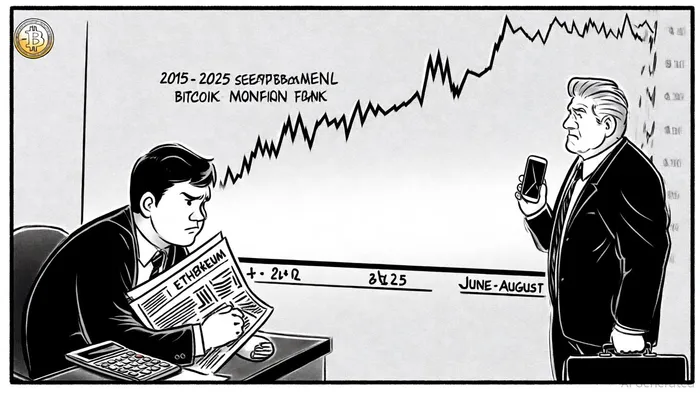
Technical Analysis: Tools for Precision Entry
To exploit autumn corrections, traders must employ technical analysis to pinpoint entry points. Three core strategies stand out:
1. Trend-Following Pullbacks with RSI and EMA
A mechanical approach involves identifying pullbacks to the 21 EMA (Exponential Moving Average) while the RSI(14) dips to 40–50 and then reclaims 50[1]. This setup filters out weak corrections and aligns with the prevailing uptrend. For example, during the 2024–2025 autumn rally, Bitcoin's price retested the 21 EMA at $85,000 in October 2024, with RSI confirming a bullish rebound[1].
2. Moving Average Crossovers
The Golden Cross (short-term SMA/EMA crossing above a long-term one) and Death Cross (bearish counterpart) are critical for trend confirmation[4]. In 2024, Bitcoin's 50 EMA crossing above its 200 EMA in September signaled a strong bullish bias, coinciding with a 30% price surge[1].
3. Fibonacci Retracements and Confluence Zones
Fibonacci levels (e.g., 61.8% retracement) act as dynamic support/resistance during corrections[3]. When these levels align with moving averages or RSI signals, they create high-probability entry zones. For instance, Ethereum's 2025 autumn correction found support at the 61.8% Fibonacci level ($1,800) in September, confirmed by RSI dipping to 45 and a retest of the 50 EMA[3].
Combining Strategies for Robust Entries
The most effective approach integrates multiple indicators. For example:
- Confluence of RSI and Moving Averages: A price pullback to the 21 EMA with RSI(14) dipping to 40–50 and then rising above 50 provides a high-confidence long entry[1].
- Volume Confirmation: Breakouts from consolidation phases are validated by increased volume and decisive candle closures[1].
- Multi-Timeframe Analysis: Using daily charts to confirm signals on 1-hour or 4-hour charts enhances precision[1].
Risk Management: The Unsung Hero
Even the best strategies require disciplined risk management. Traders should:
- Use ATR-based stop-loss orders to account for volatility[1].
- Calculate risk-reward ratios based on confluence zones (e.g., risking 2% for a 10% target).
- Avoid over-leveraging during volatile autumn months.
Conclusion: Autumn as a Strategic Advantage
The autumn crypto slump, far from being a deterrent, is a calculated opportunity for disciplined traders. By leveraging historical seasonal trends and technical analysis, investors can navigate corrections with precision. As Bitcoin and EthereumETH-- continue to mature, the interplay of institutional demand and technical setups will likely reinforce autumn's role as a season of recovery and growth.






Comentarios
Aún no hay comentarios