
Navigating Automotive Supply Chain Turbulence: Strategic Resilience in the Wake of Honda's Nexperia Crisis
The Nexperia Crisis: A Geopolitical Flashpoint
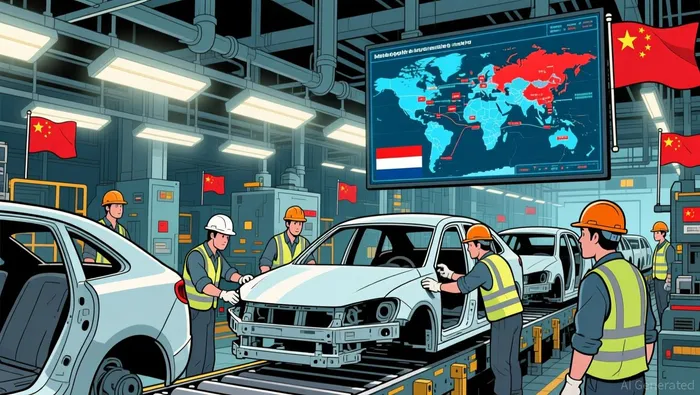
Honda's revised guidance-reducing full-year vehicle sales forecasts from 3.62 million to 3.34 million units-highlights the cascading impact of Nexperia's supply constraints, according to Marketscreener. The Dutch government's takeover of Nexperia, a subsidiary of Chinese firm Wingtech, triggered export restrictions from China, severing a critical link in the semiconductor supply chain, as CNBC reported CNBC. This geopolitical entanglement has forced Honda to implement production cuts at North American plants, including its Marysville, Ohio facility, which produces the Accord and Acura Integra, as reported by DealershipGuy. The automaker's first-half net profit plummeted 37% to ¥311.83 billion ($2.04 billion), a stark indicator of the financial toll, as Marketscreener noted Marketscreener.
The crisis also amplifies the sector's exposure to U.S. tariffs, which Honda now estimates will reduce operating profit by ¥385 billion for the fiscal year-down from an initial ¥450 billion forecast, as Marketscreener reported Marketscreener. These tariffs, aimed at curbing the U.S. trade deficit, have created a dual burden: higher costs for imported components and reduced demand in Asian markets.
Strategic Resilience: Diversification and Sector Reallocation
Honda's response to the Nexperia crisis reflects a broader industry shift toward strategic resilience. The company has adopted a "fluid" production strategy, temporarily reducing output at North American plants and offering employees flexible work arrangements, including unpaid leave, as DealershipGuy reported DealershipGuy. This approach mirrors Toyota's 2023 production cuts and Stellantis' dual-sourcing initiatives, which prioritize buffer inventory and supplier diversification, according to Everstream.
A pivotal move by Honda is its investment in Japanese chipmaker Rapidus, a strategic partnership aimed at securing advanced semiconductors for next-generation vehicles, as reported by Nikkei. This investment, expected to total several billion yen by late 2025, signals a long-term reallocation of resources toward domestic chip production. By designing in-house chips for autonomous vehicles and outsourcing manufacturing to foundries like TSMCTSM--, Honda seeks to mitigate reliance on foreign suppliers, as Marketscreener noted Marketscreener. Rapidus' pilot production of 2nm chips, slated for mass production by 2027, could further insulate the automaker from geopolitical shocks, as Nikkei reported Nikkei.
Industry-Wide Implications and Investor Takeaways
The Nexperia crisis is not an isolated incident but a symptom of systemic vulnerabilities. The automotive sector's reliance on semiconductors-from basic switches to AI-driven systems-has created a bottleneck that no single company can fully control, as Everstream reported Everstream. For investors, the key differentiator will be firms that proactively reallocate capital toward resilient supply chains. Honda's pivot to Rapidus and its revised tariff forecasts illustrate a pragmatic approach to risk management, though its short-term financial outlook remains bleak, as Marketscreener noted Marketscreener.
Broader sector trends suggest a shift toward localized production and diversified supplier networks. Companies that fail to adapt-such as Nissan, which recently cut Rogue SUV production due to Nexperia shortages, as reported by Unna-risk eroding market share. Meanwhile, automakers leveraging partnerships with chipmakers like TSMC or investing in vertical integration (e.g., Tesla's in-house battery R&D) are better positioned to navigate future disruptions, as Everstream reported Everstream.
Conclusion
Honda's Nexperia-linked crisis serves as a cautionary tale and a blueprint for resilience. While the automaker's 2025 guidance cut highlights immediate financial pain, its strategic investments in domestic chip production and flexible manufacturing underscore a forward-looking approach. For investors, the lesson is clear: supply chain resilience is no longer a peripheral concern but a core determinant of competitive advantage. As the automotive sector grapples with geopolitical and technological headwinds, companies that reallocate resources toward diversified, agile supply chains will emerge stronger in the long term.







Comentarios
Aún no hay comentarios