
Navigating the Automation Revolution: Resilient Sectors and Investment Opportunities in Food Tech, Labor Transition, and Sustainable Infrastructure
The rapid adoption of AI and robotics is reshaping global labor markets, displacing traditional roles while creating new opportunities in sectors poised to benefit from automation. For investors, the challenge lies in identifying industries and companies that not only weather the disruption but thrive amid it. This analysis explores three resilient sectors-food technology, labor transition services, and sustainable automation infrastructure-highlighting key players and growth drivers backed by recent data and market trends.
1. Food Technology: Robotics and AI as Efficiency Catalysts
The food technology sector has emerged as a prime beneficiary of automation, driven by labor shortages, hygiene demands, and the need for operational efficiency. By 2025, robotic systems accounted for 46% of food robotics deployments, with articulated robots dominating due to their flexibility in tasks like sorting, packaging, and cooking. AI-driven vision systems and machine learning algorithms have further enhanced precision, reducing waste by up to 17% in real-time trimming and sorting operations.
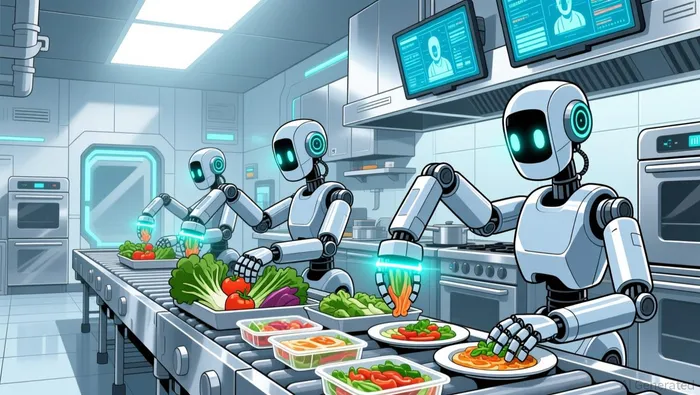 Investors should focus on companies integrating advanced hardware with AI-powered software. ABB Robotics and FANUC, for instance, have pioneered AI integration, with ABB launching an AI Startup Challenge and FANUC partnering with startups to refine manufacturing precision according to industry reports. Startups like Standard Bots are also gaining traction, leveraging collaborative robots (cobots) to address small- to mid-sized food production units. The U.S. market, particularly California, Texas, and Illinois, leads in adoption, reflecting strong commercial traction.
2. Labor Transition Services: Bridging the Skills Gap
As automation displaces entry-level roles, labor transition services are critical for retraining workers and ensuring economic resilience. Companies like Fox Robotics and GrayMatter Robotics are developing self-programming robots that adapt to varying production demands, reducing reliance on manual labor. FoxBots, for example, enable round-the-clock warehouse operations, improving job satisfaction by transitioning workers into supervisory roles.
Collaborative robotics (cobots) are also transforming labor dynamics. By 2025, over 8,000 cobots were in use in food production, a 45% increase from 2022. In logistics, autonomous mobile robots from Locus Robotics and Geekplus have achieved milestones like 3 billion picks, with projections indicating 30% of U.S. warehouses will rely heavily on robotic automation by 2030.
3. Sustainable Automation Infrastructure: Powering the Green Transition
The integration of green energy into automation infrastructure is a growing frontier. Startups like tranXenergy and MarkeDroid are leveraging AI for energy storage management and virtual power plants, optimizing renewable energy usage through predictive analytics. In Europe, 92% of firms are investing in greenhouse gas reduction measures, supported by policy incentives and AI adoption.
Infrastructure providers such as Clear Current (USA) and BH Grid Solutions (Israel) are addressing energy portfolio optimization and real-time CO2 monitoring according to industry analysis. Meanwhile, advancements in grid-enhancing technologies-like reconductoring and dynamic line rating-are enabling cost-effective grid modernization as research shows. The U.S. Department of Energy's funding for smart grid projects further underscores the sector's potential according to government reports.
Emerging technologies like green hydrogen and solid-state batteries are also gaining momentum. Norwegian startups Element One Energy and SOREN HYDROGEN are accelerating green hydrogen adoption, while Crusoe Energy Systems is tackling data center power demands using stranded energy sources according to industry forecasts. These innovations align with the global shift toward sustainable automation, offering long-term investment opportunities.
Conclusion: A Strategic Path Forward
The automation revolution is not a zero-sum game. While certain roles face disruption, the rise of AI and robotics is creating resilient sectors in food technology, labor transition services, and sustainable infrastructure. Investors who prioritize companies like ABB, FANUC, and Standard Bots, alongside upskilling platforms and green energy innovators, can capitalize on the structural shifts reshaping the global economy. As the demand for automation grows, so too does the need for infrastructure and services that ensure a just and sustainable transition.







Comentarios
Aún no hay comentarios