
Navigating Altcoin Season 2025: Strategic Entry Points Beyond Meme Coins
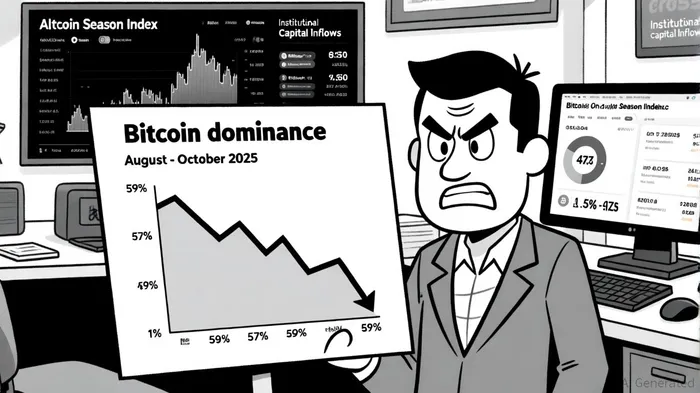
The 2025 altcoin season is unfolding against a backdrop of unprecedented institutional participation, regulatory clarity, and technological innovation. Unlike previous cycles, this season is marked by rapid narrative rotation and fragmented capital flows, with stablecoin pairs serving as primary liquidity sources for altcoins [1]. As BitcoinBTC-- dominance (BTC.D) dips below 59% in August 2025—a threshold historically linked to altcoin rallies—investors are recalibrating their strategies to capitalize on high-utility altcoins with institutional-grade fundamentals [2]. This article dissects the evolving market dynamics, identifies verifiable on-chain metrics, and highlights altcoins poised for institutional adoption ahead of October's seasonal upswing.
Market Rotation and On-Chain Signals
The traditional “Bitcoin to EthereumETH-- to altcoins” capital rotation has given way to a more dynamic, narrative-driven model. As of September 2025, BTC.D stands at 57%, reflecting a 2% decline since August, while Ethereum dominance (ETH.D) has fallen further, signaling outflows from ETHETH-- into Bitcoin [3]. Meanwhile, the Altcoin Season Index—a metric tracking the proportion of top 100 altcoins outperforming Bitcoin over 90 days—has risen to 69%, though it remains below the 75% threshold for a full-blown rally [4].
Key on-chain indicators suggest a shift in institutional capital:
- Bitcoin Dominance Breakdown: BTC.D's breach of a long-term rising trendline in late August triggered optimism about altcoin season, though mid-September volatility saw altcoins lose 4.43% of their value relative to Bitcoin [5].
- Stablecoin Liquidity: Stablecoins now underpin 78% of altcoin trading volume, with projects like BUIDL (BlackRock's tokenized fund) capturing $7 billion in institutional assets [6].
- Macro Drivers: The Federal Reserve's anticipated rate-cutting cycle in Q4 2025 could unlock $1.2 trillion in liquidity, accelerating altcoin adoption [7].
Institutional Adoption: Beyond Speculation
Institutional interest in altcoins is no longer speculative—it is strategic. Major players like BlackRock, Fidelity, and CoinbaseCOIN-- are integrating altcoins into their portfolios through tokenized funds, staking products, and RWA (real-world asset) tokenization. For example:
- BlackRock's BUIDL Fund: Holds over $200 million in tokenized stablecoins and altcoins, with a focus on SolanaSOL-- and Polygon-based assets [8].
- Fidelity's Tokenization Play: Leverages blockchain to tokenize money market funds, attracting $4.5 billion in institutional capital since Q2 2025 [9].
- Coinbase's Institutional Survey: Reveals 84% of institutions are either using or planning to adopt stablecoins for yield generation and transactional efficiency [10].
This institutional shift is driven by three factors: scalability (e.g., Solana's 160,000 TPS), regulatory alignment (e.g., tokenized U.S. Treasuries on Polygon), and real-world utility (e.g., Arweave's permanent data storage for enterprises) [11].
High-Utility Altcoins with Institutional Backing
To identify strategic entry points, we focus on altcoins with verifiable on-chain metrics, institutional partnerships, and network-driven growth.
1. Solana (SOL): The Institutional Infrastructure Play
- On-Chain Metrics: Solana's daily active addresses surged to 12.3 million in September 2025, surpassing Bitcoin and Ethereum [12]. Its TVL in DeFi protocols reached $8.9 billion, with DEX volume hitting $1.05 trillion [13].
- Institutional Adoption: Public companies like Forward Industries (FORD) hold 6.8 million SOLSOL--, staking it for validator rewards and governance [14]. The Alpenglow consensus upgrade in mid-2025 reduced validator costs, attracting 18 new institutional validators [15].
- Narrative Drivers: Solana's integration with PayPal, Shopify, and tokenized RWAs (e.g., BlackRock's BUIDL) positions it as a bridge between traditional finance and Web3 [16].
2. Polygon (MATIC): RWA Tokenization Leader
- On-Chain Metrics: Polygon's TVL in RWA tokenization reached $1.13 billion as of September 2025, with 62% of the market share in tokenized global bonds [17]. Daily transactions hit 8.4 million, driven by DeFi and cross-chain activity [18].
- Institutional Adoption: Spiko's euro MMF and USTBL token dominate Polygon's RWA ecosystem, with Franklin Templeton and Apollo deploying $3.2 billion in tokenized assets [19].
- Technical Upgrades: The “Rio” deployment on the Amoy testnet in Q3 2025 enhanced scalability, enabling 160,000 TPS and reducing gas fees by 40% [20].
3. Aptos (APT): Developer-Centric Scalability
- On-Chain Metrics: AptosAPT-- processed 162 million daily transactions in H1 2025, with 400+ new projects launched on its network [21]. Staking participation exceeds 65%, reflecting strong validator engagement [22].
- Institutional Adoption: BlackRock and Bitwise introduced institutional-grade products for Aptos, including the first non-EVM chain inclusion in BUIDL [23].
- Technical Edge: Aptos's parallel execution engine and Move programming language attract enterprises building high-performance DeFi and gaming platforms [24].
Strategic Entry Points and Risk Mitigation
While the altcoin season is gaining momentum, investors must prioritize liquidity, regulatory alignment, and network resilience. Key entry points include:
- Pre-ETF Launches: Solana's potential ETF approval in late 2025 could replicate Bitcoin's 2024 inflow pattern, with institutional capital inflows projected to reach $15 billion [25].
- RWA Tokenization: Polygon's dominance in tokenized U.S. T-Bills and private credit offers a 224% growth opportunity in Q4 2025 [26].
- Developer Activity: Altcoins with active GitHub repositories and growing validator networks (e.g., Solana's 18-month uptime record) are better positioned for sustained growth [27].
However, risks persist. A BTC.D rebound above 60% could trigger altcoin sell-offs, while regulatory scrutiny of DeFi tokens remains a wildcard [28]. Diversification across high-utility altcoins and stablecoin exposure can mitigate these risks.
Conclusion
The 2025 altcoin season is notNOT-- a return to speculative frenzy but a structural shift toward institutional-grade blockchain adoption. By focusing on altcoins with verifiable on-chain metrics, real-world utility, and institutional backing—such as Solana, Polygon, and Aptos—investors can position themselves to capitalize on October's seasonal upswing. As the Federal Reserve's rate-cutting cycle and RWA tokenization trends converge, the next bull run will reward those who prioritize fundamentals over hype.





Comentarios
Aún no hay comentarios