
Navigating Altcoin Momentum: Strategic Entry Points and Breakout Potential in Litecoin, Polygon, and BlockDAG
The Altcoin Landscape: Technical and Fundamental Catalysts
The cryptocurrency market remains a dynamic arena where technical indicators and fundamental developments often dictate short- and medium-term price action. LitecoinLTC-- (LTC), Polygon (POL), and BlockDAG (BDAG) have emerged as focal points of investor attention, each exhibiting distinct momentum drivers. This analysis evaluates their breakout potential and strategic entry points, drawing from recent price movements, on-chain activity, and project-specific milestones.
Litecoin (LTC): Defending Support Amid Mixed Signals
Litecoin has traded in a narrow range of $107.24–$111.90 over the past week, with its price currently hovering near $108.57, down 2.17% in the last 24 hours [1]. While the coin has shown short-term weakness—evidenced by a bearish RSI and MACD divergence—it remains above its critical $108 support level and its 200-day SMA of $98.25 [1]. This technical foundation suggests a potential floor for further declines, with analysts projecting a bullish rebound if LTCLTC-- can consolidate above $108.
A medium-term target of $190–$200 is contingent on sustained volume-driven buying pressure, while a more immediate $115–$120 range by October 2025 is achievable if the coin avoids a breakdown below $107.24 [1][3]. Investors should monitor on-chain metrics such as NVT (Network Value to Transactions) to gauge whether the price correction reflects genuine bearish sentiment or a temporary consolidation phase.
Polygon (POL): Symmetrical Triangle Breakout and Volume Surge
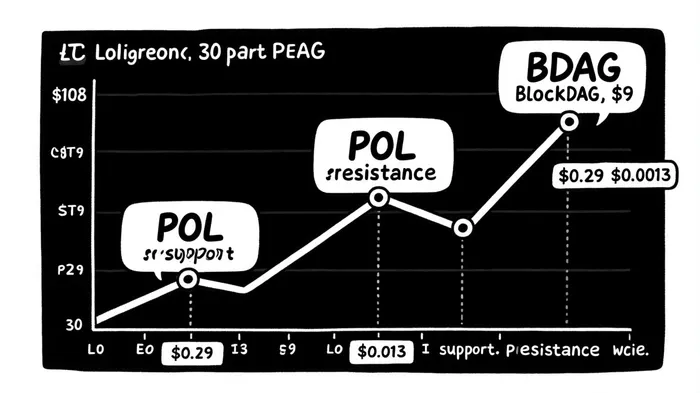
Polygon has demonstrated robust momentum, surging 14% in the past week to trade at $0.27, nearing its $0.29 resistance level [1]. The price action has formed a symmetrical triangle pattern, a classic technical formation that often signals a continuation of the prevailing trend upon a breakout. Crucially, daily trading volume has spiked to $705 million, and open interest has surpassed $169 million, validating the strength of the upward move [1].
A successful breach of $0.29 could trigger a retest of the $0.35–$0.40 range, historically a key resistance cluster. However, failure to clear $0.29 may result in a consolidation phase, with support at $0.25 acting as a critical level to watch [2]. Given the project's role in Ethereum's Layer 2 ecosystem and its recent partnerships, a breakout could attract institutional inflows, further amplifying its upside potential.
BlockDAG (BDAG): Presale Momentum and Infrastructure Development
BlockDAG has captured global attention with its $403 million presale, having sold 26.1 billion tokens at $0.0013 each [1]. The project's launch price is set at $0.05, implying a 38-fold upside from current presale levels—a stark contrast to its post-launch trajectory. This presale progress, coupled with the global shipment of X Series miners (including 2,000 X10 units weekly), underscores a strong foundation for network decentralization and hash rate growth [1].
The X1 mobile mining app, with 3 million users, further enhances BDAG's accessibility and adoption potential. While the coin is not yet tradable, the infrastructure developments suggest a high likelihood of post-launch volatility, with early buyers positioned to capitalize on the anticipated price surge.
Strategic Entry Points and Risk Mitigation
For Litecoin, a strategic entry could be initiated near the $108–$109 range, with a stop-loss below $107.24 to mitigate downside risk. Polygon's $0.27–$0.28 zone offers a high-probability entry ahead of its $0.29 resistance, while BlockDAG's presale phase presents a unique opportunity for investors willing to tolerate pre-launch illiquidity.
Conclusion
The interplay of technical resilience, volume dynamics, and project-specific catalysts positions Litecoin, Polygon, and BlockDAG as compelling candidates for breakout scenarios. While Litecoin's support level and Polygon's pattern breakout require immediate attention, BlockDAG's presale momentum offers a long-term speculative edge. Investors should balance these opportunities with risk management strategies, particularly in volatile markets.






Comentarios
Aún no hay comentarios