
Navigating the AI and Semiconductor Trade War: Opportunities in a Post-Nvidia World
The global AI and semiconductor landscape is undergoing a seismic shift, driven by geopolitical tensions, regulatory realignments, and the relentless march of technological innovation. As U.S. export controls and Chinese self-reliance initiatives collide, investors must navigate a complex web of risks and opportunities. This analysis examines the rise of Chinese chipmakers like Huawei, Cambricon, and SMIC, contrasts their progress with U.S. regulatory actions, and evaluates the investment implications of shifting dynamics in AI and semiconductors-particularly in light of Fed policy uncertainty and media sector consolidation.
The Chinese Semiconductor Renaissance: Progress and Constraints
China's push for AI self-reliance under the Made in China 2025 initiative has yielded notable advancements, even as U.S. export controls continue to stifle access to critical technologies. Huawei, the most prominent player, has developed the Ascend 910B and 910C AI chips, which, while lagging behind Nvidia's H20 and H100 in memory bandwidth and computational performance, have enabled the company to deploy systems like the CloudMatrix 384-a system that outperforms Nvidia's GB200 NVL72 in compute power and memory bandwidth at higher costs and energy consumption.
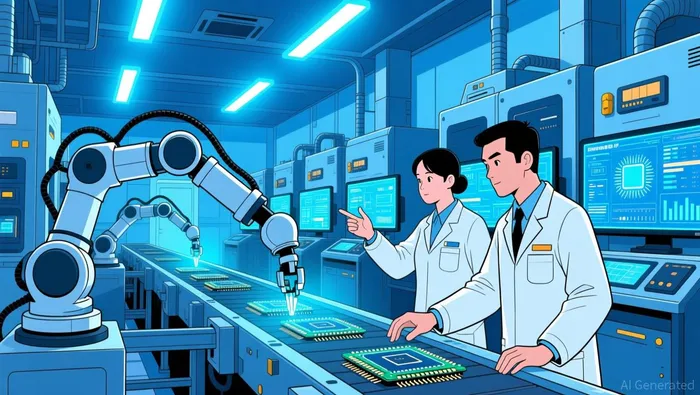 Cambricon's Siyuan series and SMIC's 7nm production challenges highlight the uneven progress of China's semiconductor ecosystem. While SMIC struggles with U.S.-led restrictions on EUV lithography equipment, Cambricon has carved a niche in cloud service providers, albeit with a smaller market share compared to Huawei. Meanwhile, Alibaba and Baidu are investing in their own AI accelerators, such as the T-Head PPU and Kunlun chips, according to industry analysis.
However, China's ambitions face persistent hurdles. U.S. export controls on HBM and EDA tools remain critical bottlenecks for high-performance AI accelerators, and domestic software ecosystems like CUDA still lag behind in maturity. As a result, Chinese cloud providers like Tencent and Baidu continue to prefer foreign chips despite resorting to black markets and smuggling to acquire them as reports indicate.
U.S. Regulatory Actions and Nvidia's Market Test
The U.S. regulatory landscape has been in flux in 2025, with President Donald Trump's approval of Nvidia H200 sales to China marking a pivotal shift. This decision, which includes a 25% revenue share, to the U.S. government, contrasts sharply with Biden-era restrictions that barred H200 and higher-end chips from entering China. While the move aims to balance national security with economic interests, it has sparked bipartisan criticism. The proposed SAFE Act seeks to codify stricter controls on advanced AI chips, reflecting deepening concerns about China's access to cutting-edge technology.
For NvidiaNVDA--, the H200 approval could recover $2–$5 billion in annual revenue, as China historically accounted for 20–25% of its data-center sales. However, risks persist. China's domestic push for self-reliance, coupled with political pushback from U.S. lawmakers, could erode long-term demand for U.S. chips. The Trump administration's decision also underscores the broader tightening of export controls under Biden, including the addition of Chinese entities to the Entity List and restrictions on semiconductor manufacturing equipment according to industry reports.
Fed Policy Uncertainty and the AI Investment Equation
The Federal Reserve's policy uncertainty in 2025 has introduced volatility into semiconductor and AI investments. With markets anticipating a rate cut in December 2025, investor sentiment is cautiously optimistic. Lower borrowing costs could spur capital-intensive sectors like semiconductors, where firms must commit vast resources years before demand materializes. However, the interplay of Moore's Law and Rock's Law-which dictates that the cost of building new fabrication plants doubles every four years-creates a high-stakes environment.
This uncertainty is compounded by the media sector's transformation. Netflix's proposed $72 billion acquisition of Warner Bros. Discovery (WBD) exemplifies a strategic shift toward content consolidation. The merger, if approved, would create a media giant with access to iconic IP like Harry Potter and DC Comics. Crucially, it would also amplify demand for AI chips, as content production increasingly relies on digital workflows, virtual production, and AI-assisted editing. For instance, LED volume stages and Unreal Engine environments require significant computational power, driving growth in AI chip demand.
Investment Implications: A Post-Nvidia World
The convergence of geopolitical risk, regulatory realignment, and sectoral shifts presents both challenges and opportunities for investors.
Chinese Semiconductor Exposure: While Huawei and Cambricon are making strides, their reliance on domestic ecosystems and unresolved bottlenecks (e.g., HBM, EDA tools) suggest a long-term, rather than immediate, replacement of U.S. capabilities. Investors should prioritize companies with strong government backing and vertical integration, such as SMIC, which remains critical to China's chip production despite its 7nm limitations as analysis shows.
U.S. Semiconductor Stocks: Nvidia's H200 approval offers short-term revenue recovery but introduces political risk. Investors must weigh the company's near-term gains against the likelihood of stricter export controls under the SAFE Act. Meanwhile, firms like Broadcom and AMD, which cater to AI infrastructure and custom chip development, may benefit from sustained demand in both U.S. and Chinese markets according to market analysis.
Media Sector Synergies: The Netflix-WBD merger underscores the growing intersection of AI and content production. Investors should monitor AI-driven workflows in media, as they could drive demand for chips optimized for real-time rendering and data processing.
Fed Policy Sensitivity: A December 2025 rate cut could alleviate financing costs for semiconductor projects, but investors must remain cautious about macroeconomic headwinds. The sector's capital intensity makes it particularly sensitive to interest rate fluctuations as economic analysis shows.
Conclusion
The AI and semiconductor trade war is far from a binary conflict between U.S. and Chinese players. Instead, it is a dynamic arena shaped by regulatory pivots, technological innovation, and macroeconomic forces. While Chinese chipmakers are closing the gap, U.S. firms retain critical advantages in software ecosystems and advanced manufacturing. For investors, the key lies in hedging against geopolitical risks while capitalizing on sectoral realignments-whether through exposure to China's self-reliance drive, U.S. semiconductor resilience, or the AI-driven media revolution. In a post-Nvidia world, adaptability will be the ultimate competitive advantage.





Comentarios
Aún no hay comentarios