
Navigating the AI Industrial Bubble: Investment Timing and Sector Positioning in 2025
The artificial intelligence sector in 2025 is a double-edged sword: a goldmine of transformative potential and a minefield of speculative excess. Valuation metrics tell a story of exuberance, with Generative AI platforms trading at a median of 45x revenue and AI Infrastructure at 32x, while Healthcare AI and Fintech AI command 28x and 15x, respectively, according to an Aventis Advisors report. These premiums reflect investor optimism about AI's scalability but also raise red flags about overvaluation. The question for investors is no longer if to enter the AI space, but how to navigate the industrial bubble while capitalizing on its long-term societal and economic impact.
The Bubble in Context: Dot-Com Parallels and Infrastructure Overbuild
The AI boom of 2025 mirrors the dot-com era in its speculative fervor and infrastructure overinvestment. Just as fiber-optic networks were overbuilt in the late 1990s, today's AI sector is seeing a rush to construct data centers and computational infrastructure. Projects like Meta's Manhattan-sized data center and the $500 billion Stargate Project illustrate this trend, according to a Fortune analysis. Jeff Bezos, sounding a familiar alarm, has labeled the AI sector an "industrial bubble," noting that while many ventures will collapse, the survivors could reshape industries, in an Invezz interview.
Yet, unlike the dot-com era, today's AI firms are generating revenue. Microsoft's Azure cloud service, for instance, reported a 39% year-over-year growth to an $86 billion run rate, as noted in the Fortune analysis. However, that same piece cites a recent MIT study revealing that 95% of AI pilot projects fail to deliver meaningful results, underscoring the gap between hype and execution. Investors must distinguish between companies with scalable business models and those chasing vaporware.
Societal Impact: Job Displacement vs. Productivity Gains
The societal implications of AI are equally complex. While automation threatens routine jobs-3,900 U.S. job losses were directly attributed to AI in May 2023, according to a Vibecentral report-it also creates high-skill roles in algorithm development and data analysis, with median salaries hitting $156,998 in Q1 2025. Sectors like healthcare and education are seeing a 50-60% increase in AI-driven job creation, but the transition is uneven. Goldman Sachs estimates AI could displace 6-7% of the U.S. workforce, though historical patterns suggest this will be offset by new roles over time.
The challenge lies in addressing the AI skills gap, where 84% of companies report difficulties in workforce adaptation, as noted in the Vibecentral report. Proactive reskilling programs and ethical AI deployment will be critical to mitigating social backlash and ensuring long-term productivity gains.
Sustainability and Regulation: The New Frontier
AI's role in sustainability is reshaping investment logic. In energy, AI optimizes grid efficiency and reduces consumption by up to 60% in certain applications, according to a Microsoft blog post. Microsoft's One Digital Grid Platform and energy-efficient data center cooling technologies are prime examples. Regulatory frameworks like the EU's AI Act and the AI Continent Action Plan are pushing for ethical AI deployment, transparency, and energy efficiency, as outlined in an Eversheds-Sutherland update. These regulations not only mitigate risks but also create opportunities for firms aligning with ESG goals.
In Asia, Hong Kong's generative AI use checklist and the EU's simplified SFDR categorization for sustainable funds are tightening the rules around greenwashing, a trend highlighted in the Eversheds-Sutherland update. Investors must now prioritize companies that integrate AI into circular economy models and ESG reporting, as these will dominate the post-regulation landscape.
Investment Timing and Sector Positioning
For timing, later-stage companies with proven ROI are the sweet spot. Series C+ rounds averaged $158M in 2025, reflecting capital's shift toward de-risked ventures, per the Aventis Advisors report. Generative AI and LLMs dominate funding (26% of total AI investment), but sectors like Healthcare AI and AI Infrastructure offer more balanced fundamentals. Healthcare AI's 28x revenue multiple is justified by tangible clinical outcomes, while AI Infrastructure's 32x multiple is supported by the sector's 40% growth rate.
Sector positioning should also consider consolidation trends. Private equity and strategic acquirers are aggressively targeting niche players in logistics, energy, and healthcare, creating opportunities for investors to capitalize on efficiency-driven M&A. Sustainability-linked AI firms, particularly those leveraging predictive analytics for climate modeling, are also well-positioned as regulatory tailwinds strengthen.
Conclusion: Balancing Bubble Risks with Long-Term Gains
The AI industrial bubble is real, but its collapse will likely leave behind a transformed economy. Investors who focus on sectors with strong fundamentals-Healthcare AI, AI Infrastructure, and sustainability-driven innovation-can ride the wave without getting burned. As Bezos noted in the Invezz interview, industrial bubbles leave behind "transformative innovations," and the winners will be those who bet on AI's ability to solve real-world problems, not just chase valuations.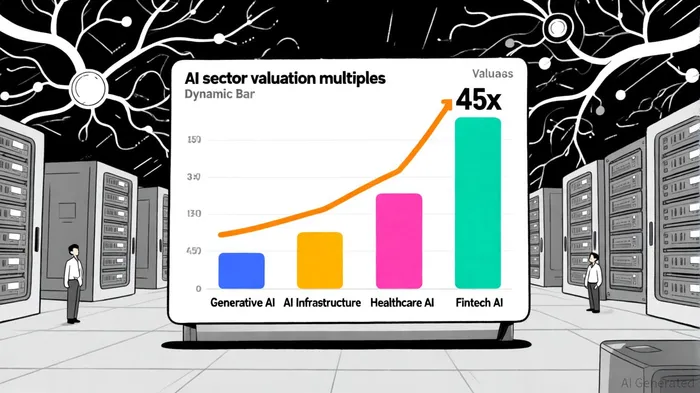





Comentarios
Aún no hay comentarios