
Navigating the AI Crossroads: Nvidia and AMD's 15% Revenue-Sharing Deal and the Future of U.S.-China Tech Dynamics
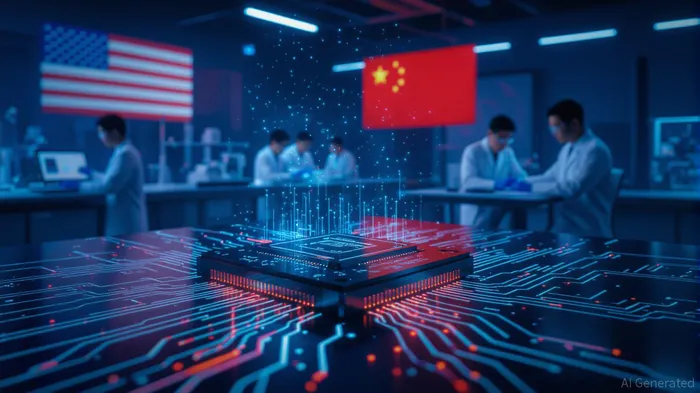
The 2025 revenue-sharing agreement between NvidiaNVDA--, AMDAMD--, and the U.S. government has ignited a firestorm of debate among investors, policymakers, and technologists. At its core, the deal allows these semiconductor giants to resume selling AI chips to China—specifically Nvidia's H20 and AMD's MI308—while ceding 15% of their China-derived revenues to the U.S. Treasury. For investors, this arrangement represents a high-stakes gamble at the intersection of geopolitics, technological competition, and corporate strategy.
Strategic Value: A Calculated Move in the AI Arms Race
The U.S. government's decision to monetize access to China's AI market reflects a broader strategy to maintain dominance in artificial intelligence. By allowing limited chip exports, Washington aims to prevent China from fully decoupling from U.S. technology, which could accelerate Beijing's push for indigenous alternatives. Nvidia and AMD, in turn, gain access to a market projected to grow to $100 billion in AI spending by 2025, a critical revenue stream for companies already grappling with Biden-era export restrictions.
For investors, the deal's strategic value lies in its potential to stabilize long-term growth for these firms. Nvidia, for instance, could generate $23 billion in China AI chip sales annually, with the U.S. government receiving $3.5 billion in return. This revenue-sharing model effectively subsidizes U.S. technological leadership while keeping Chinese competitors at bay. However, the arrangement's sustainability hinges on whether it can deter China from investing heavily in domestic chip development—a risk that remains unaddressed.
Risk-Reward Dynamics: Constitutional Quandaries and Market Volatility
Critics argue the 15% fee resembles an unconstitutional export tax, a violation of the U.S. Constitution's export clause. Legal challenges could force the government to renegotiate or abandon the deal, creating regulatory uncertainty for investors. Additionally, the precedent of monetizing export controls risks normalizing a “pay-to-play” system, where access to strategic markets becomes contingent on financial concessions.
From a market perspective, the deal's impact on stock valuations is mixed. While the resumption of China sales could boost short-term earnings, the 15% cut reduces profit margins. reveals a 20% surge post-deal announcement, but this optimism may wane if geopolitical tensions escalate or if the U.S. government faces backlash from Congress. AMD, which has yet to disclose detailed financial projections, may see similar volatility.
U.S.-China Tech Decoupling: A Double-Edged Sword
The agreement underscores the fragility of U.S.-China tech relations. While it delays full decoupling, it also highlights the U.S. government's willingness to leverage export controls as a financial tool—a departure from traditional security-focused policies. For investors, this duality creates a paradox: the U.S. seeks to preserve its AI edge by retaining market access, yet the same policies could erode trust in American technology if perceived as transactional.
China's response further complicates the landscape. Despite U.S. assurances, Beijing has raised concerns about potential security vulnerabilities in the H20 chip, a claim Nvidia has denied. If China shifts toward domestic alternatives like Huawei's chips, the long-term value of the U.S. deal could diminish. suggests a 15% CAGR, but this growth may not materialize if U.S. chips are excluded.
Investment Advice: Balancing Optimism and Caution
For investors, the key is to assess the deal's durability. The 15% revenue-sharing model is a novel experiment, and its success depends on three factors:
1. Geopolitical Stability: A shift in U.S. administrations or a deterioration in U.S.-China relations could terminate the agreement.
2. Technological Competition: If China's AI capabilities outpace U.S. offerings, demand for American chips may wane.
3. Legal Scrutiny: Constitutional challenges could force a reevaluation of the deal's structure.
A diversified approach is prudent. Investors should consider hedging against sector-specific risks by allocating to AI infrastructure (e.g., cloud providers) or alternative semiconductors. For Nvidia and AMD, the deal offers near-term tailwinds but carries long-term uncertainties. Those with a high-risk tolerance may capitalize on the AI boom, while conservative investors should monitor regulatory developments closely.
Conclusion: A Precipice of Innovation and Conflict
Nvidia and AMD's 15% revenue-sharing deal is a microcosm of the broader U.S.-China tech rivalry. It reflects the U.S. government's desperation to retain AI leadership while acknowledging the economic realities of a globalized market. For investors, the deal presents a compelling but precarious opportunity—one that demands a nuanced understanding of both technological progress and geopolitical chess. As the AI race intensifies, the true value of this arrangement will be measured not in quarterly earnings, but in the long-term balance of power between two technological titans.





Comentarios
Aún no hay comentarios