
Navigating the Abyss: Risk Management in the Wake of Fartcoin's 28% Plunge Amid Bearish Crypto Sentiment
The Fartcoin Collapse: A Case Study in Sentiment-Driven Volatility
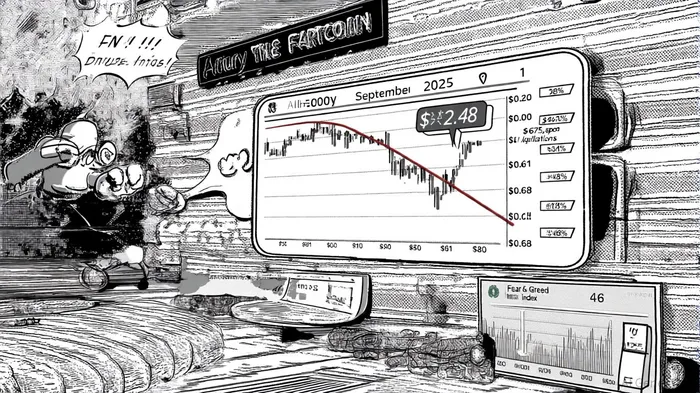
Fartcoin, the flatulence-themed SolanaSOL-- memeMEME-- coin, has plummeted 28% in a week, trading below $0.61 as of September 2025—a stark contrast to its January 2025 peak of $2.48 [1]. This collapse reflects broader bearish trends in the meme coin sector, where tokens like Pudgy Penguins' PENGU and Pump.fun's PUMP have also faltered [1]. The decline is not merely technical but deeply rooted in sentiment shifts. The Fear & Greed Index, a barometer of market psychology, sits at 46 (Fear), with 74% of analysts predicting further downward movement [1].
Technical indicators corroborate this pessimism. The Moving Average Convergence Divergence (MACD) has entered a bearish crossover, while the Chaikin Money Flow (CMF) signals outflows, suggesting capitulation among holders [3]. A $675,000 spot sell-off and $44 million in liquidations in late August 2025 acted as catalysts, accelerating the downtrend [6]. These events underscore the fragility of meme coins, which thrive on retail hype but crumble under liquidity pressure.
Sentiment as a Double-Edged Sword
Fartcoin's price has historically mirrored its social media mindshare. Data from cookie.fun reveals a direct correlation between viral engagement and price action: a May 2025 spike in sentiment drove the token to $0.000045, while waning interest saw it retreat to $0.000032 within days [2]. This pattern aligns with academic research on cryptocurrency volatility, which demonstrates that fear-driven sentiment amplifies price swings, particularly in speculative assets [4].
However, sentiment-driven corrections are not unique to Fartcoin. A Cryptocurrency Fear Sentiment Index (CFSI), derived from Google Trends data, shows that global crises—such as the Russia-Ukraine war and the pandemic—have historically exacerbated volatility in BitcoinBTC-- and EthereumETH-- [4]. For meme coins, which lack intrinsic value, sentiment is both a lifeline and a liability.
Risk Management in a Meme Coin Meltdown
The Fartcoin sagaSAGA-- highlights the critical need for disciplined risk management in volatile crypto markets. Three strategies stand out:
Position Sizing and Diversification: The “1% rule” advises limiting exposure to any single asset to 1% of a portfolio, mitigating the impact of sudden drops like Fartcoin's 28% collapse [5]. Diversification across sectors (e.g., layer-1s, blue-chip altcoins) and geographies further reduces risk [6].
Stop-Loss and Take-Profit Orders: Automated exits prevent emotional overexposure. For Fartcoin, a stop-loss below $0.70 in late August could have limited losses, while a take-profit at $1.00 in March 2025 would have locked in gains during its earlier rally [7].
Sentiment Monitoring: Tools like the Fear & Greed Index and on-chain analytics (e.g., liquidation data) provide early warnings of capitulation or euphoria. Fartcoin's October 2025 price target of $0.464393 (-25.26%) hinges on sustained bearish sentiment [4].
The Long Game: Can Fartcoin Bounce Back?
While short-term forecasts are grim, some analysts argue Fartcoin's cultural saturation—its status as a mainstream meme brand—could buffer it against traditional corrections [4]. However, this depends on Solana's broader momentum and a resurgence in meme coin hype. CoinCodex predicts a potential uptrend by 2027, albeit at levels far below its peak [4]. For now, though, Fartcoin remains a cautionary tale of speculative excess.
Conclusion
Fartcoin's 28% drop is a microcosm of crypto's volatility, driven by sentiment shifts and technical breakdowns. For investors, the lesson is clear: meme coins demand rigorous risk management. Position sizing, sentiment analysis, and disciplined exits are not optional—they are survival tools in a market where euphoria and panic alternate with clockwork precision. As the Fear & Greed Index lingers in fear territory, the question is not whether Fartcoin will rebound, but whether investors are prepared for the next plunge.






Comentarios
Aún no hay comentarios