
Navigating the S&P 500's Volatility: A Strategic Guide for Investors in Uncertain Times
The S&P 500's recent volatility, marked by a 2.5% three-day decline in late November 2025 and a further drop in late December, underscores the growing challenges investors face in an environment of macroeconomic uncertainty and geopolitical turbulence according to market analysis. As inflationary pressures persist, interest rate expectations shift, and global tensions escalate, the need for a disciplined, defensive approach to portfolio management has never been more critical. This analysis explores how investors can strategically rebalance their holdings to prioritize resilience and capitalize on sector rotation opportunities amid these headwinds.
The Drivers of Recent Market Volatility
The S&P 500's decline in late 2025 was fueled by a confluence of factors. A delayed U.S. jobs report revealed a 4.6% unemployment rate and a loss of 105,000 payrolls in October, reigniting fears of a hawkish Federal Reserve response. Simultaneously, November inflation data exceeded expectations, compounding concerns about prolonged high interest rates. These macroeconomic signals were amplified by sector-specific developments: key artificial intelligence (AI) stocks, including BroadcomAVGO-- and OracleORCL--, suffered steep declines due to profit-taking and weak quarterly results.
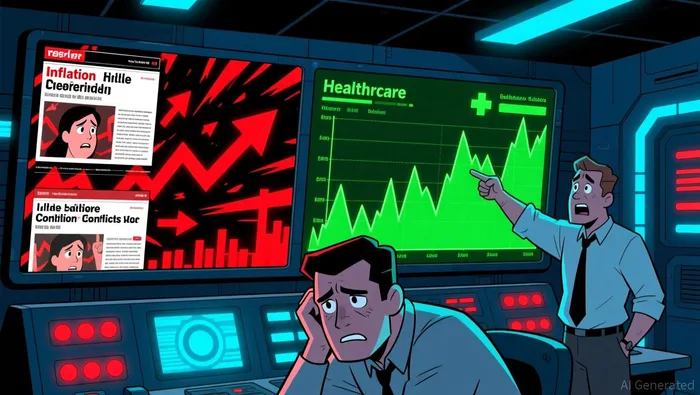
Geopolitical risks further exacerbated market jitters. Escalating U.S.-China competition over AI and strategic dependencies, coupled with ongoing conflicts in the Middle East and Eastern Europe, heightened uncertainty about energy security and global trade dynamics. Meanwhile, U.S. trade policies-such as sweeping tariffs on imports-introduced inflationary pressures and disrupted supply chains, compounding the challenges for export-driven economies.
Defensive Sectors Outperform Amid Deteriorating Conditions
Amid this backdrop, defensive sectors demonstrated relative resilience. The S&P 500 Health Care Sector, for instance, surged 9.14% in November 2025, as investors sought stability in essential services. Similarly, utilities and consumer staples held up better than the broader market, reflecting their low sensitivity to interest rate fluctuations and economic cycles according to market analysis. In contrast, technology and energy sectors faced significant headwinds. Technology stocks, particularly those tied to AI, saw sharp declines as higher discount rates eroded valuations tied to long-term earnings projections. Energy stocks also struggled, with softening oil prices and oversupply concerns dragging down performance.
This divergence highlights a critical lesson for investors: in rising rate environments and periods of geopolitical uncertainty, defensive positioning becomes paramount. Sectors with predictable cash flows and low volatility-such as healthcare and utilities-are better equipped to weather market stress than growth-oriented or cyclical industries.
Strategic Rebalancing: A Sector Rotation Framework
Given these dynamics, a strategic rebalancing toward defensive sectors and a tactical rotation into "real economy" sectors like industrials and financials could enhance portfolio resilience. Here's how investors might approach this:
- Prioritize Defensive Sectors: Allocate a larger portion of equity exposure to healthcare, utilities, and consumer staples. These sectors historically outperform during market downturns and offer downside protection according to market analysis. For example, healthcare's 9.14% gain in November 2025 illustrates its ability to deliver stability even as growth stocks falter.
Rotate into Real Economy Sectors: While defensive sectors provide safety, industrials, financials, and materials offer exposure to economic recovery and inflation-linked demand according to market research. These sectors tend to benefit from infrastructure spending, rising commodity prices, and a normalization of interest rates. However, investors should monitor geopolitical risks-such as energy disruptions in the Middle East-that could temporarily derail performance according to market analysis.
Reassess Growth Stock Exposure: Growth stocks, particularly in AI and technology, remain vulnerable to valuation corrections. While innovation in these fields is undeniable, their performance is highly sensitive to interest rate expectations and earnings revisions according to market analysis. Investors should consider trimming overvalued positions and reinvesting proceeds into more resilient sectors.
- Hedge Against Geopolitical Risks: Diversify across regions and asset classes to mitigate exposure to trade wars, cyber threats, and nationalism-driven deglobalization according to research. Gold, Treasury bonds, and defensive equities can serve as hedges against sudden market shocks.
Conclusion: Adapting to a New Normal
The S&P 500's volatility in late 2025 serves as a stark reminder of the importance of adaptability in portfolio management. As inflation, interest rates, and geopolitical tensions continue to shape market conditions, investors must prioritize defensive positioning and sector rotation to navigate uncertainty. By shifting toward resilient sectors and maintaining a disciplined approach to risk, investors can not only protect capital but also position themselves to capitalize on emerging opportunities in a rapidly evolving landscape.





Comentarios
Aún no hay comentarios