
Navigating the S&P 500's Correction: Tactical Entry Points in a Volatile Market
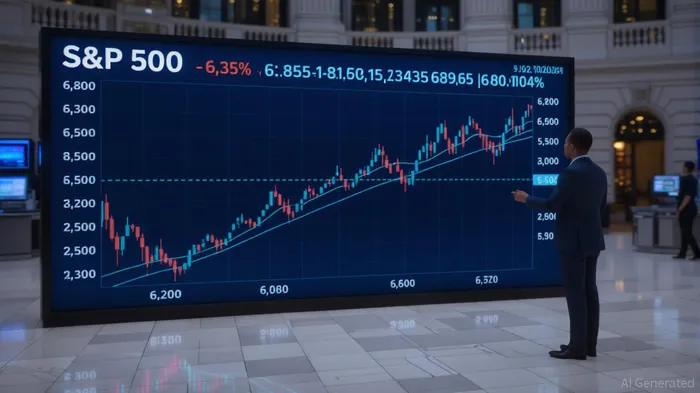
The S&P 500's recent 0.21% decline from its 52-week high of 6,480.28 has reignited debates about market volatility and the potential for tactical entry points. While the pullback appears modest compared to historical corrections—such as the 34% drop in 2020 or the 56% collapse in 2008—it has nonetheless triggered a recalibration of investor sentiment. For those attuned to market cycles, this correction may represent a strategic opportunity to reassess positioning in a profit-taking-driven environment.
The Anatomy of the Pullback
The S&P 500's decline in August 2025, though shallow, has been swift and technically significant. The index closed at 6,468.54 on August 14, 2025, after a 2% drop on August 1, breaking a 32-trading-day streak without a 1% decline. This move dragged the index below its 20-day moving average, a critical technical level that had previously acted as dynamic support. The pullback aligns with historical seasonal patterns: August and September have averaged a 3.8% loss for the S&P 500 over the past 35 years, with the VIX volatility index typically surging by 8.4% during this period.
The correction has been driven by a confluence of factors:
1. Macroeconomic Headwinds: A weaker-than-expected July jobs report, downward revisions to prior employment data, and the looming implementation of new tariffs (e.g., elevated rates on goods from India and Southeast Asia) have heightened uncertainty.
2. Valuation Concerns: The Magnificent Seven tech stocks, which have driven much of the S&P 500's gains, now trade at valuations far above historical averages. Earnings growth, while robust (projected to exceed 10% year-over-year), may struggle to justify current multiples in a slowing economy.
3. Policy Uncertainty: The Federal Reserve's mixed signals on rate cuts and the potential for further tariff-driven inflation have created a fog of uncertainty.
Sector Rotations and Tactical Opportunities
The correction has exposed divergent sector performances, offering clues for tactical positioning:
- Technology and AI-Driven Sectors: Despite the broader pullback, the Magnificent Seven remain resilient, with capex expectations for 2025 exceeding $375 billion. However, their dominance has left the S&P 500 heavily skewed toward growth stocks, creating an overhang for value sectors.
- Value and Cyclical Sectors: Energy, industrials, and financials have underperformed, reflecting concerns about slowing global demand and tighter monetary policy. These sectors may offer attractive entry points if the correction proves to be an overreaction.
- Defensive Sectors: Utilities and consumer staples have held up better, suggesting a flight to quality amid volatility.
Is This a Durable Trend or an Overcorrection?
The key question for investors is whether the correction reflects a durable trend shift or a temporary overcorrection. Historical data suggests the latter:
- Historical Resilience: The S&P 500 has averaged a 24% return within 24 months of a correction's bottom. Even the 2022 bear market (-33.8%) was followed by a 26.3% rebound in 2023.
- Fundamental Tailwinds: Earnings growth remains strong, particularly in AI-driven industries. The S&P 500's 18.58% one-year return as of August 2025 indicates a market still in a long-term uptrend.
- Valuation Metrics: While the S&P 500's forward P/E ratio is elevated, it remains below the levels seen during the dot-com bubble (2000) or the 2020 pandemic peak.
However, risks persist. A stagflationary scenario—high inflation coupled with slowing growth—could prolong the correction. The implementation of new tariffs and the Federal Reserve's policy path will be critical in determining the market's trajectory.
Actionable Guidance for Investors
- Dollar-Cost Averaging into Corrections: For long-term investors, the current pullback offers an opportunity to accumulate quality assets at discounted prices. Focus on sectors with strong fundamentals, such as AI-driven tech or undervalued value stocks.
- Hedging Against Volatility: Use options strategies (e.g., protective puts or iron condors) to mitigate downside risk while maintaining exposure to growth sectors.
- Rebalancing Portfolios: Shift allocations toward defensive sectors (e.g., utilities, healthcare) and reduce overexposure to stretched growth stocks.
- Monitoring Key Indicators: Watch the 6,200 support level for the S&P 500 and the VIX for signs of stabilizing volatility. A break below 6,200 could trigger further selling, while a rebound above the 20-day moving average would signal a resumption of the uptrend.
Conclusion
The S&P 500's recent correction, while unsettling, is a familiar chapter in the market's cyclical narrative. For investors with a long-term horizon, this pullback may represent a tactical entry point to capitalize on discounted valuations and sector rotations. However, caution is warranted: the path forward will depend on macroeconomic clarity, policy decisions, and the resilience of corporate earnings. By staying disciplined and diversified, investors can navigate near-term uncertainty while positioning for the next phase of the market cycle.






Comentarios
Aún no hay comentarios