
Navigating the 2026 Medicare Part B Premium Surge: Strategic Adjustments for Retiree Investment Portfolios
The 2026 Medicare Part B premium increase, officially announced by the Centers for Medicare & Medicaid Services (CMS) on November 14, 2025, marks a pivotal moment for retirees. The standard monthly premium will rise to $202.90-a 9.7% increase from $185.00 in 2025 according to CMS-and the annual deductible will climb to $283, a $26 jump as reported by Medicare Rights. This surge, coupled with income-related adjustments for high earners, underscores the growing financial strain on retirees, particularly those relying on fixed incomes. For context, the 2026 cost-of-living adjustment (COLA) adds approximately $56 to the average Social Security benefit, yet the Part B premium increase alone will consume nearly one-third of this increase.
The Financial Pressure on Retirees
The 2026 changes are not an isolated event but part of a broader trend of accelerating healthcare inflation. According to a report by the Retirement Systems of America, healthcare costs for retirees have historically outpaced general inflation by 2-3 percentage points annually. The 2026 premium hike, combined with a 10% increase in the Part B deductible, exacerbates this pressure. For retirees on modest incomes, these costs could erode savings or force difficult trade-offs between healthcare and other essential expenses.
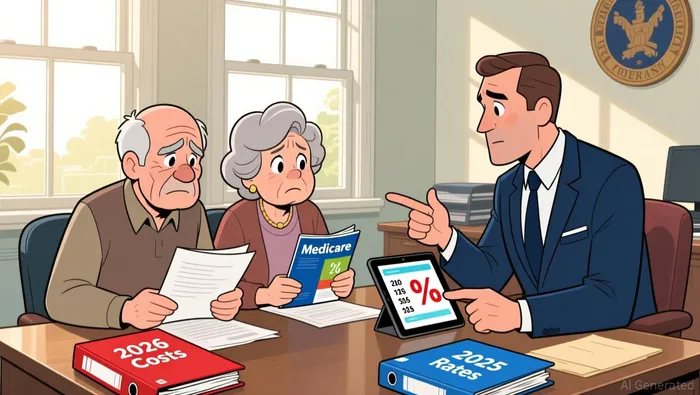 High-income beneficiaries face an additional burden through the Income-Related Monthly Adjustment Amount (IRMAA). For example, couples earning between $342,001 and $410,000 in 2024 will pay an extra $527.50 monthly for Part B and $60.40 for Part D in 2026 according to Nationwide Financial. This highlights the need for retirees to proactively manage their income streams to avoid inadvertently triggering higher premiums.
Strategic Investment Adjustments
To mitigate the impact of rising Medicare costs, retirees must adopt a dual focus: optimizing income streams and adjusting investment portfolios to hedge against healthcare inflation.
1. Tax-Efficient Withdrawal Strategies
A cornerstone of long-term financial planning is coordinating withdrawals from taxable, tax-deferred, and Roth accounts to minimize tax liabilities. For instance, partial Roth conversions executed during years of lower taxable income can reduce future Required Minimum Distributions (RMDs) and lower the risk of IRMAA surcharges. By converting traditional IRA funds to Roth accounts early in retirement, retirees lock in favorable tax rates and create a tax-free income source to offset rising premiums.
Tax-loss harvesting is another critical tool. Selling investments at a loss to offset capital gains can reduce taxable income in years when larger distributions are necessary. This strategy not only lowers the immediate tax burden but also preserves more income for healthcare expenses. Financial advisors increasingly recommend AI-driven platforms to model future RMDs and tax brackets, enabling personalized withdrawal plans as noted in Mezzi's analysis.
2. Portfolio Reallocation for Healthcare Inflation
Retirees should adjust their asset allocations to account for the projected 5-6% annual healthcare inflation over the next decade. During market downturns, shifting toward cash and bonds can reduce the need to sell equities at a loss to meet RMDs. Conversely, during market upturns, taking RMDs earlier in the year allows retirees to lock in gains and minimize the number of shares sold to meet withdrawal requirements as recommended by Kiplinger.
For example, a retiree with a $500,000 portfolio might allocate 30% to short-term bonds and 20% to dividend-paying equities to generate stable income while preserving capital. This approach balances growth potential with liquidity, ensuring sufficient funds to cover Medicare premiums and other healthcare costs.
3. Income Stream Optimization
Retirees must also evaluate their Medicare coverage during the open enrollment period (October 15 to December 7, 2025) to explore alternatives such as Original Medicare with Medigap or Medicare Advantage plans as advised by Mercer Advisors. For those with employer-sponsored retiree health plans, reviewing cost-sharing structures and out-of-pocket maximums can reveal opportunities to reduce expenses.
Additionally, retirees should consider Qualified Charitable Distributions (QCDs) to satisfy RMDs while supporting charitable causes. This strategy not only reduces taxable income but also avoids pushing retirees into higher tax brackets or IRMAA tiers.
Conclusion
The 2026 Medicare Part B premium surge demands a proactive, strategic approach to retirement planning. By integrating tax-efficient withdrawal methods, portfolio reallocation, and income stream optimization, retirees can hedge against healthcare inflation and preserve their financial security. As CMS projects continued premium increases over the next decade, the urgency to act is clear. Retirees who adapt now will be better positioned to navigate the evolving healthcare cost landscape without compromising their quality of life.







Comentarios
Aún no hay comentarios