
Navigating the 2025 Government Shutdown Risk: Sector Hedges and Strategic Reallocation
The U.S. government shutdown looms as a persistent shadow over markets in 2025, with partisan gridlock over funding legislation creating a 54-55% probability of a shutdown before year-end, per prediction markets like Polymarket and Kalshi[1]. House Speaker Mike Johnson's refusal to reverse Medicaid cuts and Affordable Care Act subsidies, coupled with Senate Minority Leader Chuck Schumer's warnings of bipartisan failure, underscores the fragility of negotiations[1]. While Congress has until September 30 to pass a full-year appropriations bill or a short-term continuing resolution (CR), the proposed Republican CR—a stopgap measure extending current funding through November 21—fails to address Democratic priorities, heightening the risk of a shutdown.
Sector-Specific Vulnerabilities and Opportunities
Historical precedents reveal stark sectoral divergences during government shutdowns. Defense and aerospace861008-- industries, reliant on federal contracts, typically face immediate headwinds. During the 35-day 2018–2019 shutdown, companies like Lockheed MartinLMT-- and BoeingBA-- saw delayed payments and project approvals, eroding investor confidence[2]. Similarly, healthcare providers face mixed impacts: while Medicare operations continue, administrative slowdowns and Medicaid funding disputes can dampen sentiment[2]. Consumer discretionary sectors, dependent on government employee spending, often contract, with retail and hospitality stocks underperforming[2].
Conversely, defensive sectors and safe-haven assets tend to outperform. Gold, for instance, surged approximately 7% during the 2018–2019 shutdown, reflecting its role as a hedge against uncertainty[2]. Utilities and technology sectors, less tied to government funding, have historically demonstrated resilience. The S&P 500, though volatile during shutdowns, has historically rebounded within 12 months, suggesting a long-term recovery bias[2].
Strategic Hedging: Defensive Portfolios and ETFs
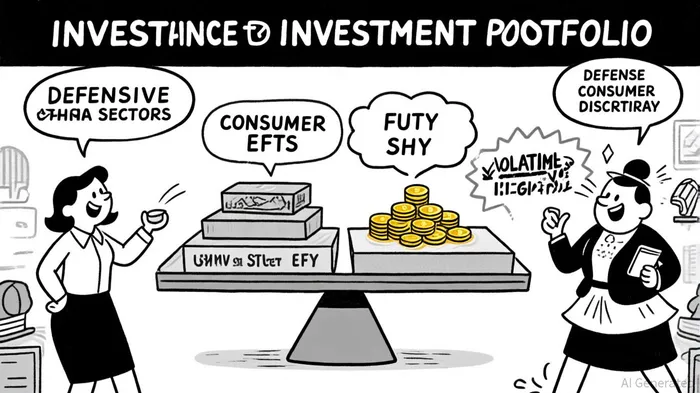
Investors navigating this environment should prioritize asset reallocation toward defensive strategies. Exchange-traded funds (ETFs) targeting low-volatility stocks, utilities, and high-quality bonds offer a structured approach. The iShares Edge MSCI Min Vol USA ETF (USMV), for example, focuses on low-beta stocks to mitigate bearish market risks[3]. Similarly, the Fidelity MSCI Utilities ETF (FUTY) capitalizes on the stable cash flows of utility companies, which historically outperform during economic stress[3].
For bond-based protection, the iShares 1-3 Year Treasury Bond ETF (SHY) provides liquidity and stability through short-term U.S. Treasurys, a traditional safe haven during political turmoil[3]. Defensive equity strategies, such as the Invesco S&P 500 High Div Low Vol ETF (SPHD), combine high dividend yields with low volatility by emphasizing healthcare and consumer staples[3]. The Vanguard Consumer Staples ETF (VDC), which includes essential goods giants like Procter & Gamble and CostcoCOST--, further diversifies risk across non-cyclical demand[3].
A practical example from the 2018 shutdown illustrates the efficacy of such strategies: a portfolio combining Procter & Gamble and Duke EnergyDUK-- delivered an 11.5% gain, outperforming the broader market[2]. This underscores the value of maintaining a disciplined, long-term approach rather than reacting impulsively to short-term volatility.





Comentarios
Aún no hay comentarios