
Naver's Strategic Alliances in E-commerce: Kurly, Lotte, and the Future of Fresh Food Delivery
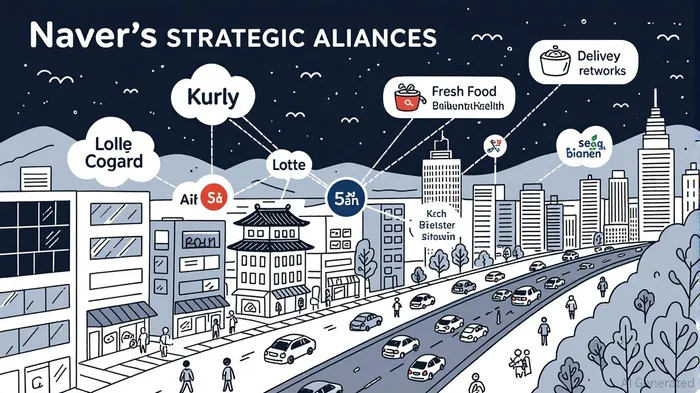
In South Korea’s fiercely competitive e-commerce landscape, Naver (NAVER, 035420.KS) has embarked on a bold strategy to dominate the high-growth fresh food delivery sector. By forging strategic alliances with Kurly and Lotte Group, Naver is leveraging its digital prowess to bridge gaps in logistics and offline retail, positioning itself to challenge Coupang’s dominance. This analysis evaluates the financial and operational implications of these partnerships, their alignment with market trends, and Naver’s potential to reshape Korea’s grocery ecosystem.
Strategic Alliances: Bridging Digital and Physical Retail
Naver’s collaboration with Kurly, a pioneer in early-morning fresh food delivery, has birthed KurlyN Mart, a joint venture that combines Kurly’s logistics expertise with Naver’s 40 million-strong user base and AI-driven personalization tools. This partnership directly targets Coupang’s Rocket Fresh service, which has long dominated the sector with its overnight delivery model. KurlyN Mart’s focus on curated fresh produce and same-day delivery aims to differentiate it in a market where 30% of online food sales are attributed to fresh groceries [2].
Simultaneously, Naver’s alliance with Lotte Group, Korea’s largest offline retailer, represents a broader push to integrate digital and physical retail. By embedding Naver’s AI technologies into Lotte’s 2,000+ stores and logistics network, the partnership seeks to create an “Agentic Enterprise” by 2030, where autonomous systems optimize inventory, marketing, and customer experiences [1]. Lotte’s offline presence complements Naver’s digital-first approach, particularly in fresh food delivery, where Naver historically lagged behind rivals.
Market Dynamics: A $4.26 Billion Opportunity by 2030
The South Korean fresh food delivery market is projected to grow at a 6.15% CAGR from 2025 to 2030, reaching $4.26 billion by 2030 [2]. This growth is fueled by urbanization, smartphone penetration (98% in 2025), and advancements in cold-chain logistics. For context, 70% of households now have access to same-day delivery, supported by over 100 automated fulfillment centers [3].
Naver’s commerce revenue surged 16% year-over-year in H1 2025, reaching 1.649 trillion won, driven by its marketplace model and partnerships like KurlyN Mart [1]. Meanwhile, Kurly’s valuation of 633.5 billion won (as of August 2025) presents an attractive entry point for Naver, which is reportedly considering acquiring a 10% stake to become its largest shareholder [4]. This move would not only strengthen Naver’s fresh food offerings but also provide a strategic foothold in the premium grocery segment, where Kurly’s curated selection and early-morning delivery have attracted urban professionals.
Competitive Positioning: Challenging Coupang and SSG.com
Coupang’s Rocket Fresh service remains the gold standard, offering next-day delivery of fresh groceries since 2019. However, Naver’s alliances are narrowing the gapGAP--. KurlyN Mart’s integration of AI-driven recommendations and Lotte’s automated logistics center in Busan (set to open in 2026) are critical differentiators [3]. Additionally, Naver’s partnership with convenience stores like CU for one-hour delivery via Now Delivery underscores its commitment to speed and convenience [4].
SSG.com, another major player, leverages Shinsegae Group’s offline presence for hybrid delivery-pickup services. Yet, Naver’s dual focus on AI and logistics infrastructure—bolstered by Lotte’s scale—positions it to outpace competitors in cost efficiency and customer personalization.
Financial and Operational Risks
While the alliances are promising, challenges persist. Kurly reported an operating loss of 18.3 billion won in 2024, despite a 13.7 billion won EBITDA profit, highlighting the sector’s high operational costs [4]. Naver’s investment in Kurly must balance growth with profitability. Similarly, Lotte’s reliance on offline retail exposes it to shifting consumer preferences, though its Ocado-powered Zetta app demonstrates a commitment to digital adaptation [3].
Government support for cold-chain logistics and smart retail could mitigate these risks, as improved infrastructure is expected to reduce spoilage and stabilize profit margins [3].
Conclusion: A Path to Dominance
Naver’s strategic alliances with Kurly and Lotte are not merely defensive moves against CoupangCPNG-- but calculated investments in Korea’s $4.26 billion fresh food delivery market. By combining Kurly’s logistics, Lotte’s offline scale, and its own AI capabilities, Naver is creating a seamless, omnichannel grocery ecosystem. With projected market growth and a 10% stake in Kurly potentially securing a strategic investor position, Naver is well-positioned to dominate the sector—provided it can navigate operational costs and sustain innovation.
**Source:[1] Lotte, Naver form alliance to reclaim dominance in Korea's retail market [https://news.nate.com/view/20250908n18926][2] South Korea Quick Commerce Market Size & Share Analysis [https://www.mordorintelligence.com/industry-reports/south-korea-quick-commerce-market][3] South Korea Retail Sector Market Size & Share Analysis [https://www.mordorintelligence.com/industry-reports/south-korea-retail-industry][4] Naver mulls acquiring about a 10% stake in Kurly [https://www.kedglobal.com/e-commerce/newsView/ked202504130001]







Comentarios
Aún no hay comentarios