
Naver's $10.3 Billion Strategic Move: A New Era for AI and Blockchain-Driven Fintech
Strategic Integration of AI and Blockchain
Naver's acquisition of Dunamu is a calculated move to merge its AI-driven digital infrastructure with Dunamu's blockchain expertise. The integration of Upbit's trading capabilities and Dunamu's EthereumETH-- Layer-2 blockchain, GIWA, into Naver's ecosystem is expected to accelerate the development of a won-backed stablecoin, enabling faster cross-border transactions and seamless integration with Naver Pay. This synergy is critical for Naver's vision of a "full-stack digital finance platform," where AI and blockchain converge to create next-generation financial infrastructure.
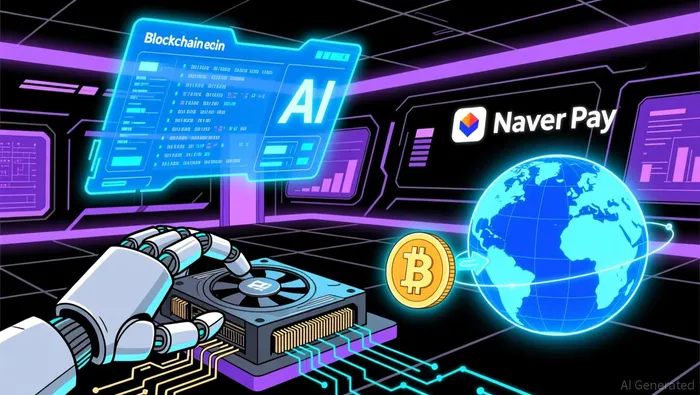 A key milestone in this integration is the launch of the Dongbaek-jeon stablecoin in Busan, South Korea's second-largest city. The stablecoin, backed by fiat reserves and built on GIWA, is set to debut in December 2025, with a digital wallet in its final testing phase. This initiative aligns with South Korea's regulatory push for local-currency stablecoins, which could see legislation requiring 100% fiat-backed reserves and public blockchain usage.
Financial Commitments and Allocation
While the $6.8 billion investment plan lacks a granular breakdown, Naver has already signaled its intent to prioritize AI infrastructure. In 2025, the company announced a $690 million investment in 60,000 Nvidia Blackwell GPUs to bolster its AI capabilities, supporting robotics, cloud computing, and physical AI applications. This allocation underscores Naver's focus on AI as a foundational layer for its blockchain-driven fintech ambitions.
The broader $6.8 billion plan is expected to fund joint ventures with fintech and AI startups, overseas expansion, and the development of scalable blockchain solutions like GIWA. These investments aim to position Naver as a global fintech leader, rivaling hubs like Singapore and Japan. However, the absence of a detailed timeline for these expenditures raises questions about execution risks and prioritization.
Strategic Milestones and Timelines
The merged entity has outlined several strategic milestones for 2025–2030:
1. 2025–2026: Finalize the integration of Upbit's infrastructure into Naver Pay and launch the Dongbaek-jeon stablecoin in Busan.
2. 2027–2028: Expand the stablecoin ecosystem to other Korean cities and explore international partnerships for cross-border payments.
3. 2029–2030: Pursue a Nasdaq IPO, leveraging the combined entity's valuation potential and the growing institutional interest in crypto assets.
Regulatory hurdles, however, remain a wildcard. South Korea's Financial Services Commission and Fair Trade Commission are scrutinizing the merger for antitrust concerns and stablecoin issuance restrictions. Naver's CEO has stated there are "no current plans" for an IPO according to Nasdaq reporting, but the company's long-term strategy hints at a Nasdaq listing as a potential exit for investors.
Long-Term Investment Potential
Naver's move into blockchain and AI-driven fintech is a high-stakes bet with significant upside. The integration of Dunamu's crypto infrastructure with Naver's AI capabilities creates a unique value proposition: a platform that can tokenize assets, streamline payments, and leverage machine learning for personalized financial services according to Korea Tech Desk. If successful, the merged entity could capture a substantial share of the $1.5 trillion global stablecoin market and the $100 billion AI fintech sector as reported by MEXC.
However, risks abound. Regulatory shifts, particularly around stablecoin issuance and crypto trading, could delay or derail key milestones. Additionally, the integration of two large entities-Naver's consumer-focused ecosystem and Dunamu's crypto-centric operations-requires cultural and operational alignment, which is never guaranteed.
Conclusion
Naver's $10.3 billion acquisition of Dunamu and its $6.8 billion AI/blockchain investment plan represent a visionary leap into the future of digital finance. By combining AI, blockchain, and a robust regulatory environment, Naver is positioning itself to lead the next wave of fintech innovation. For investors, the key question is whether the company can navigate regulatory challenges and execute its ambitious roadmap. If it succeeds, the rewards could be transformative-not just for Naver, but for the global fintech landscape.







Comentarios
Aún no hay comentarios