
Nauticus Robotics' Aquanaut Mark 2 and the Deep-Sea Robotics Revolution: How Deepwater Capabilities Are Catalyzing Oil & Gas Automation Growth
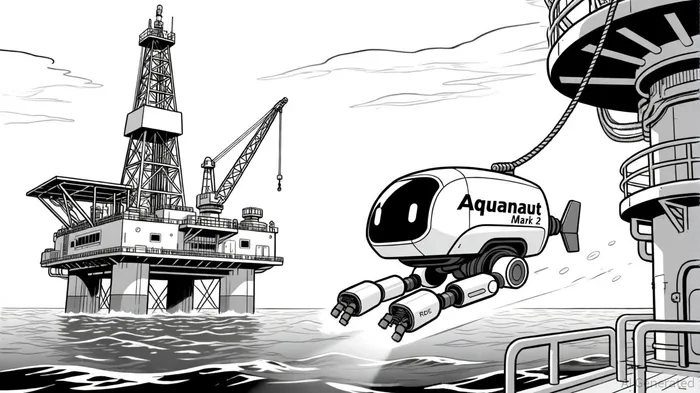
The global oil and gas industry is undergoing a seismic shift as deepwater operations become increasingly automated. At the forefront of this transformation is Nauticus RoboticsKITT--, whose Aquanaut Mark 2 autonomous underwater vehicle (AUV) is redefining the economics and safety of subsea inspections. With its recent 2,300-meter depth milestone and untethered autonomy, the Aquanaut Mark 2 exemplifies how cutting-edge robotics are accelerating automation in one of the most challenging industrial sectors[1]. This analysis explores how Nauticus' innovations align with—and are being driven by—the broader automation megatrend in deepwater oil and gas, positioning the company as a pivotal player in a $60.62 billion market by 2030[2].
Deepwater Capabilities: A Technical Leap Forward
Traditional subsea operations rely on tethered remotely operated vehicles (ROVs), which require cumbersome topside infrastructure, real-time human oversight, and significant fuel consumption. Nauticus' Aquanaut Mark 2, by contrast, operates untethered, leveraging AI-driven navigation and acoustic communication to perform tasks such as pipeline inspections, leak detection, and seabed mapping[3]. Its recent 2,300-meter test in the Gulf of Mexico—240 kilometers offshore—demonstrates its ability to function in ultra-deepwater environments without the limitations of tethers[4].
This untethered autonomy offers three critical advantages:
1. Cost Efficiency: Nauticus estimates that the Aquanaut Mark 2 reduces operational costs by 30–40% compared to traditional methods, primarily by eliminating the need for large support vessels and diesel-powered equipment[5].
2. Environmental Impact: By minimizing fuel consumption and emissions, the technology aligns with the oil and gas sector's decarbonization goals[6].
3. Safety and Scalability: Removing human operators from high-risk environments while enabling simultaneous multi-vehicle deployments enhances both safety and operational throughput[7].
The Aquanaut's proprietary ToolKITT software further differentiates it, enabling real-time mission adjustments and cross-platform compatibility with existing subsea hardware[8]. This adaptability is crucial for oil and gas firms seeking to integrate automation without overhauling legacy systems.
Market Dynamics: Automation as a Strategic Imperative
The deepwater oil and gas automation market is expanding rapidly, driven by the need to extract resources from increasingly remote and hostile environments. According to market data, the broader oil and gas automation sector was valued at $43.35 billion in 2025 and is projected to grow at a 6.94% CAGR through 2030[9]. Within this, the underwater robotics segment—encompassing both ROVs and AUVs—is expected to surge at a 14.5% CAGR, reaching $13.02 billion by 2030[10].
Nauticus' recent projects underscore this trend. In 2025, the company secured a long-term contract for 120 days of drill support operations with a marine transportation firm, while simultaneously deploying a second ROV alongside an Aquanaut Mark 2 in the Gulf of Mexico[11]. These efforts reflect a dual strategy: leveraging traditional ROVs to maintain market relevance while accelerating adoption of autonomous systems.
The Asia-Pacific region, with its burgeoning energy demand and deepwater LNG projects, is a key growth area. However, North America—particularly the Gulf of Mexico—remains a critical testing ground for automation technologies, given its mature offshore infrastructure and regulatory environment[12]. Nauticus' collaboration with a second global supermajor in the GOM highlights the sector's confidence in its solutions[13].
Case Studies: Validating the Value Proposition
Real-world deployments have validated the Aquanaut Mark 2's potential. In December 2024, Nauticus completed a multi-day inspection project for a supermajor oil and gas company, aligning with the client's subsea technology roadmap[14]. Separately, in Brazil, the company executed Phase I of a four-phase contract, demonstrating the Aquanaut's ability to perform light maintenance tasks in deepwater fields[15]. These case studies illustrate the vehicle's versatility and its capacity to reduce nonproductive time—a persistent challenge in offshore operations.
Challenges and Opportunities
Despite its progress, Nauticus faces headwinds. High upfront costs for automation technologies and volatility in oil prices could slow adoption among smaller operators[16]. However, the company's $12 million funding raise in 2024—aimed at accelerating Aquanaut certification and expanding its platform-independent software—positions it to mitigate these risks[17]. Additionally, strategic partnerships with marine transportation firms and energy giants provide a stable revenue stream while the broader market matures.
Investment Implications
Nauticus Robotics is not merely a beneficiary of the automation wave—it is a catalyst. By addressing the technical and economic pain points of deepwater operations, the Aquanaut Mark 2 is accelerating the transition from manual to autonomous subsea workflows. For investors, the company's unique value proposition lies in its ability to combine cutting-edge robotics with pragmatic cost savings, all while aligning with global decarbonization trends.
As the oil and gas industry grapples with the dual pressures of resource depletion and environmental scrutiny, Nauticus' deepwater capabilities offer a compelling solution. With its recent milestones and expanding partnerships, the company is well-positioned to capture a significant share of a market that is poised for exponential growth.





Comentarios
Aún no hay comentarios