
Nature's Sunshine: Premium Valuation Without Moats, Sell
The recent secondary offering by Fosun Pharma USA, a major shareholder in Nature's Sunshine Products (NATR), has sent a clear signal to the market: the company's ownership structure is shifting, and its long-term value proposition is under scrutiny. While the offering itself doesn't involve new capital for the company, the 15.4% increase in shares outstanding—equivalent to 2.85 million shares—threatens to dilute existing shareholders and depress the stock price. This move, combined with the company's structural weaknesses and lack of durable competitive advantages, makes NATR a compelling sell for investors.
The Dilution Dilemma
The secondary offering, priced at $12.00 per share, is a textbook example of shareholder exit. Fosun, which has held a stake in Nature's SunshineNATR-- for years, is offloading its position, and the company has no obligation to repurchase the shares. While it has a $15 million repurchase authorization, this pales in comparison to the $34.2 million in proceeds Fosun will pocket. The result? A 15.4% dilution of the equity base, which could drag earnings per share (EPS) down from $0.25 to $0.21 if profits remain flat.
This dilution isn't just a numbers game—it's a psychological one. Shareholders will question whether management is prioritizing liquidity for insiders over long-term growth. The offering also raises red flags about the company's ability to defend its valuation. At a forward P/E of 30x, NATRNATR-- trades at a premium to peers like GNC Holdings (GNC) and Herbalife (HLF), which are valued at 18x and 22x, respectively. Without a clear moat to justify this gap, the stock is vulnerable to a re-rating.
Structural Weaknesses: A House of Cards
Nature's Sunshine's business model is built on fragile foundations. Let's break down the key vulnerabilities:
Inventory Overhang: The company's inventory ballooned to $69.3 million in Q2 2025, a $4.4 million increase from Q1. This suggests poor demand forecasting or overproduction, which could lead to markdowns or write-offs. In a sector where margins are razor-thin, such inefficiencies are catastrophic.
Geographic Concentration: Asia-Pacific and North America account for 85% of sales, with Japan alone contributing 27% of regional growth. While this focus has driven recent gains, it also exposes the company to macroeconomic shocks. Taiwan and South Korea, for instance, are grappling with inflation, political instability, and weak consumer demand. A slowdown in these markets could erase years of progress.
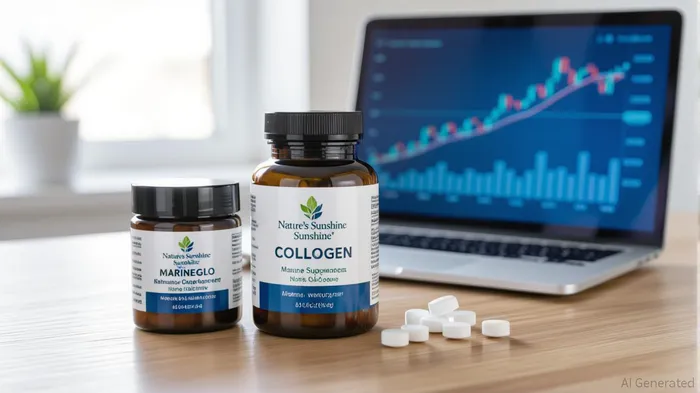
Collagen Market Overexposure: Nature's Sunshine's MarineGlo product targets the booming collagen segment, which is growing at 15–20% annually. But the company is playing catch-up in a crowded field. Brands like The Ordinary and Glossier have already captured market share with aggressive marketing and lower prices. Without a clear innovation edge, Nature's Sunshine risks becoming a me-too player.
Digital Dependency: The “Subscribe and Thrive Autoship” program now drives 53% of DTC sales, but this model is a double-edged sword. While it ensures recurring revenue, it also locks customers into rigid purchasing cycles. If consumer preferences shift or digital ad costs rise, the company's margins could crater.
The Moat Myth
Despite claims of a “strong competitive moat,” Nature's Sunshine lacks the pricing power or differentiation to justify its premium valuation. Its gross margin of 71.7% is impressive, but this is largely due to low-cost manufacturing in Asia, not brand strength or innovation. The company's digital transformation and product launches (e.g., MarineGlo) are commendable, but they're reactive, not proactive. Competitors can replicate these strategies with minimal effort.
Moreover, the company's balance sheet, while technically strong ($81.3 million in cash, zero debt), is a false comfort. The $25 million share repurchase program is a drop in the bucket compared to the $34.2 million in dilution. Investors should ask: If the company can't defend its equity base, how can it protect its long-term value?
The Sell Case
The combination of dilution, structural weaknesses, and a lack of moats creates a perfect storm for a sell-off. Here's why investors should act now:
- Short-Term Pain: The secondary offering will weigh on the stock price, especially if repurchases are minimal.
- Long-Term Risk: Without a sustainable edge in collagen or digital sales, the company's growth is at risk.
- Valuation Disconnect: At 30x forward earnings, NATR is overpriced relative to its fundamentals.
Final Verdict
Nature's Sunshine is a cautionary tale of overvaluation in the absence of durable advantages. The secondary offering by Fosun is the final nail in the coffin for a stock that's been propped up by short-term gains and speculative hype. Investors should cut their losses and reallocate to companies with real moats—think Amazon (AMZN) or Apple (AAPL)—that can weather macroeconomic storms.
Bottom Line: Sell NATR. The dilution, structural flaws, and lack of differentiation make it a high-risk, low-reward proposition.





Comentarios
Aún no hay comentarios