
Natural Gas Price Weakness: A Buying Opportunity Amid Seasonal Demand Shifts?
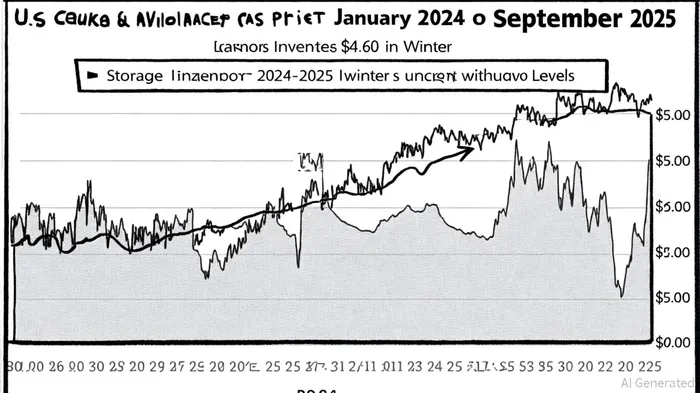
Natural gas markets in Q3 2025 are navigating a complex interplay of seasonal demand shifts, inventory dynamics, and geopolitical volatility. With the Henry Hub spot price averaging $3.00/MMBtu, traders are weighing whether current price weakness represents a strategic entry point ahead of the winter 2025–2026 surge. This analysis explores the case for short-term trading opportunities, supported by technical indicators, seasonal patterns, and evolving supply-demand fundamentals.
Seasonal Demand and Inventory Dynamics: A Structural Tailwind
Natural gas prices are inherently cyclical, driven by heating demand in winter and cooling demand in summer. According to the U.S. Energy Information Administration (EIA), Q3 2025 prices reflect a confluence of high inventories, robust production, and reduced power sector consumption during the summer [2]. However, the seasonal withdrawal of inventories at a faster-than-normal rate is expected to drive prices toward a winter peak of $4.60/MMBtu in January 2026 [2].
Historical data underscores the reliability of this pattern. For instance, the winter of 2024–2025 saw record consumption, depleting over 1 Tcf of storage and pushing Northeast spot prices to $33.515/MMBtu [3]. While spring 2025 brought milder temperatures and inventory recovery, the market remains sensitive to pipeline constraints and rising LNG export demand, particularly in the Northeast [3]. Traders leveraging seasonal strategies can capitalize on these predictable shifts by entering long positions in late summer as inventories begin to decline.
Technical Indicators: A Case for Strategic Entry Points
From a technical perspective, natural gas is consolidating within a $2.00–$5.00 range, with key support at $2.50–$3.00 and resistance at $6.00–$7.00 [1]. A breakout above $5.00 could signal a move toward the $6.00–$7.00 zone, while a failure to hold above $3.00 may retest lower support levels. Given the current price weakness near the $3.00 average, traders might consider mean reversion strategies, targeting oversold conditions identified by the RSI or stochastic oscillator.
Moreover, trend-following strategies could benefit from the anticipated winter surge. AI-driven tools now enable real-time detection of emerging trends, allowing traders to align positions with the projected $4.60/MMBtu peak [2]. For example, a long futures contract initiated in September 2025 could capture gains as inventories tighten and demand accelerates.
Geopolitical and Supply-Side Risks: A Double-Edged Sword
While seasonal and technical factors favor a bullish case, short-term volatility remains a concern. The Israel-Iran conflict and Middle East tensions have already exacerbated price swings, complicating forecasts [2]. Additionally, global LNG supply growth—driven by projects like Plaquemines LNG Phase 1 and Cheniere's Corpus Christi Stage 3—could moderate winter price spikes if exports outpace domestic demand [1].
However, these risks also create opportunities. For instance, geopolitical shocks often trigger overreactions in the market, creating entry points for contrarian traders. A disciplined approach using stop-loss orders (e.g., 10% below entry price) and diversification across energy commodities (e.g., crude oil, LNG) can mitigate downside risks [2].
Conclusion: A Calculated Bet on Winter Demand
Natural gas's current price weakness, while influenced by summer oversupply, aligns with a well-established seasonal pattern of winter-driven strength. For short-term traders, the combination of technical support levels, inventory dynamics, and projected demand surges presents a compelling case for strategic entry. However, success hinges on rigorous risk management and real-time monitoring of geopolitical and supply-side developments.
As the EIA notes, natural gas prices are expected to nearly double compared to 2024 by 2026, outpacing crude oil's projected decline [2]. For traders with a 3–6 month horizon, the winter 2025–2026 period offers a high-probability window to capitalize on this divergence.







Comentarios
Aún no hay comentarios