
US Natural Gas Price Outlook Amid Shifting Weather Dynamics and Growing LNG Demand
The U.S. natural gas market in late 2025 finds itself at a crossroads, where short-term weather-driven volatility clashes with long-term structural shifts in global energy demand. Investors navigating this landscape must weigh the immediate impacts of seasonal temperature fluctuations against the enduring forces of liquefied natural gas (LNG) export growth and production constraints. This analysis explores how these dual dynamics are shaping the price outlook for natural gas, drawing on the latest data from authoritative sources.
Short-Term Volatility: Weather and Inventory Dynamics
The U.S. Energy Information Administration (EIA) has revised its Winter Fuels Outlook to reflect a colder-than-average 2025–2026 winter, which could elevate residential heating demand and, consequently, natural gas prices. However, this forecast has already experienced significant swings. For instance, as December 2025 progressed, late-season weather predictions shifted toward milder conditions, causing natural gas futures prices to plummet by 15% as of December 19, with Henry Hub prices settling at $3.98/MMBtu.
This volatility is further compounded by inventory levels. As of December 12, 2025, U.S. natural gas storage stood at 3,579 billion cubic feet (Bcf), 0.9% above the five-year average. While robust production-up 4.8% year-over-year-has kept supply resilient, shifting temperature forecasts have created uncertainty. 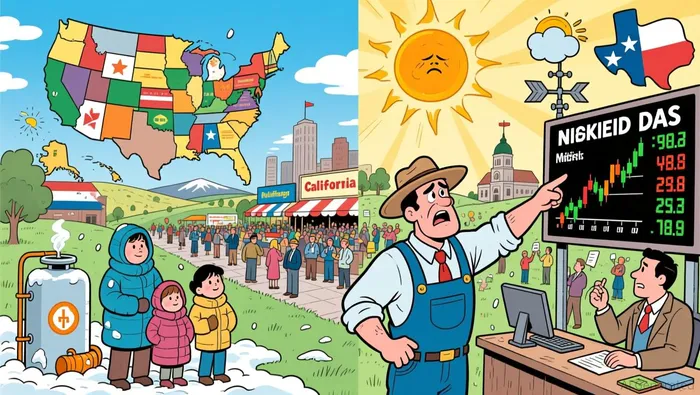 Warmer-than-expected conditions could reduce heating demand, easing upward pressure on prices. Thus, short-term price movements remain highly sensitive to weather modeling and inventory adjustments.
Long-Term Fundamentals: LNG Export Growth and Structural Demand
Beyond seasonal fluctuations, the U.S. natural gas market is being reshaped by structural trends, particularly the rapid expansion of LNG export capacity. By 2029, U.S. LNG export capacity is projected to nearly double to 30 billion cubic feet per day (Bcf/d), driven by strong global demand in Asia and Europe. The International Energy Agency (IEA) notes that the U.S. and Qatar will account for 70% of global LNG expansion by 2030, with the U.S. already supplying 55% of Europe's LNG needs.
This growth is underpinned by the AI-driven data center industry and industrial manufacturing, which are expected to boost natural gas demand in the power sector by 4.2 Bcf/d between 2025 and 2030. However, production bottlenecks-such as permitting delays for gas-fired power plants and constraints in LNG facility utilization-pose risks to this trajectory. Additionally, a projected global LNG surplus as early as 2026 could temper price growth, as oversupply pressures emerge.
Balancing the Equation: Weather vs. Structure
The interplay between these forces creates a nuanced outlook. While colder winter weather could temporarily spike prices, the EIA emphasizes that long-term price trends will be dominated by LNG export demand, which is expected to outpace domestic production growth. Conversely, a mild winter or unexpected inventory buildups may provide short-term relief, as seen in December 2025.
Investors must also consider the risk of a global LNG surplus, which could cap prices despite strong export demand. The IEA warns that this surplus may limit the operational efficiency of new U.S. export facilities, creating a potential drag on price appreciation.
Conclusion: A Dual-Track Investment Strategy
For investors, the U.S. natural gas market demands a dual-track approach. Short-term positions should remain agile, hedging against weather-driven price swings and inventory fluctuations. Meanwhile, long-term exposure should focus on the structural tailwinds of LNG export expansion and industrial demand growth, while monitoring risks like global oversupply and regulatory bottlenecks.
As the EIA and IEA both underscore, the coming years will test the resilience of the U.S. natural gas sector. Those who balance immediate volatility with enduring fundamentals will be best positioned to navigate this dynamic market.







Comentarios
Aún no hay comentarios