
Natural Gas Market Volatility: A Strategic Entry Point Amid Deteriorating Fundamentals?
Deteriorating Fundamentals: A Perfect Storm
According to the International Energy Agency (IEA), Q3 2025 has seen a sharp contraction in demand from price-sensitive markets like China and India, where industrial and residential consumption has declined year-over-year due to high prices. Meanwhile, Europe's reliance on liquefied natural gas (LNG) has surged, with imports projected to hit record levels in 2025 driven by reduced Russian pipeline supplies and aggressive storage replenishment, according to the IEA. This bifurcation in demand patterns has created a fragile global balance, where any disruption-whether weather-related or geopolitical-could trigger sharp price swings.
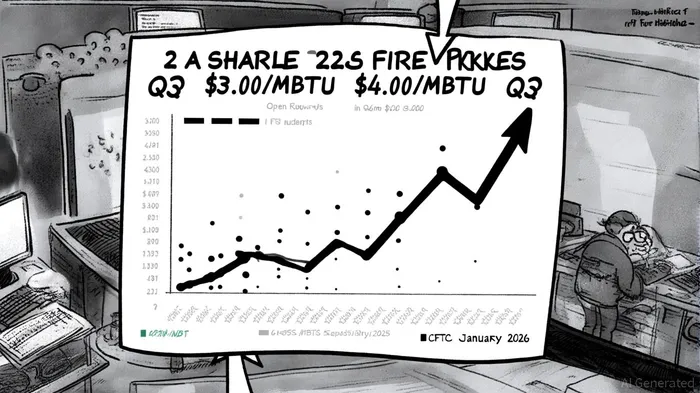
The United States, a key player in the global LNG export boom, faces its own paradox. While Henry Hub prices averaged $3.00/MMBtu in Q3 2025 due to high inventory levels and weak power-sector demand, the EIA's Short-Term Energy Outlook projects a winter peak of $4.60/MMBtu by January 2026. This projected rise is fueled by rapid inventory draws and the ramp-up of new LNG export terminals, such as Venture Global's Plaquemines and Cheniere's Corpus Christi Stage 3 projects. However, the market's reliance on these projects introduces execution risk: delays or operational bottlenecks could exacerbate supply shortages and amplify volatility.
Contango and Open Interest: A Market in Transition
The natural gas futures curve has shifted into a pronounced contango structure, with forward prices for 2025 averaging 85 cents higher than 2024 prices at this time last year, according to Natural Gas Intel's forward-curve analysis. This reflects growing concerns about supply adequacy, particularly as storage inventories decline and cold snaps drive heating demand. Contango typically incentivizes producers to maintain output, as hedging becomes more attractive, as Natural Gas Intel notes. Yet, this dynamic could backfire if production outpaces demand, leading to a sudden oversupply and price collapse.
Open interest trends further complicate the picture. The Commodity Futures Trading Commission's (CFTC) Commitments of Traders (COT) reports, as summarized in the CFTC COT report, reveal a surge in commercial net positions, which rose 14.67% week-over-week to 119,742 as of September 23, 2025. In contrast, COT data show large speculators hold net short positions of -128,084, signaling a risk-off stance. This divergence between commercial and speculative positioning highlights a tug-of-war between those betting on structural supply constraints and those anticipating a near-term price correction.
Tactical Shorting Opportunities: Navigating the Risks
For investors considering short positions, the current market environment offers both catalysts and hazards. The contango structure and speculative short positions suggest a bearish bias, but the market's sensitivity to geopolitical shocks-such as the Israel-Iran conflict-introduces a layer of unpredictability, as the IEA highlights. Additionally, the EIA's forecast of a $4.60/MMBtu winter peak implies that short-sellers must contend with seasonal demand spikes, which could temporarily negate broader bearish trends.
A tactical approach would involve hedging against short-term volatility while targeting longer-term structural weaknesses. For instance, shorting near-term contracts (e.g., December 2025) could capitalize on expected inventory draws, while rolling positions into 2026 futures might benefit from potential oversupply risks as new LNG projects come online. However, this strategy requires close monitoring of COT reports and open interest trends to gauge shifts in market sentiment, and a careful read of forward-curve developments reported by market outlets.
Conclusion: A High-Risk, High-Reward Proposition
The natural gas market's volatility in Q3 2025 is a product of both structural imbalances and transient shocks. While deteriorating fundamentals and speculative positioning present tactical shorting opportunities, the path to profitability is fraught with risks. Investors must weigh the potential rewards of a price correction against the likelihood of geopolitical or weather-driven disruptions. As the winter heating season approaches, the market's ability to balance supply, demand, and sentiment will determine whether this volatility translates into a strategic entry point-or a costly trap.





Comentarios
Aún no hay comentarios