
Natural Gas Market Downturn Amid Abundant Supply and Mild Weather: Navigating Risks and Opportunities
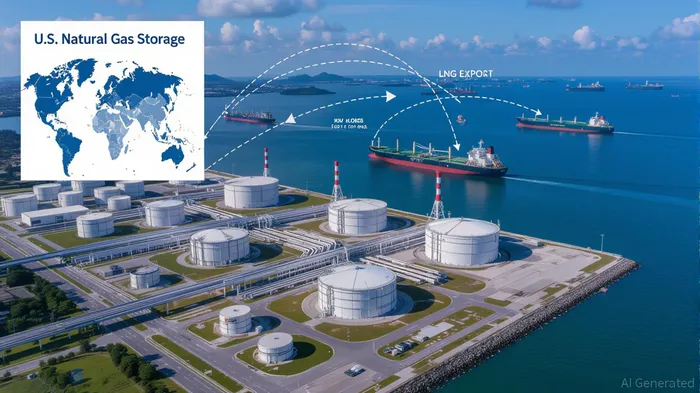
The natural gas market in 2025 is at a crossroads, shaped by a perfect storm of oversupply, mild weather, and shifting global demand patterns. For investors, this environment presents both risks and opportunities, but understanding the nuances of the current landscape is critical to making informed decisions.
Supply Dynamics: A Delicate Balance
Global natural gas supply has surged in 2025, driven by the ramp-up of U.S. liquefied natural gas (LNG) projects like Plaquemines and Corpus Christi Stage 3. These facilities have added 30 billion cubic meters (bcm) of annual LNG capacity, offsetting declines in Russian piped gas deliveries to Europe. However, this growth has come at a cost. U.S. dry natural gas production hit 106 billion cubic feet per day (Bcf/d) in 2025, pushing storage levels to 3,130 billion cubic feet (Bcf) by August—6% above the five-year average. While this abundance has stabilized prices, it has also created a surplus that threatens to depress margins for producers.
The geopolitical landscape adds further complexity. The Israel-Iran conflict in June 2025 briefly spiked prices due to fears of Strait of Hormuz disruptions, but the market has since stabilized. This volatility underscores the fragility of global supply chains, even as new LNG projects come online.
Demand Weakness: A Double-Edged Sword
Seasonal demand weakness, particularly in Asia, has exacerbated the oversupply issue. China's LNG imports are projected to decline in 2025, while India's gas demand fell 7% year-on-year in the first half of the year. These declines are driven by macroeconomic uncertainty and fierce competition for flexible LNG cargoes from Europe, which now accounts for 61% of U.S. LNG exports. Meanwhile, the U.S. power sector has reduced gas consumption by 4% in 2025, shifting to cheaper coal and renewables.
The EIA forecasts a gradual decline in U.S. prices to $3.04 per million British thermal units (MMBtu) by year-end 2025, but this assumes no major disruptions. If mild winter conditions persist into the 2025/26 heating season, storage withdrawals could lag, further pressuring prices.
Investment Risks: Oversupply and Price Volatility
The primary risk for investors lies in the oversupply-driven price compression. U.S. producers, already operating near full capacity, face margin erosion as Henry Hub prices trade below $3.50/MMBtu. Companies with high leverage or limited cost control are particularly vulnerable. Additionally, geopolitical tensions—such as the potential for renewed Middle East conflicts—could reintroduce volatility, making long-term planning challenging.
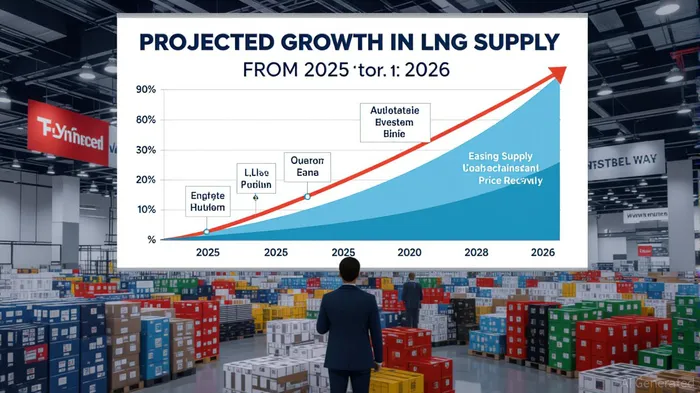
Storage levels also pose a risk. While current inventories are 3% above the five-year average, the EIA projects they could reach 3.9 trillion cubic feet (Tcf) by October 2025. This surplus could delay price recovery until 2026, when new LNG projects in Qatar and Canada begin to ease global supply constraints.
Opportunities: LNG Exports and Infrastructure Plays
Despite the headwinds, opportunities exist for investors who can navigate the market's volatility. The U.S. LNG export boom is a prime example. With global LNG demand expected to grow 7% in 2026, companies with export infrastructure—such as Golden Pass and Plaquemines—are well-positioned to benefit. These facilities not only generate steady cash flows but also insulate producers from domestic price swings.
Another opportunity lies in midstream infrastructure. As production shifts to shale plays like the Haynesville and Permian, pipeline and processing companies stand to gain from increased throughput. These firms are less exposed to commodity price swings and offer more predictable returns.
Strategic Recommendations for Investors
- Hedge Against Price Volatility: Consider natural gas futures or ETFs to offset exposure to price swings. The current oversupply suggests a bearish near-term outlook, but geopolitical risks could create short-term rallies.
- Focus on LNG Infrastructure: Prioritize companies with long-term export contracts and low-cost production. These firms are better positioned to weather the current downturn and capitalize on 2026's expected supply growth.
- Monitor Storage Trends: Keep a close eye on EIA storage reports. If withdrawals accelerate in Q4 2025, it could signal a turning point in the market.
- Diversify Geographically: While the U.S. market is oversupplied, emerging markets in Asia and Europe offer growth potential as LNG demand rebounds.
Conclusion
The natural gas market in 2025 is a study in contrasts: abundant supply meets weak demand, and geopolitical risks clash with long-term growth prospects. For investors, the key is to balance caution with opportunity. While the near-term outlook is bearish, the structural shift toward LNG and the resilience of U.S. production suggest that the market will stabilize by mid-2026. By focusing on infrastructure, hedging strategies, and global demand trends, investors can navigate the downturn and position themselves for the next upturn.







Comentarios
Aún no hay comentarios