
U.S. National Security Tech Innovation and AI Integration: Strategic Investment in Defense-Aligned AI and Emerging Tech Firms
The U.S. defense sector is undergoing a transformative shift, driven by a surge in strategic investments in artificial intelligence (AI) and emerging technologies. From 2023 to 2025, global military expenditures have climbed to $2.7 trillion, with the U.S. leading private AI investments at $67 billion-8.7 times China's allocation. This escalation reflects a deliberate pivot toward software-defined, AI-integrated systems, as the Department of Defense (DoD) seeks to maintain a technological edge in an era of geopolitical rivalry. For investors, this represents a high-stakes opportunity: defense-aligned AI and emerging tech firms are not only reshaping military capabilities but also driving cross-sector innovation with long-term economic implications.
Strategic Initiatives and Case Studies: From GAMECHANGER to Replicator
The DoD's Fulcrum strategy, launched in 2025, underscores its commitment to modernizing IT systems, adopting zero-trust cybersecurity frameworks, and embedding AI into operational workflows. A pioneering example is GAMECHANGER, an AI-powered search tool co-developed with Booz AllenBAH-- in 2018 and deployed in 2020. By streamlining access to the DoD's vast regulatory and policy frameworks, GAMECHANGER has improved administrative efficiency, reducing the time required to locate critical directives from hours to seconds. This initiative exemplifies the DoD's broader push to integrate AI into enterprise operations, a strategy accelerated by rising tensions with China and the need to outpace adversaries in digital warfare.
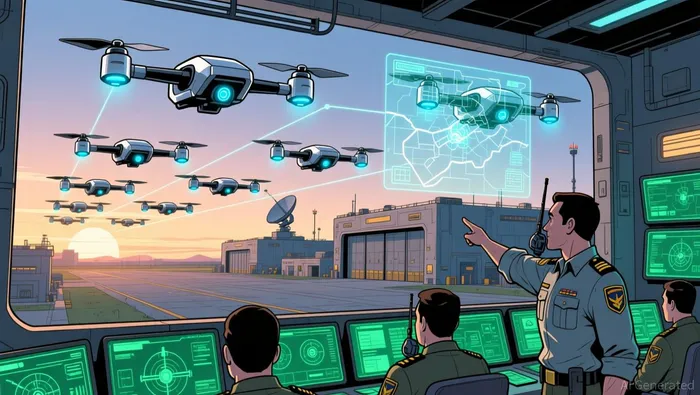 Parallel efforts are focused on autonomous systems. The Replicator Initiative, announced in 2024, aims to deploy thousands of AI-driven drones, sensors, and other autonomous platforms within 18–24 months. This aligns with the Joint All-Domain Command and Control (JADC2) system, which leverages AI to integrate real-time data across air, land, sea, space, and cyberCYBER-- domains. Startups like Anduril Industries and Chaos Industries have emerged as key partners, securing $2.5 billion and $500 million in funding, respectively, to develop modular, AI-enhanced systems for battlefield coordination and logistics.
Investment Criteria and the Digital-Military-Industrial Complex
The DoD's investment criteria for AI startups emphasize modernization, rapid prototyping, and commercial alignment. Through the Defense Innovation Unit (DIU) and Office of Strategic Capital (OSC), the department prioritizes technologies that address 14 critical areas outlined in the National Defense Science and Technology Strategy (NDSTS), though current leadership is narrowing this list to focus on high-impact priorities like AI, autonomy, and software-defined command and control. Flexible contracting mechanisms, such as Other Transaction Agreements (OTAs), enable faster adoption of private-sector solutions, bypassing traditional procurement bottlenecks.
This collaboration has given rise to a digital-military-industrial complex, with Big Tech firms like Microsoft, Amazon, and Google playing pivotal roles. For instance, Microsoft's Azure cloud infrastructure underpins the Joint Warfighting Cloud Capability (JWCC), while Palantir's AI-driven analytics platforms are used for intelligence processing and decision-making according to analysis. These partnerships highlight the interdependence between national security and commercial innovation, with the DoD acting as both a customer and a catalyst for technological advancement.
Expert Analysis: Effectiveness and Challenges
The effectiveness of these investments is evident in operational metrics. DoD contracts for AI-related fields surged by 150% in 2023, with the potential value of awards reaching $4.56 billion. AI is also modernizing logistics and training: predictive maintenance tools reduce aircraft downtime by up to 30%, while synthetic training environments enhance readiness at lower costs. However, challenges persist. The FY2025 defense budget request for science and technology-$17.2 billion- marks a 3.5% decline from 2024, raising concerns about sustaining long-term R&D in areas like directed energy and advanced computing. Delays in congressional appropriations and fragmented program continuity further complicate progress.
ROI and Cross-Sector Spillovers
Despite these hurdles, the ROI for defense-aligned AI investments is compelling. The FY2025 budget allocates $1.8 billion specifically for AI initiatives, targeting supply chain optimization and battlefield intelligence. Startups like Scale AI and Kratos have demonstrated high returns, with Palantir's 2018 legal victory against the U.S. Army reinforcing the value of commercial solutions over in-house development. Beyond defense, AI innovations in predictive analytics and automation are spilling over into manufacturing, energy, and cybersecurity, driving productivity gains across industries.
Future Outlook: Strategic Opportunities for Investors
For investors, the defense AI landscape offers dual opportunities: defense-specific applications and cross-sector scalability. The DoD's emphasis on modular, software-defined systems ensures that technologies developed for military use can be adapted for civilian markets. For example, AI-driven predictive maintenance in defense logistics could revolutionize industrial manufacturing, while cybersecurity frameworks designed for zero-trust architectures may find applications in finance and healthcare.
However, success hinges on aligning with the DoD's evolving priorities. Startups must demonstrate agility in addressing high-impact use cases, such as autonomous systems for JADC2 or AI-powered threat detection. Investors should also monitor geopolitical dynamics, as tensions with China and Russia are likely to sustain demand for advanced capabilities.
Conclusion
The U.S. defense sector's embrace of AI and emerging technologies is not merely a response to immediate security threats but a strategic investment in long-term dominance. By fostering a digital-military-industrial complex and prioritizing rapid innovation, the DoD is creating a fertile ground for startups that can deliver both operational superiority and cross-sector value. For investors, the key lies in identifying firms that align with the DoD's modernization goals while leveraging their technologies for broader economic impact. In an era where national security and technological leadership are inextricably linked, defense-aligned AI represents one of the most consequential investment opportunities of the decade.







Comentarios
Aún no hay comentarios