
National Security Risks and the Geopolitical Implications for Bitcoin Mining Infrastructure
The National Security Crisis in Chinese Bitcoin Mining Hardware
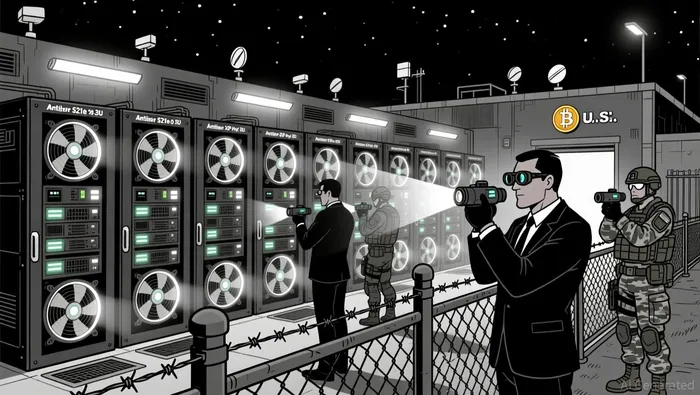
The U.S. government's Operation Red Sunset, led by the Department of Homeland Security, has uncovered alarming vulnerabilities in Chinese Bitcoin mining hardware. According to a Bloomberg report, Bitmain's mining machines-deployed near critical infrastructure such as a Microsoft data center supporting the Pentagon and an Air Force nuclear missile base in Cheyenne, Wyoming-could be remotely manipulated for espionage or sabotage. A Senate Intelligence Committee report in July 2025 highlighted that Bitmain's devices "could be controlled from China," introducing "several disturbing vulnerabilities" to U.S. national security.
These risks are not hypothetical. The investigation revealed that Bitmain's hardware, which includes models like the Antminer S21e XP Hyd 3U (860 TH/s) and S21 XP+ Hyd (500 TH/s), operates with energy efficiencies that make them attractive to miners but also amplify their potential as tools for covert infrastructure manipulation. Bitmain has denied allegations of remote control capabilities, calling them "unequivocally false" according to the report, but the U.S. government's actions-including detaining shipments at ports and disassembling devices for inspection-underscore the gravity of the threat.
The U.S. Response: Tariffs, Policy, and the Push for Domestic Alternatives
While the U.S. has not yet introduced direct subsidies for domestic mining hardware, it has implemented aggressive policy measures to counter Chinese dominance. Tariffs on ASICs imported from China now stand at 57.6%, with further adjustments pending. These tariffs aim to incentivize onshoring of production, though companies like Luxor Technology acknowledge that full domestic manufacturing will take years due to reliance on Asian-sourced components according to industry analysis.
The Biden administration's May 2024 executive order blocking a crypto mining facility near a nuclear weapons base-citing foreign-sourced equipment-signals a broader strategy to isolate critical infrastructure from foreign influence. Meanwhile, bipartisan legislative efforts, including a GOP-led call for investigations into Chinese mining firms according to political sources, reflect growing consensus on the need to address supply chain risks.
Despite these measures, U.S. manufacturers like Auradine (Teraflux AH3880, 600 TH/s) and MicroBT (WhatsMiner M66S++, 356 TH/s) remain niche players in a market dominated by Chinese firms. However, Bitmain's recent announcement to build a U.S. manufacturing facility-likely to mitigate import risks-highlights the shifting dynamics. Investors must weigh whether such moves will dilute the U.S. government's ability to enforce security standards or accelerate the adoption of domestic alternatives.
Security Certifications: A Critical Differentiator
A key distinction between U.S. and Chinese mining hardware lies in security certifications. While U.S. manufacturers are increasingly adopting standards like FIPS (Federal Information Processing Standards) and Common Criteria-common in defense and financial sectors-Chinese hardware lacks such certifications according to industry analysis. The absence of verifiable security protocols in Bitmain's devices raises concerns about backdoors or firmware vulnerabilities that could be exploited by foreign actors as reported by Bloomberg.
For example, the Senate Intelligence Committee's findings suggest that Bitmain's hardware could be "controlled from China," a claim Bitmain denies according to the report. Without independent verification, investors face a dilemma: trust unproven assertions from a foreign entity or support U.S. firms that prioritize transparency and compliance with domestic security frameworks.
Strategic Implications for Investors
The geopolitical stakes are clear. As the U.S. government prioritizes infrastructure security, investors should consider the following:
1. Divest from Chinese-supplied hardware: The risk of regulatory intervention, asset seizures, or operational shutdowns as seen in the Cheyenne case makes Chinese equipment a liability.
2. Support U.S. manufacturers with security certifications: Firms like Auradine and MicroBT, which emphasize compliance with U.S. standards, are better positioned to meet future regulatory demands.
3. Monitor policy shifts: The Trump administration's recent tariff overhaul and ongoing investigations according to political sources indicate that the regulatory environment will remain volatile.
Conclusion
The Bitcoin mining industry is no longer just about computational power-it is a front line in the U.S.-China tech war. As national security concerns eclipse economic incentives, the strategic divestment from Chinese hardware and advocacy for U.S. alternatives are not merely prudent but imperative. Investors who align with this shift will not only mitigate geopolitical risks but also capitalize on a sector poised for transformation under the weight of policy and security imperatives.







Comentarios
Aún no hay comentarios