
National Security Risks and Consumer Trust in Tech Supply Chains: Assessing the Investment Implications of the FTC's Scrutiny of TP-Link
The U.S. Federal Trade Commission's (FTC) ongoing investigation into TP-Link Systems Inc. has reignited debates about national security risks in global tech supply chains and the fragility of consumer trust in companies with opaque corporate structures. At the heart of the scrutiny is whether TP-Link misled U.S. consumers by concealing its continued ties to China following a 2024 corporate restructuring. This case, occurring amid heightened geopolitical tensions and a broader U.S. strategy to curb Chinese influence in critical infrastructure, raises critical questions for investors: How do regulatory actions and geopolitical risks shape market dynamics? What lessons can be drawn from past U.S. bans on Huawei and ZTE? And what are the potential financial implications for TP-Link and its competitors?
The FTC's Case: Misleading Claims and National Security Concerns
The FTC's investigation centers on whether TP-Link created a false sense of security by portraying itself as a U.S.-based company while maintaining significant operational and financial links to China. According to a Bloomberg report, despite TP-Link's 2024 restructuring-splitting into TP-Link Global Inc. (U.S.) and TP-Link Corporation Pte. Ltd. (Singapore)-the company's research, development, and manufacturing operations remain heavily concentrated in China. This has led U.S. lawmakers and cybersecurity experts to warn of vulnerabilities that could be exploited by Chinese state-sponsored actors.
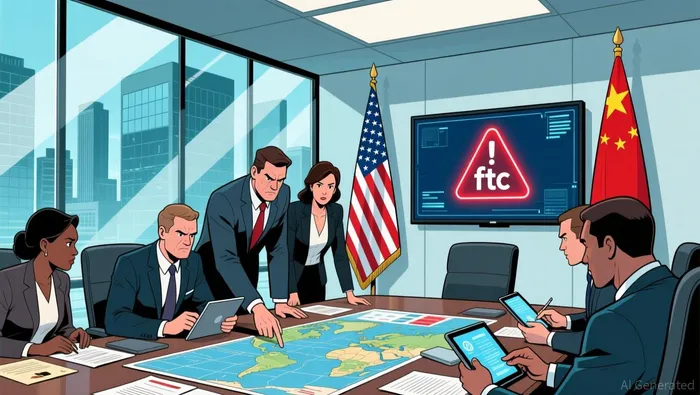 The FTC's probe is part of a multi-agency effort, with the Department of Justice (DOJ) also investigating TP-Link's pricing strategies for potential antitrust violations. Meanwhile, the Department of Commerce has proposed a ban on TP-Link's U.S. sales, citing national security risks tied to its supply chain. These overlapping investigations highlight the complexity of balancing corporate transparency with geopolitical strategy, particularly in an industry where supply chains are inherently global.
Corporate Restructuring and the Illusion of Independence
TP-Link's 2024 restructuring was marketed as a strategic move to distance the company from its Chinese roots. The firm's co-founder, Jeffrey Chao, has repeatedly denied any links to the Chinese government and emphasized that "sensitive operations" have been relocated to the U.S.". However, a Bloomberg investigation revealed that the restructuring did not fully sever ties to China, with critical functions such as firmware development and quality control still based in Shenzhen. This duality-claiming U.S. independence while retaining Chinese operational depth-has fueled skepticism among regulators and lawmakers.
The company's market dominance further complicates the situation. TP-Link holds an estimated 65% of the U.S. router market, a position that has drawn comparisons to Huawei's pre-ban era. Unlike Huawei, however, TP-Link has not yet faced a direct U.S. ban. Instead, it is navigating a web of regulatory uncertainty, with the FTC's investigation still in its early stages. This ambiguity creates a unique risk profile for investors: while TP-Link's market share remains intact, the potential for a ban or reputational damage could trigger a sharp decline in revenue and stock value.
Lessons from Huawei and ZTE: The Double-Edged Sword of U.S. Restrictions
The U.S. bans on Huawei and ZTE offer instructive parallels. When Huawei was added to the Entity List in 2019, its global smartphone sales plummeted by 40%, and U.S. tech firms like Intel and Qualcomm lost over $33 billion in sales. However, Huawei's strategic pivot to R&D and domestic innovation-culminating in the development of HarmonyOS and self-sufficient semiconductor capabilities-allowed it to retain a 31% global market share in telecom equipment by 2024. This resilience underscores a key risk for U.S. policymakers: export controls can inadvertently accelerate technological self-reliance in sanctioned firms.
ZTE's experience, by contrast, was more catastrophic. A 2018 U.S. ban nearly collapsed the company due to its reliance on U.S. components. This outcome highlights the importance of pre-existing supply chain diversification. For TP-Link, the question is whether its restructuring and claims of U.S. independence are sufficient to withstand a potential ban or whether it will face a ZTE-style collapse.
Investment Implications: Market Volatility and Strategic Risks
The uncertainty surrounding TP-Link has already begun to affect market dynamics. For instance, shares of Netgear Inc., a TP-Link competitor, surged by 3.6% following news of the FTC's investigation, illustrating how regulatory risks can create opportunities for rivals. However, TP-Link's dominant market position means that even a partial restriction could disrupt the U.S. router market, with ripple effects on suppliers and partners.
For investors, the key risks include:
1. Regulatory Outcomes: A full or partial U.S. ban would directly impact TP-Link's revenue, given its 65% market share.
2. Reputational Damage: Even without a ban, the FTC's allegations could erode consumer trust, particularly among security-conscious buyers.
3. Antitrust Penalties: The DOJ's investigation into predatory pricing could result in fines or forced price adjustments, reducing profit margins.
Conversely, TP-Link's claims of U.S. compliance and cybersecurity investments could mitigate some risks. The company has emphasized its "robust cybersecurity practices" and transparency, though these assertions remain unverified by independent audits.
Conclusion: Navigating a Geopolitical Minefield
The FTC's scrutiny of TP-Link is emblematic of a broader struggle to reconcile global supply chain realities with national security imperatives. For investors, the case underscores the importance of scrutinizing corporate transparency, geopolitical alignment, and contingency planning. While TP-Link's current market position appears resilient, the potential for regulatory action or reputational harm introduces significant volatility.
History with Huawei and ZTE suggests that U.S. bans can have mixed outcomes-sometimes crippling firms, other times spurring innovation. TP-Link's ability to navigate this landscape will depend on its capacity to prove its independence from China and adapt to a regulatory environment increasingly shaped by geopolitical rivalry. For now, investors must weigh these risks against the company's market dominance and the uncertain trajectory of U.S. policy.







Comentarios
Aún no hay comentarios