
U.S. National Debt and the Looming Fiscal Crisis: Implications for Investors
The U.S. national debt has reached a critical inflection point. In fiscal year 2025, the federal budget deficit stood at $1.8 trillion, a modest decline from the prior year but still a staggering figure that underscores the fragility of fiscal sustainability. With federal debt held by the public now at $30.1 trillion-99% of GDP-and total federal debt at $37.4 trillion (123% of GDP), the trajectory is alarming according to the Congressional Budget Office. The Congressional Budget Office (CBO) projects that by 2035, this debt will balloon to 118% of GDP, driven by rising interest costs and mandatory spending on programs like Social Security and Medicare. For investors, this is not just a macroeconomic concern-it is a structural shift that will redefine asset valuations, inflation dynamics, and fiscal policy risks for decades.
The Debt Accumulation: A Perfect Storm of Policy and Demographics
The U.S. debt story is one of compounding pressures. Revenues in FY2025 hit $5.2 trillion, buoyed by a 9% surge in individual income tax collections and a 153% spike in customs duties from tariffs. Yet outlays soared to $7.0 trillion, with Social Security, Medicare, and Medicaid spending rising 8% year-over-year. Meanwhile, interest payments on the debt hit $1 trillion for the first time, now rivaling defense spending according to fiscal analysis. This fiscal imbalance is not a temporary anomaly-it is a symptom of deeper structural issues: an aging population, rising healthcare costs, and a political system gridlocked on meaningful reform.
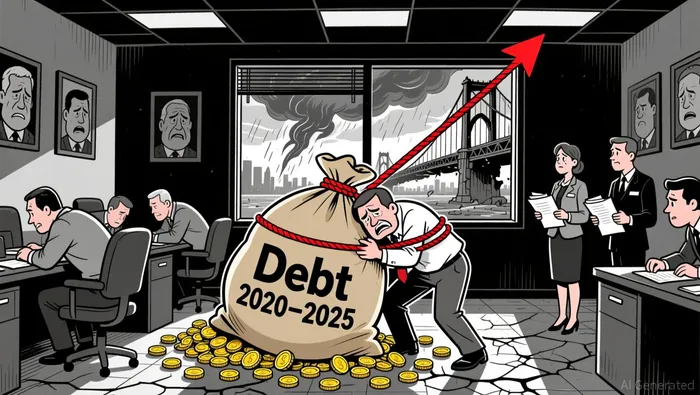
The CBO warns that deficits will grow to $2.7 trillion by 2035, even after adjusting for timing effects according to the CBO report. This trajectory is exacerbated by the fact that 80% of federal debt is now marketable, exposing the government to volatile investor sentiment and rising yields. As the Federal Reserve's holdings of U.S. Treasuries grow, concerns about "fiscal dominance" loom large. This erosion of central bank independence could destabilize investor confidence, triggering a self-fulfilling spiral of higher yields and inflation.
Asset Valuations: The Double-Edged Sword of Debt
High national debt has historically had mixed effects on asset valuations. During the 2000s and 2020s, U.S. fiscal policy relied on deficit spending to stabilize markets during crises, which propped up equities and bonds despite rising debt levels. However, this strategy is becoming riskier. For instance, Japan's public debt-to-GDP ratio exceeds 240%, yet its economy remains stagnant due to underinvestment in innovation and education according to research. The U.S. faces a similar risk: while its economy is more dynamic, the crowding out of private investment by government borrowing could stifle long-term growth.
Equities and bonds have historically shown reversion to the mean during high-debt periods, with large-cap stocks delivering returns ranging from -18.1% to +32.4% annually between 2000 and 2020. Bonds, meanwhile, have been more volatile, with high-grade bonds swinging between -13.0% and +8.7%. The key takeaway? Diversification remains critical, but investors must now factor in a new variable: the likelihood of prolonged fiscal strain.
Inflation: A Hidden Cost of Debt Servicing
Inflation is both a weapon and a vulnerability in the debt story. While moderate inflation can reduce the real value of debt-think the 12.9% inflation rate in 1946 that helped shrink the debt-to-GDP ratio according to economic analysis-high and unpredictable inflation erodes investor confidence. With interest payments now at $1 trillion annually, the government's reliance on inflation as a debt management tool is a double-edged sword.
The risk is acute. As foreign central banks shift away from U.S. Treasuries toward gold-a trend pushing gold's share of global reserves to nearly 20%- the U.S. dollar's dominance is under threat. This shift could force the Federal Reserve to tolerate higher inflation to keep yields manageable, further pressuring asset valuations and corporate margins.
Fiscal Policy Risks: The Political and Structural Quagmire
Fiscal consolidation-historically the U.S.'s go-to solution for debt crises-is now politically and structurally unfeasible. Aging demographics and rising healthcare costs mean that mandatory spending will dominate the budget, leaving little room for discretionary cuts. Meanwhile, political polarization has rendered tax increases or spending reforms unlikely without major economic or political shocks according to economic analysis.
This stalemate has global ramifications. U.S. Treasuries, the bedrock of the global financial system, are losing their aura of invulnerability. A loss of confidence could trigger a surge in yields, forcing the government to pay even more to service its debt-a feedback loop that could spiral into a fiscal crisis.
Investor Strategies: Navigating the New Normal
For investors, the path forward requires a blend of caution and adaptability. Historically, energy price caps and targeted fiscal interventions have proven more effective than monetary tightening in managing inflation without exacerbating inequality. Similarly, investors should prioritize assets that hedge against fiscal uncertainty:
- Tactically allocate to inflation-protected assets (e.g., TIPS, commodities, real estate) to offset rising costs.
- Diversify geographically to reduce exposure to U.S. fiscal risks, particularly in emerging markets with stronger fiscal positions.
- Rebalance portfolios toward equities in sectors insulated from interest rate hikes (e.g., technology, healthcare).
- Monitor gold and alternative reserves as indicators of waning confidence in U.S. debt.
The U.S. has navigated high-debt periods before, but the current environment-marked by slow growth, high interest rates, and geopolitical fragmentation- makes past strategies less applicable. Investors must now prepare for a world where fiscal sustainability is not a given but a contested battleground.
Conclusion: A Time Bomb or a Manageable Challenge?
The U.S. national debt is not an immediate catastrophe but a ticking time bomb. While the country's economic resilience and global demand for Treasuries provide a buffer, the structural forces driving debt accumulation-demographics, healthcare costs, and political dysfunction-are formidable. For investors, the key is to recognize that this is not a short-term volatility event but a long-term reconfiguration of risk. The era of "muddling through" may be ending. The question is whether investors are ready to adapt.







Comentarios
Aún no hay comentarios