
National Beverage Corp. (FIZZ): A Tale of Resilient Fundamentals and a Troubled Market Outlook
National Beverage Corp. (FIZZ): A Tale of Resilient Fundamentals and a Troubled Market Outlook
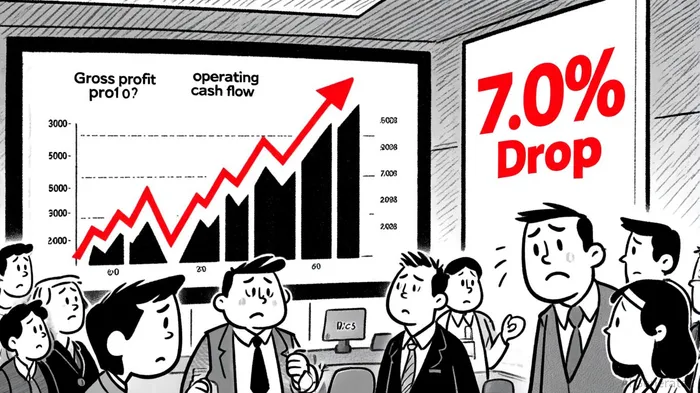
National Beverage Corp. (NASDAQ:FIZZ) has long been a poster child for disciplined capital allocation and pricing power in the beverage sector. Yet, its Q2 2025 earnings report-marked by a 3% year-over-year decline in net sales to $291 million, according to the Q2 2025 earnings report-triggered a 7.0% stock price drop post-announcement, according to AAII, despite a 4.2% year-over-year increase in net income to $45.6 million in the company's Q2 earnings filing. This dissonance between financial strength and market sentiment raises critical questions for investors: Is the stock unfairly punished, or does the market foresee structural challenges that FIZZ's balance sheet cannot yet obscure?
Fundamentals: A Fortress of Margin Expansion and Liquidity
FIZZ's Q2 results underscore its ability to navigate headwinds through cost discipline and pricing power. Gross profit rose to $109 million, with margins expanding to 37.6%-a 0.8% year-over-year improvement, as noted in the Panabee report. This was achieved despite a 3.9% decline in case volume across core segments, including carbonated soft drinks and Power+ Brands, per the AssetRoom release. The company's operating income of $57.9 million is consistent with third‑party PESTEL analysis, and a 3% increase in operating cash flow to $59.1 million was highlighted in the Panabee coverage, further highlighting its operational resilience.
Liquidity remains robust, with working capital of $329.2 million and a current ratio of 3.2x, according to the Panabee report, supported by $150 million in undrawn credit facilities noted in the AssetRoom release. Even after a $304 million special dividend in July 2024 (called out in the PESTEL analysis), FIZZFIZZ-- retained a cash balance of $250 million per Panabee, demonstrating its capacity to reward shareholders without compromising financial flexibility.
Market Sentiment: Volume Erosion and Skepticism About Growth
The stock's sharp post-earnings decline reflects investor concerns about FIZZ's ability to sustain profitability amid shrinking volume. Case volume fell 3.9% year-over-year, per the AssetRoom release, driven by weakening demand in both traditional soft drinks and newer Power+ Brands. While a 4.4% increase in average selling price offset some of this decline (noted in the company's Q2 earnings filing), the strategy of prioritizing price over volume has raised red flags. Analysts warn that such tactics may erode long-term market share, particularly in a sector where consumer preferences are shifting toward health-conscious alternatives, as discussed in the PESTEL analysis.
Compounding these worries is the inefficiency of FIZZ's cost structure. Selling, general, and administrative (SG&A) expenses rose by $2.1 million and represented 16.5% of sales, largely due to increased marketing spend (per Panabee and the AssetRoom release), yet this investment yielded minimal top-line growth, suggesting diminishing returns on brand promotion. UBS Group's recent downgrade of FIZZ to "sell" with a reduced price target from $45 to $40-highlighted in the PESTEL analysis-underscores skepticism about the company's ability to reverse these trends.
The Disconnect: Why Strong Numbers Aren't Enough
FIZZ's Q2 results highlight a classic case of "good news, bad news." The good news is that the company's gross margin expansion and liquidity position are enviable. The bad news is that these strengths are increasingly decoupled from its core business health. For instance:
- Structural Industry Challenges: Rising raw material costs-aluminum up 18.1% and sugar up 17.9%-are squeezing margins, while shifting consumer demand for low-sugar beverages threatens FIZZ's traditional product lines, as detailed in the PESTEL analysis and the AssetRoom release.
- Innovation Gaps: Management's emphasis on health-conscious brands has yet to translate into volume recovery (see the company's Q2 earnings filing), leaving investors questioning the company's agility in adapting to trends.
- Dividend Fatigue: The $304 million special dividend, while a testament to FIZZ's cash generation and noted in the PESTEL analysis, may have signaled to the market that management lacks compelling reinvestment opportunities-a red flag for growth-oriented investors.
Investor Implications: A Stock at a Crossroads
FIZZ's Q2 performance encapsulates a broader dilemma for value investors. On one hand, its balance sheet and margin resilience suggest a company capable of weathering short-term volatility. On the other, the persistent volume declines and inefficient cost structure indicate a business struggling to adapt to a changing landscape.
For long-term investors, the key question is whether FIZZ's management can pivot effectively. The company's $150 million in undrawn credit facilities and strong pricing power provide a buffer, but these advantages will count for little if consumer trends continue to favor competitors with more agile product portfolios.
Historical data from the past three years reveals a consistent pattern: FIZZ's stock has averaged a 10.2% decline by day 30 post-earnings, with the most pronounced weakness occurring between days 6-15 after the report. This suggests that the market's skepticism is not a one-off reaction but a recurring theme. A simple buy-and-hold strategy initiated immediately after earnings has, on average, destroyed value over the past three years, with the hit rate of positive returns falling below 20% after day 9. These findings underscore the need for investors to approach post-earnings strategies with caution, particularly during the critical second trading week following a report.
Conclusion
National Beverage Corp. remains a study in contrasts: a company with fortress-like fundamentals and a stock price that reflects deepening doubts about its growth trajectory. While the Q2 results demonstrate operational discipline, they also expose vulnerabilities in a sector defined by rapid innovation and shifting consumer preferences. For FIZZ to rekindle investor confidence, it must prove that its recent cost-cutting and pricing strategies are not just stopgaps but part of a coherent plan to reclaim market share in a post-sugar world. Until then, the disparity between its financial strength and market sentiment will likely persist.





Comentarios
Aún no hay comentarios