
Nasdaq's Repeated Volatility Events in the Nordic Markets and Their Implications for Institutional Investors
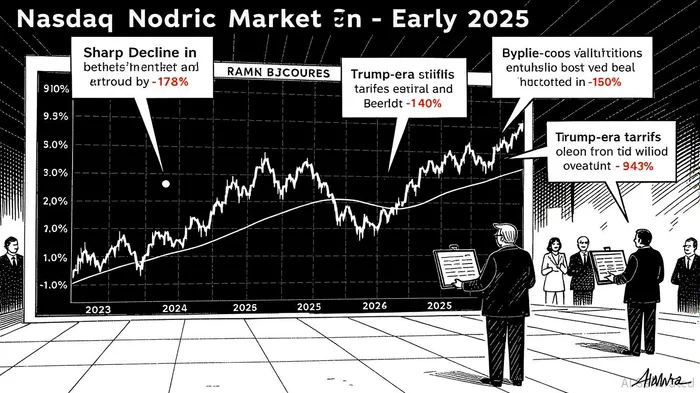
The Nasdaq Nordic markets have become a focal point of global volatility in 2025, driven by a toxic mix of geopolitical tensions, trade policy uncertainty, and the accelerating dominance of algorithmic trading. For institutional investors, the interplay between these factors has created a landscape where systemic risks are no longer abstract concerns but tangible threats to portfolio stability.
The Perfect Storm: Trade Policy and Geopolitical Uncertainty
The first half of 2025 saw the Nasdaq Nordic indices endure one of their steepest declines in modern history, with the NDX dropping 13.5% from its 2024 peak by March 2025 [1]. This volatility was catalyzed by the Trump administration’s aggressive tariff regime, which disrupted global supply chains and triggered cross-asset correlations. For instance, the April 2025 three-day selloff in the S&P 500—its sharpest since World War II—spilled over into Nordic markets, where energy and technology sectors bore the brunt of the fallout [2].
Compounding these pressures, geopolitical tensions in the Middle East and China’s growing influence in AI-driven industries have introduced persistent uncertainty. JPMorgan’s 1.3% GDP growth forecast for 2025 underscores the fragility of the global recovery, with inflationary pressures and aging demographics further straining market resilience [3].
Algorithmic Trading: A Double-Edged Sword
While algorithmic trading has long been celebrated for its efficiency, its role in amplifying volatility cannot be ignored. In the Nordic markets, high-frequency trading (HFT) strategies have exacerbated liquidity asymmetries, particularly during periods of stress. For example, the collapse of Silicon Valley Bank in 2023—a U.S.-centric event—triggered cascading algorithmic sell-offs in Nordic fixed-income derivatives, exposing vulnerabilities in interconnected trading systems [4].
Nasdaq Nordic’s Pre-Trade Risk Management (PRM) system, designed to prevent execution errors like “fat finger” trades, has been a critical safeguard [5]. However, the system’s real-time validation capabilities do little to mitigate broader systemic risks when multiple algorithms react to the same macroeconomic signals. Studies show that competing HFT firms can widen bid-ask spreads and reduce liquidity during crises, creating a self-reinforcing cycle of panic [6].
Regulatory Responses: Progress and Gaps
Post-2023 reforms have sought to address these risks. The UK’s Financial Conduct Authority (FCA) has imposed stricter operational resilience requirements on principal trading firms, mandating rigorous algorithmic testing [7]. Similarly, the U.S. SEC has expanded oversight of proprietary trading strategies, while Nasdaq itself has introduced liquidity stress-testing (LST) reforms to better align with commercial realities [8].
Yet gaps remain. Emerging markets, where retail investors dominate, face unique challenges. Algorithmic trading there often reduces spreads but destabilizes markets by prioritizing short-term gains over long-term liquidity provision [9]. Nordic regulators, while proactive, must adapt frameworks to address AI-driven trading strategies that evolve faster than traditional oversight mechanisms.
Implications for Institutional Investors
For institutional investors, the key takeaway is clear: diversification and dynamic risk management are no longer optional. The rise of algorithmic-driven volatility demands real-time monitoring of liquidity conditions and macroeconomic triggers. For example, the MSCIMSCI-- ACWI Index’s rebound in Q2 2025—spurred by trade deal progress with China—illustrates how geopolitical resolutions can rapidly reverse market trends [10].
Investors should also prioritize assets less susceptible to algorithmic manipulation. Defensive sectors like utilities and healthcare, which rely less on high-frequency trading, may offer relative stability. Conversely, technology and energy stocks—highly exposed to algorithmic flows—require hedging strategies to mitigate sudden reversals.
Conclusion
The Nasdaq Nordic markets’ volatility in 2025 is a microcosm of broader systemic risks in a hyper-connected, algorithm-driven world. While regulatory frameworks are evolving, the speed of technological change outpaces oversight, leaving institutional investors to navigate a minefield of uncertainties. The path forward lies in balancing innovation with caution—a lesson etched in the market’s recent turbulence.
Source:
[1] Analysis of the international Stock Market situation (Summer 2025) [https://isdo.ch/analysis-of-the-international-stock-market-situation-summer-2025/]
[2] End of 1H2025 Market Volatility: Why ETFs Are Headed for Gains [https://www.nasdaq.com/articles/end-1h2025-market-volatility-why-etfs-are-headed-gains]
[3] Navigating Market Risks in the Second Half of 2025: ETFs to Consider [https://www.nasdaq.com/articles/navigating-market-risks-second-half-2025-etfs-consider]
[4] Algorithmic Trading and Challenges on Retail Investors in Emerging Markets [https://www.researchgate.net/publication/363124358_Algorithmic_Trading_and_Challenges_on_Retail_Investors_in_Emerging_Markets]
[5] Pre-Trade Risk Management [https://www.nasdaq.com/solutions/pre-trade-risk-management]
[6] Competition among high-frequency traders and market ..., [https://www.sciencedirect.com/science/article/abs/pii/S0165188924001143]
[7] Regulatory Roundup: Expectations of PTFs [https://www.nasdaq.com/articles/regulatory-roundup-august-2023]
[8] Liquidity Stress Testing After 2023 Bank Failures [https://www.nasdaq.com/articles/fintech/regulatory-news/liquidity-stress-testing-post-2023-bank-failures]
[9] Algorithmic Trading and Market Quality [https://www.researchgate.net/publication/346199820_Algorithmic_Trading_and_Market_Quality_International_Evidence]
[10] Global markets power through persistent volatility [https://www.seic.com/insights/global-markets-power-through-persistent-volatility]





Comentarios
Aún no hay comentarios