
Nasdaq's Gold-Backed Crypto Assets: A New Era for Institutional-Grade Digital Commodities
The institutional-grade digital transformation of commodities markets is accelerating, and Nasdaq's foray into gold-backed crypto assets marks a pivotal moment in this evolution. By leveraging TetherUSDT-- Gold (XAUT) and strategic partnerships, Nasdaq is notNOT-- only redefining gold's role in modern finance but also addressing institutional demand for inflation-hedging, programmable assets. This analysis explores the implications of Nasdaq's initiatives, contextualized within broader regulatory shifts, institutional adoption trends, and global market dynamics.
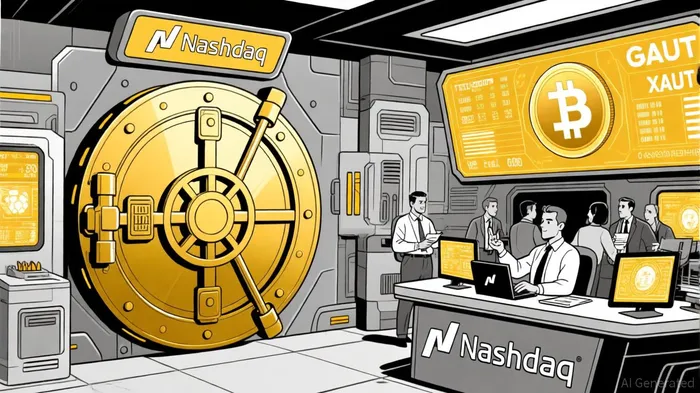
Aurelion's Tether Gold Treasury: A Strategic Play for Institutional Capital
Nasdaq's first Tether Gold treasury, spearheaded by Aurelion Inc. (formerly Prestige Wealth Inc.), represents a bold step toward institutional-grade digital commodities. The company secured $150 million in financing-$100 million via private placement and $50 million through a senior debt facility-led by AntalphaANTA--, Tether, and Kiara Capital, according to a Faegredrinker analysis. This capital will fund the acquisition of Tether Gold (XAUT) as a reserve asset, with unencumbered holdings to be used as collateral on Antalpha's lending platform, generating annualized returns of 50–100 basis points, per a VgLawFirm analysis.
Aurelion's rebranding to AURE, effective October 13, 2025, underscores its commitment to positioning Tether Gold as a stable, redeemable asset. CEO Björn Schmidtke emphasized XAUT's role as a hedge against inflation and market volatility, a claim supported by Tether's 100% gold-backed reserves and real-time auditability, as detailed in a World Economic Forum report. Antalpha's CFO, Paul Liang, further highlighted the potential for users to redeem physical gold bars via Tether Gold, bridging the gap between digital tokens and tangible assets, as the VgLawFirm analysis notes.
This initiative aligns with broader trends in gold-backed crypto, such as STBL's fully auditable and redeemable tokens, but Aurelion's Nasdaq listing and institutional-grade infrastructure give it a unique edge. By integrating Tether Gold into a regulated, transparent framework, Nasdaq is addressing skepticism around digital assets' utility and security, a critical barrier for institutional adoption.
Institutional Adoption: A Tipping Point for Digital Commodities
The 2025 Institutional Investor Digital Assets Survey reveals that 86% of surveyed institutions now have exposure to digital assets or plan to allocate capital in 2025, according to the 2025 Institutional Investor Digital Assets Survey. Notably, 59% of these investors allocate more than 5% of their assets under management (AUM) to cryptocurrencies, with diversification extending beyond BitcoinBTC-- and EthereumETH--. Tokenization is a key driver, with 73% of institutions holding alternative cryptocurrencies and expected DeFi engagement set to triple within two years.
Nasdaq's gold-backed assets cater to this demand by offering a hybrid of traditional and digital finance. For instance, Davis Commodities Limited (DTCK), another Nasdaq-listed entity, is pioneering a "commodity treasury" model linked to its Real Yield Token (RYT) initiative. This framework, which includes a proposed $2.5 billion digital commodity reserve, aims to stabilize global agri-finance and ESG-certified commodity trading, a trend explored in the World Economic Forum report. Such innovations reflect a broader shift: institutional investors are no longer viewing digital assets as speculative but as essential tools for diversification, yield generation, and ESG alignment.
Regulatory Clarity: A Catalyst for Growth
Regulatory developments in 2025 have created a fertile environment for Nasdaq's initiatives. The U.S. Commodity Futures Trading Commission (CFTC) has shifted from enforcement-driven oversight to fostering innovation, removing its digital asset derivatives advisory in March 2025 and introducing policies focused on fraud and manipulation, as the Faegredrinker analysis outlines. Meanwhile, the Digital Asset Market Clarity Act of 2025 (H.R. 3633) provides a provisional framework for digital commodities, distinguishing them from securities and exempting DeFi from traditional regulations, according to the VgLawFirm analysis.
Globally, the EU's Markets in Crypto-Assets (MiCA) regulation, fully implemented in January 2025, sets a gold standard for stablecoin oversight, requiring full reserves and regular audits, as previously noted. Similarly, Singapore, Hong Kong, and Japan have adopted stringent yet innovation-friendly frameworks, while the UAE's Abu Dhabi Global Market is positioning itself as a stablecoin hub. These developments reduce regulatory uncertainty, enabling Nasdaq and its partners to scale gold-backed crypto assets with confidence.
The Future of Institutional-Grade Commodities
Nasdaq's entry into gold-backed crypto assets is part of a larger paradigm shift in commodities markets. Tokenization is enabling fractional ownership, programmable settlements, and real-time transparency, while ESG-certified commodities command premium prices, as the World Economic Forum report explores. For example, Davis Commodities' ESG-focused initiatives are already attracting capital, with a $30 million raise funding both traditional and digital strategies, consistent with the VgLawFirm analysis.
However, challenges remain. Regulatory fragmentation and liquidity issues persist, particularly in low-infrastructure markets. Yet, as the Digital Asset Market Clarity Act and MiCA demonstrate, harmonized frameworks are emerging. Institutions are also prioritizing cybersecurity and data governance, recognizing that digital transformation requires robust infrastructure.
Investment Implications
For investors, Nasdaq's gold-backed crypto assets present a compelling opportunity. Aurelion's AURE ticker offers exposure to a Tether Gold treasury with institutional-grade backing, while Davis Commodities' RYT initiative highlights the scalability of tokenized commodities. The broader market is primed for growth: 84% of institutional investors are using or interested in stablecoins for yield generation, and tokenization is projected to unlock trillions in liquidity.
Conclusion
Nasdaq's gold-backed crypto assets are not just a product-they are a symptom of a deeper transformation in how commodities are traded, stored, and valued. By combining gold's time-tested resilience with blockchain's programmability, Nasdaq is addressing institutional demand for innovation, transparency, and yield. As regulatory clarity and technological infrastructure mature, the institutional-grade digital commodities market is poised to become a cornerstone of global finance.







Comentarios
Aún no hay comentarios