
Nasdaq Futures at Structural Decision Point: Breakout or Rotation?
The Nasdaq Futures market in November 2025 stands at a critical juncture, where technical price structure and macroeconomic catalysts converge to determine whether the index will break out of its consolidation phase or rotate into a new trend. With key support and resistance levels under pressure and shifting Fed policy signals, investors must navigate a complex interplay of institutional demand, geopolitical dynamics, and valuation concerns.
Technical Price Structure: A Tenuous Balance
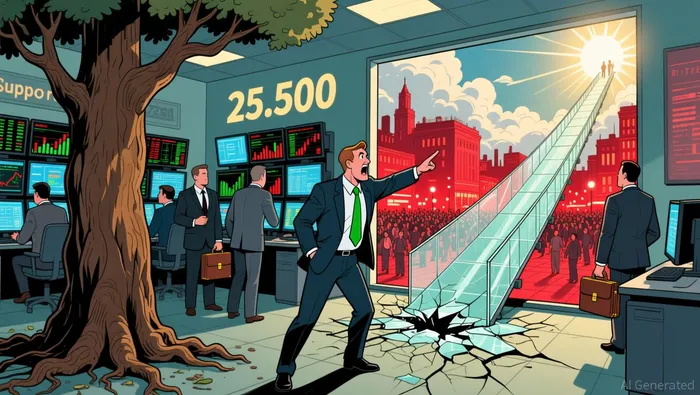
The Nasdaq 100 has maintained a bullish long-term trend despite short-term volatility, with critical technical levels defining its trajectory. A key support zone at 25,500 has held firm, preventing a deeper correction, while the 26,100–26,400 range has acted as an exhaustion zone for buyers since October 2025. Price action within intraday five-minute structures has reinforced the integrity of these zones, with rebounds from 25,400 confirming institutional demand and hinting at a potential rally toward 25,900–26,100. However, a breakdown below 24,709 would invalidate the bullish trend line established since May 2025, increasing downside risk to 24,000 and beyond.
 The index's behavior reflects a tug-of-war between short-term profit-taking in the tech sector and long-term optimism driven by AI innovation. For instance, a 2.7% rebound on November 25, 2025 pushed the Nasdaq Composite to 22,872, fueled by gains in AI hyperscalers like Alphabet and AMDAMD--. Yet, this rally occurred against a backdrop of mixed signals, including insider selling and technical fatigue indicators.
Macroeconomic Catalysts: Uncertainty and Dovish Signals
The Federal Reserve's policy trajectory remains a pivotal factor. While the Fed cut the Federal Funds rate by 25 basis points in October 2025 and paused quantitative tightening, Chair Jerome Powell's cautious stance-suggesting a December rate cut is "not a foregone conclusion"-has introduced uncertainty. However, dovish signals from officials like Mary Daly and John Williams have elevated the CME FedWatch probability of a December cut to 81%. This ambiguity has created a tug-of-war in Nasdaq Futures, as traders balance optimism over cheaper capital with concerns about inflation's stickiness.
Inflation data, meanwhile, remains a double-edged sword. Core CPI in November 2025 hovered near 3%, reflecting persistent pressures despite earlier declines. The partial government shutdown further complicated the economic narrative, delaying key data releases and amplifying market volatility. Private indicators, such as the ISM Manufacturing PMI, underscored a fragile economic environment, with manufacturing contraction offset by resilient services activity.
Geopolitical developments have also shaped the landscape. A truce in the U.S.-China tech war-marked by resumed rare earth magnet shipments and agricultural purchases-has eased trade tensions, while hybrid warfare in Europe and Japan's historic leadership shift added layers of uncertainty. These factors have influenced risk appetite, with Nasdaq Futures reacting sharply to news cycles, particularly in AI-driven sectors.
Alignment and Implications: Breakout or Rotation?
The alignment between technical levels and macroeconomic catalysts suggests a structural decision point. The Fed's rate cut and balance sheet pause have provided a floor for Nasdaq Futures, with the 25,380/25,400 support level holding during the November 2025 correction. This resilience indicates that institutional buyers are stepping in, particularly in AI infrastructure stocks, as the White House's "Genesis Mission" executive order aims to accelerate AI-driven scientific discovery.
However, the index's inability to break above 26,400-despite AI optimism-signals potential exhaustion. A breakout would require a catalyst beyond current expectations, such as a surprise Fed pivot or a surge in AI adoption metrics. Conversely, a rotation into value sectors or defensive plays could occur if inflation surprises to the upside or geopolitical tensions escalate.
For now, the market appears to be in a "wait-and-see" mode. The 25,500 support level acts as a critical filter: a sustained close above this zone would validate the bullish case, while a breakdown would force a reevaluation of the long-term trend.
Conclusion
Nasdaq Futures are at a crossroads, where technical structure and macroeconomic forces intersect. While institutional demand and AI-driven optimism provide a floor, the lack of a clear breakout above 26,400 and the Fed's cautious stance suggest caution. Investors should monitor the 25,500 support level closely, as its integrity will determine whether the index continues its bullish trajectory or enters a period of consolidation and rotation. In this environment, disciplined risk management and scenario planning remain paramount.







Comentarios
Aún no hay comentarios