
The Nasdaq at a Crossroads: Is Now the Time to Buy for Long-Term Growth?
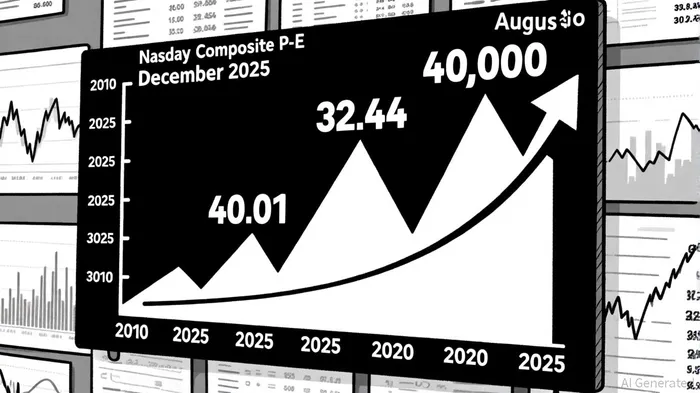
The Nasdaq Composite has long been the barometer for tech-driven innovation and growth. As we approach the final quarter of 2025, the index finds itself at a pivotal valuation inflection pointIPCX--. With a current P/E ratio of 32.44 as of August 20, 2025[1], and a forward 5-year return projection of 9.32%[2], the question for growth-oriented investors is clear: Does this represent a strategic entry or accumulation opportunity, or a cautionary signal in a market still reeling from the 2024 euphoria?
Valuation Metrics: "Fair" but Not Foolproof
The Nasdaq's P/E ratio has dropped sharply from 40.01 in December 2024[3] to 32.44 in late 2025, a correction that aligns with its 5-year historical average of 27.25–32.74[4]. This "Fair" valuation suggests the market has tempered its exuberance, but not abandoned its optimism. Meanwhile, the Price-to-Book (P/B) ratio for the Nasdaq Composite index stands at 4.53 as of September 17, 2025[5], a 6.69% premium to its 12-month average. While this implies investors are still willing to pay a premium for the index's intangible assets (software, patents, and R&D pipelines), it's a far cry from the frothy 40+ P/B ratios seen in 2024[6].
Growth Projections: A Tech-Driven Bull Case
The long-term outlook for the Nasdaq is nothing short of audacious. By 2026, the index is projected to hit 25,712—a 23% jump from its current 20,893 level[7]. This momentum is expected to accelerate, with forecasts of 28,177 by 2027 and 40,000 by 2030[8]. These numbers hinge on three pillars:
1. AI and Semiconductor Breakthroughs: Companies like NVIDIANVDA-- and AMDAMD-- are on the cusp of delivering next-gen chips that could redefine cloud computing and machine learning.
2. Quantum Computing: Early-stage advancements in quantum hardware are attracting billions in R&D investment, with potential applications in drug discovery and cryptography.
3. 5G and Edge Computing: The rollout of 5G networks is creating a "connected everything" ecosystem, from autonomous vehicles to smart cities.
Risk vs. Reward: A Cramer-Style Balancing Act
While the fundamentals are compelling, investors must grapple with the risks. A P/E of 32.44 is "Fair," but it's still elevated compared to the S&P 500's 22.50[9]. Additionally, the Nasdaq's heavy weighting toward tech stocks (e.g., AAPLAAPL--, MSFTMSFT--, NVDA) means it's more vulnerable to regulatory scrutiny and interest rate volatility. However, the index's historical performance offers reassurance: After years of 30%+ gains, the Nasdaq has historically surged an average of 19% in the following year[10].
Strategic Entry Points: Buy the Dip, Not the Peak
For growth investors, the current valuation represents a "buy the dip" scenario. The drop from 40.01 to 32.44 in six months[11] has created a margin of safety absent in 2024. Accumulating positions in high-conviction tech names—particularly those leading in AI infrastructure and quantum computing—could yield outsized returns. That said, dollar-cost averaging over the next 6–12 months would mitigate short-term volatility while aligning with the index's long-term trajectory.
Conclusion: A "Green Light" for the Long-Term
The Nasdaq Composite's valuation is neither a screaming bargain nor a bubble. It's a calculated bet on the future of technology, with growth projections that demand a leap of faith but are underpinned by tangible innovation. For investors with a 5–10 year horizon, this is a "green light"—provided they diversify across sectors and maintain a disciplined approach to risk management.







Comentarios
Aún no hay comentarios