
Nasdaq Bid Price Deficiencies and Survival Strategies for Small-Cap Firms
The Nasdaq's evolving delisting rules have created a high-stakes environment for small-cap companies, particularly those struggling to meet bid price requirements. From 2023 to 2025, regulatory changes have accelerated delisting timelines and reduced procedural safeguards, leaving firms with limited time to address deficiencies. For investors, this raises critical questions: Are these companies viable long-term investments, or do the risks of delisting and liquidity collapse outweigh potential rewards?
The New Delisting Landscape
Nasdaq's revised rules, approved by the SEC in early 2025, mandate immediate delisting for companies trading below $0.10 for ten consecutive days or with a Market Value of Publicly Held Shares (MVPHS) below $5 million while failing numeric listing requirements. Previously, firms had up to 360 days to regain compliance through measures like reverse stock splits. Now, companies that execute multiple reverse splits within a two-year period are ineligible for additional compliance periods. These changes aim to enhance market integrity but have disproportionately impacted small-cap firms, which often lack the liquidity to sustain investor confidence according to research.
For example, MMTECMTC--, Inc. (NASDAQ: MTC) received a delisting determination in October 2025 after failing to maintain a $1.00 bid price for 30 consecutive days according to financial reports. Similarly, Digital Brands GroupDBGI--, a retail-focused company, was delisted in December 2024 after repeated attempts to comply with bid price rules failed, including a November 2022 reverse split that only temporarily stabilized its share price according to retail industry analysis.
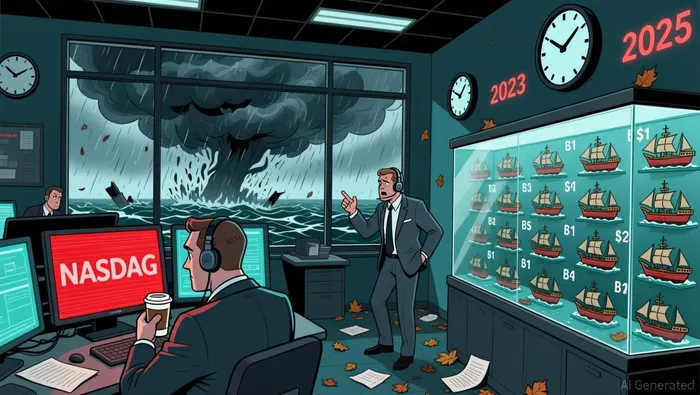
Survival Strategies: A Double-Edged Sword
Small-cap firms facing delisting threats typically employ three strategies: reverse stock splits, capital raising, and legal appeals. Reverse splits, while common, often signal desperation and can trigger further investor skepticism. For instance, Lipella Pharmaceuticals, a biotech firm delisted in 2024, executed a 1-for-10 reverse split in 2023 to meet bid price requirements but saw its stock price plummet further in the OTC market.
Capital raising through equity or debt financing is another option, though it risks diluting existing shareholders or increasing leverage. Companies must also navigate complex regulatory appeals, which are now less effective due to shortened timelines. As of December 2023, 464 Nasdaq-listed companies traded below $1.00 per share, many of which lacked viable strategies to address their deficiencies.
Investment Risks and Viability
Investing in companies facing Nasdaq delisting threats carries significant risks. Post-delistment, securities typically migrate to the OTC market, where liquidity dries up, and trading volumes collapse. A 2023 study found that delisted firms experience an average 70% decline in trading volume and a 50% drop in market capitalization within six months. For example, Digital Brands Group's stock fell 97.58% year-to-date before its delisting, eroding investor value according to market analysis.
Moreover, the new rules limit opportunities for recovery. Firms that delist due to bid price deficiencies often lack the financial health to attract new investors, and their reputational damage makes future capital raises difficult. While some companies, like those in the biotech sector, may pivot to niche markets, most small-cap firms lack such flexibility according to investment research.
Conclusion: Proceed with Caution
For investors, the key takeaway is clear: small-cap companies facing Nasdaq delisting threats are high-risk propositions. While survival strategies like reverse splits or capital raises may offer short-term reprieves, they rarely address underlying financial weaknesses. The Nasdaq's stricter rules have reduced the margin for error, making it harder for struggling firms to regain compliance.
Investors should prioritize due diligence, scrutinizing a company's liquidity, governance, and long-term viability before committing capital. For those willing to take on the risk, opportunities may exist in undervalued firms with strong fundamentals-but the potential for total loss remains high. In this new regulatory environment, patience and caution are paramount.







Comentarios
Aún no hay comentarios